JavaScript has been the core language of web development for more than 20 years.
Yet with the rise of AI and the spread of TypeScript, many engineers are starting to wonder what the future holds for JavaScript.
Drawing on reliable data from Japan’s Ministry of Economy, Trade and Industry (METI), Stack Overflow, GitHub, and other sources, this article explains why JavaScript’s future outlook is strong, what JavaScript engineers actually earn, and which skills you will need going forward.
- Three reasons JavaScript has a strong future, backed by data
- What JavaScript engineers actually earn, including freelance rates
- The essential skills to prioritize for your career from 2025 onward, and the order to learn them in

1. Three Reasons JavaScript Has a Strong Future

When assessing JavaScript’s future, a vague sense that “everyone seems to use it” is not a solid basis for judgment.
Below are three evidence-based reasons, drawn from public-sector data and global developer surveys, why we can say with confidence that JavaScript’s outlook is strong.
JavaScript Has Ranked No. 1 in Usage in a Global Developer Survey for 13 Consecutive Years
Stack Overflow’s annual Developer Survey is one of the most reliable public datasets on how engineers around the world actually work.
In the 2025 edition (over 49,000 respondents), JavaScript held the top spot as the “most-used programming language” for the 13th year in a row, used by 66% of respondents.
What 13 Straight Years at No. 1 Means
In the history of programming, it is not unusual for a language to enjoy a brief boom and then see demand collapse a few years later.
JavaScript, however, has never given up the top spot since the survey began in 2011. Its unique position as the only standard scripting language that runs in the browser continues to underpin demand.
A Language That Scales From Beginners to Large-Scale Development
Because JavaScript runs in any browser, it has the lowest barrier to entry of any language for people just starting to program.
At the same time, tech companies such as Meta, Vercel, and Google continue to build their core products with it, and it is used everywhere from small projects to large enterprise systems. This broad user base is what has kept JavaScript at No. 1 for 13 years.
In Japan, there are also structural factors driving up demand for JavaScript. METI’s “Survey on IT Talent Supply and Demand” estimates that Japan could face a shortage of up to roughly 790,000 IT professionals by 2030.
Source: Stack Overflow Developer Survey 2025
The Shortage of Web Developers Is Especially Severe
This shortage spans every type of IT role.
Given that digital transformation (DX) across e-commerce, finance, healthcare, government, and every other industry depends on building and maintaining web systems, demand for JavaScript engineers, who sit at the center of web development, is expected to remain high.
The Talent Shortage Will Not Be Solved in the Short Term
With a shrinking workforce due to Japan’s low birth rate and accelerating digitalization, the IT talent shortage is expected to continue beyond 2030.
In a market where supply is chronically short, engineers who have mastered JavaScript will retain their value over the medium to long term.
Source: METI, “Survey on IT Talent Supply and Demand (Summary)”
GitHub Trend Data Shows the JavaScript Ecosystem Continues to Grow
Many engineers worry that JavaScript will be replaced by TypeScript. The data in GitHub Octoverse 2025, however, contradicts that concern.
TypeScript’s Rapid Growth Means JavaScript Is Evolving
According to GitHub Octoverse 2025, in August 2025 TypeScript became the No. 1 language on GitHub by monthly contributors for the first time, overtaking JavaScript and Python.
This is not a sign of JavaScript’s decline. It shows that the entire JavaScript-based ecosystem is evolving toward greater type safety and higher quality.
TypeScript is a superset of JavaScript, and TypeScript code is ultimately compiled into JavaScript before it runs.
A Shift Into “Maturity,” Not “Decline”
JavaScript still has an enormous base of monthly contributors (about 2.15 million), and activity across the combined JavaScript/TypeScript ecosystem exceeds that of Python.
The same report found that about 80% of new repositories use one of six languages: Python, JavaScript, TypeScript, Java, C++, and C#. This indicates that the ecosystem is in a phase of maturity and expansion, not decline.
Source: GitHub Octoverse 2025
▼Related Reading
TypeScript is driving the JavaScript ecosystem forward. Learn how it differs from JavaScript and why it matters.

2. JavaScript Engineer Salaries and Market Value in Practice

Economic evidence is an essential indicator when judging a language’s future.
Here, we look at what JavaScript engineers actually earn, using data on both freelancers and full-time employees.
Freelance JavaScript Projects Average ¥8.73 Million a Year, With 84.5% Offering Remote Work
According to a private survey published in March 2026 by Levtech Freelance, a freelance engineer agency, which analyzed data from more than 40,000 projects, the average annual income for freelance JavaScript projects is ¥8.73 million.
A Strong Fit for Remote Work
The same survey recorded a remote work rate of 84.5%, confirming that many freelance JavaScript engineers are able to work from home.
As a language that combines high income with location-independent work, JavaScript is in high demand in the freelance market.
Also Near the Top in Project Volume
In the same survey, JavaScript ranked 4th by number of projects.
This shows that JavaScript is not confined to a few niche areas; it receives a steady flow of work from a wide range of companies and projects.
Source: Levtech Freelance, “Latest Survey of JavaScript Engineer Projects, March 2026”
JavaScript Engineer Salaries Vary Widely by Framework Skills and Years of Experience
Not all JavaScript engineers are valued equally. Market value differs greatly depending on skill set and depth of hands-on experience.
A private survey published in 2025 by Sokudan, a freelance project platform, shows that years of professional experience and framework proficiency translate directly into annual income and rates.
Salary Guide by Years of Experience
Based on the survey data, the approximate ranges are as follows.
| Years of experience | Estimated annual income (freelance equivalent) |
|---|---|
| 1–2 years | Approx. ¥5–6.5 million |
| 3–5 years | Approx. ¥7–8.5 million |
| 6+ years | ¥9–12 million or more |
Framework Proficiency Pushes Rates Higher
Engineers who can work with React or Next.js often earn several hundred thousand yen more per month than those who only know vanilla JavaScript.
The same applies to TypeScript: the larger the project, the more likely TypeScript is listed as a requirement. A market where investing in your skills translates directly into higher income is one of the defining features of the JavaScript field.
Source: Sokudan, “Survey of Average Annual Income and Project Volume for JavaScript Projects (2025)”
▼Related Reading
Want to push your income further? See which roles and career routes help IT engineers reach ¥10 million a year.

Full-Time JavaScript Engineers Also Earn More Than the Average Worker
Although income levels are lower than for freelancers, full-time JavaScript engineers still earn more than the average salary in Japan.
Wage Levels for Full-Time Engineers According to Government Data
According to the Ministry of Health, Labour and Welfare’s “2024 Basic Survey on Wage Structure,” the average wage (hourly equivalent) for software developers working in web and app development is ¥2,898, an increase of 25.3% over the four years since 2020.
Converted to an annual figure based on scheduled working hours, the baseline is roughly ¥5.5–6 million. However, engineers with in-demand skills such as React or TypeScript often earn well above this, and job openings in the ¥6–8 million range are common depending on experience, skills, and company size.
Source: Ministry of Health, Labour and Welfare, “2024 Basic Survey on Wage Structure”
Choosing Between Full-Time Employment and Freelancing
Full-time employment offers advantages over freelancing in income stability, social insurance, and employee benefits.
Freelancing, on the other hand, offers more upside through high-paying projects. Whichever career path you choose, your JavaScript skills form the foundation of your market value.
■Turn Your JavaScript Skills Into a Higher Salary in Japan
BLOOMTECH Career for Global helps engineers find roles that properly reward skills in JavaScript, TypeScript, React, and more. Our service is for engineers living in Japan with Japanese proficiency at JLPT N2 level or above. Our advisors will review your experience and introduce positions that match your salary goals.
▼Contact BLOOMTECH Career for Global here
3. The Wide Range of Development Areas Behind JavaScript’s Future
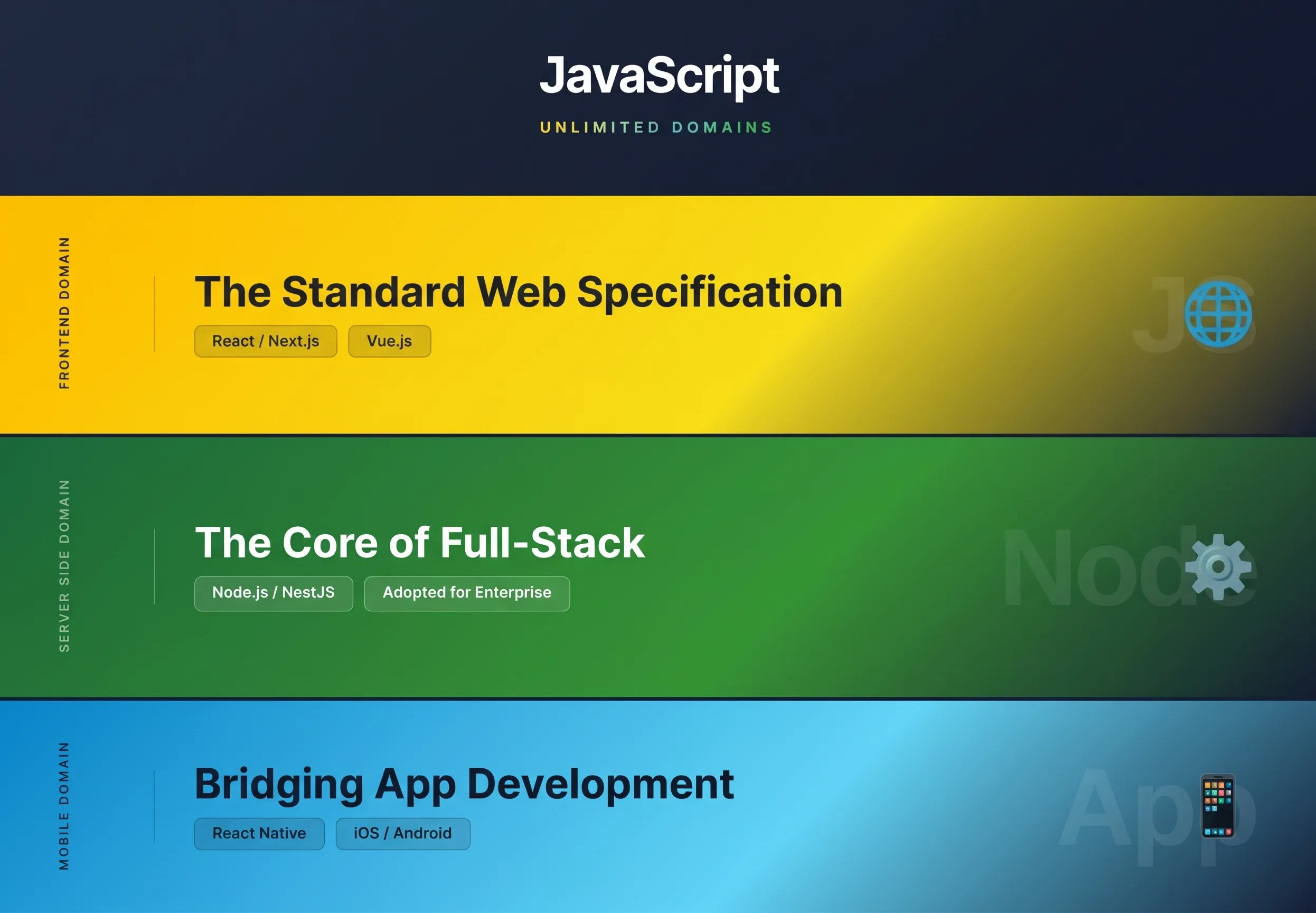
Many engineers still think of JavaScript as a “front-end-only language.”
Today, however, JavaScript is a highly versatile language that lets you build web front ends, server-side systems, and mobile apps with a single language. This breadth of application is a key strength supporting its future.
JavaScript Is the Core of Front-End Development With React, Vue, and Next.js
In modern web front-end development, most JavaScript is written through frameworks.
The three most widely adopted are React, Vue.js, and Next.js.
React and Next.js Lead the Job Market
According to the JetBrains Developer Ecosystem Survey 2025 (24,534 respondents), React has the highest usage rate among JavaScript frameworks and is firmly established as the standard for front-end development.
Next.js is a full-stack framework built on React, and the number of companies adopting it is growing rapidly along with rising demand for SSR (server-side rendering).
Source: JetBrains Developer Ecosystem Survey 2025
Vue.js Remains Popular for Small and Mid-Sized Projects
Thanks to its gentle learning curve and extensive Japanese documentation, Vue.js has a strong track record in small and mid-sized web development projects in Japan.
Engineers who can work with both React and Vue.js have access to a wider range of projects.
▼Related Reading
Weighing front-end against back-end work? Compare web development roles, salaries, and required skills in Japan.

Node.js Has Made JavaScript a Standard Choice for Server-Side Development
With the arrival of Node.js, JavaScript evolved into a language that runs outside the browser, on the server side.
As a result, “full-stack development,” building both the front end and back end in the same language, can now be done entirely in JavaScript.
A Shortcut to Becoming a Full-Stack Engineer
Node.js-based frameworks include the lightweight Express and the enterprise-oriented NestJS.
NestJS has an architecture inspired by Angular and is well suited to building large-scale API servers.
Mastering React on the front end and then moving on to Node.js + NestJS greatly increases your market value as a full-stack engineer.
When to Use Each Major Node.js Framework
Express is well suited to lightweight APIs and learning, while NestJS is recommended for team development and large-scale APIs.
A realistic learning path is to master the basics with Express first, then move to NestJS as project scale requires.
A Proven Track Record in Large-Scale Services
In Japan, companies such as LINE and Demae-can are using Node.js to build their systems, and its track record in large-scale services continues to grow.
These examples demonstrate Node.js’s stability and scalability, further encouraging the use of JavaScript on the server side.
▼Related Reading
Ready to take JavaScript to the server side? Learn how Node.js works, what it can do, and its market value.

React Native Lets You Use JavaScript for Mobile App Development
JavaScript is not limited to the web. With Meta’s React Native, you can apply your JavaScript and React knowledge directly to building iOS and Android apps.
The Benefits of Cross-Platform Development
Normally, iOS requires Swift and Android requires Kotlin, which means the cost of hiring specialist engineers for each platform.
React Native solves this problem by letting you build apps for both platforms from a single codebase.
It is widely adopted by startups and small to mid-sized companies focused on development costs, making it a realistic route for JavaScript engineers to win mobile projects.
A Career Bridge From Web Engineer to Mobile Engineer
The component design skills you build through React development on the web carry over directly to React Native, so the learning curve is low.
JavaScript serves as a bridge language that supports a career shift from web to mobile, broadening your options as an engineer.
4. The Latest Trends Shaping JavaScript’s Future

For medium- to long-term career planning, it is not enough to check JavaScript’s current outlook; you also need to understand what changes lie ahead.
Here we look at the latest JavaScript trends along three axes: TypeScript, AI, and SSR.
Moving to TypeScript Is Becoming the Market Standard for JavaScript Development
According to the JetBrains Developer Ecosystem Survey 2025, TypeScript adoption in JavaScript projects is rising year after year, and in team-based and large-scale development in particular, TypeScript is becoming a de facto requirement.
In Large-Scale Development, TypeScript Is Becoming the Non-Negotiable Standard
The larger the codebase, the more likely untyped JavaScript is to cause unexpected bugs and rising maintenance costs.
TypeScript’s static typing prevents these risks up front and also improves the accuracy of IDE code completion and refactoring.
GitHub Octoverse 2025 data also shows TypeScript reaching No. 1 on GitHub by monthly contributors for the first time, and standardization in the enterprise space is expected to advance further.
Learning JavaScript and Then TypeScript Step by Step Makes the Most Sense
Because TypeScript uses JavaScript syntax as-is, the most efficient approach is to learn JavaScript while gradually picking up TypeScript’s type system.
A “JavaScript fundamentals → TypeScript” learning path matches current job requirements and offers a high return on your learning investment.
Sources: JetBrains Developer Ecosystem Survey 2025 / GitHub Octoverse 2025
AI Tools Are Changing, Not Lowering, the Market Value of JavaScript Engineers
In the Stack Overflow Developer Survey 2025, 84% of respondents said they use or plan to use AI tools at work, while 46% of developers said they do not trust AI output, a sharp rise from the previous year (31%).
Many engineers fear that AI will take their jobs, but the data paints a somewhat different picture.
AI Handles Code Generation; Humans Handle Design and Judgment
AI tools are highly efficient at generating boilerplate code and repetitive logic.
On the other hand, advanced work such as overall system design, requirements definition, UX quality decisions, and code review is still led by human engineers.
Solid JavaScript Fundamentals Are the Foundation for Using AI
Only engineers with a firm grasp of JavaScript fundamentals can properly evaluate the quality of AI-generated code and fix or improve it appropriately.
The spread of AI lowers the value of engineers who lack fundamentals, while raising the productivity and market value of those who have them.
Source: Stack Overflow Developer Survey 2025
The Spread of SSR, Led by Next.js, Is Driving JavaScript Demand Even Higher
Recent web front-end development places growing emphasis on performance and SEO, and adoption of Next.js, which enables SSR (server-side rendering) and ISR (incremental static regeneration), is accelerating.
SSR and Island Architecture Are Becoming the New Standard
Development is shifting away from SPA-centric approaches toward SSR, which improves initial load speed and Core Web Vitals.
Island Architecture, used by Astro and Fresh, makes only parts of a page dynamic with JavaScript and is drawing attention as a new approach to performance optimization.
Wider Next.js Adoption Translates Directly Into Job Demand
Web companies in Japan and abroad are migrating to Next.js, and demand for engineers with Next.js experience is growing.
Upgrading your skills from React to Next.js is one of the most cost-effective career investments in today’s front-end engineering market.
■日本でエンジニアとしてキャリアアップしたい方へ
海外エンジニア転職支援サービス『 Bloomtech Career 』にご相談ください。「英語OK」「ビザサポートあり」「高年収企業」など、外国人エンジニア向けの求人を多数掲載。専任のキャリアアドバイザーが、あなたのスキル・希望に合った最適な日本企業をご紹介します。
▼簡単・無料!30秒で登録完了!まずはお気軽にご連絡ください!
Bloomtech Careerに無料相談してみる
5. Skills JavaScript Engineers Should Build Right Now
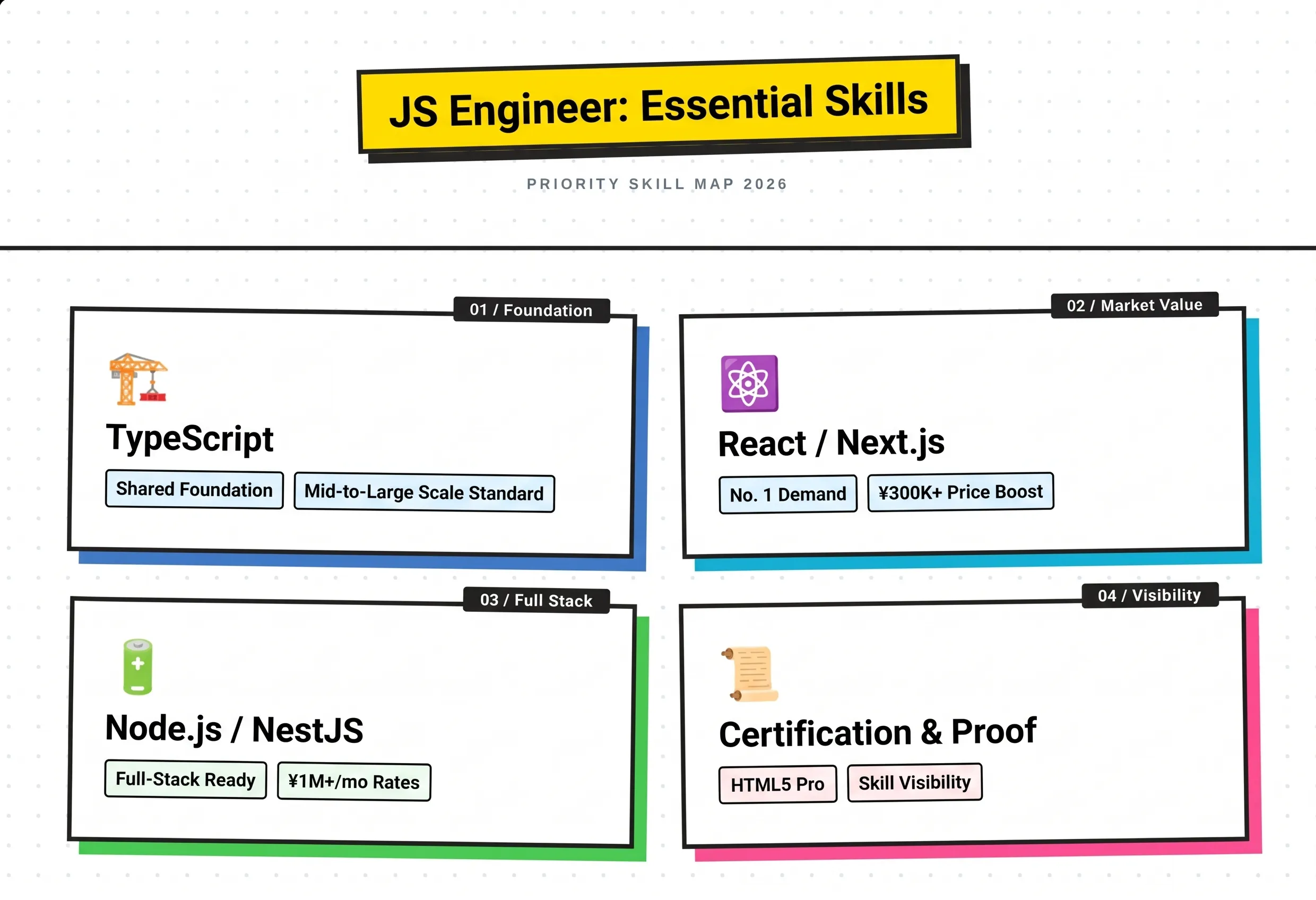
Once you recognize JavaScript’s strong outlook, the next question is what to learn and in what order. Piling up skills at random will not necessarily raise your market value.
Based on job posting data and its relationship to salaries, here is a skill map with clear priorities.
TypeScript Is the Shared Foundation Every JavaScript Engineer Should Learn First
A rapidly growing number of web and SaaS job postings now list TypeScript as a required or preferred skill.
Having “JavaScript experience only” is increasingly limiting the range of jobs you can apply for.
How Widespread TypeScript Is in Job Requirements
According to the JetBrains Developer Ecosystem Survey 2025, the share of projects using TypeScript is rising every year, and TypeScript has become the standard language for many mid- to large-scale front-end projects.
For React and Next.js projects, TypeScript is now generally expected as part of the package.
The Learning Path From JavaScript Fundamentals to TypeScript
TypeScript is a language that contains JavaScript, so JavaScript code runs as TypeScript without modification.
Recommended Learning Order
The most efficient path is to first master JavaScript basics such as variables, functions, asynchronous processing, and DOM manipulation, then gradually learn TypeScript-specific features such as type annotations, interfaces, and generics.
Source: JetBrains Developer Ecosystem Survey 2025
Mastering React and Next.js Has the Most Direct Impact on a JavaScript Engineer’s Market Value
By number of job postings, demand for React far exceeds that of any other front-end framework.
React is a UI library developed by Meta. Its component-based design is widely adopted, and it is used by everyone from startups to large enterprises.
Learning React Is Your Gateway to Next.js Projects
Next.js is built on React’s component design, so it cannot be used without React.
A step-by-step path of “first master component design, state management, Hooks, and API fetching in React, then learn SSR, routing, and data fetching in Next.js” is the route that leads most directly to higher market value.
Impact on Salary
According to Sokudan’s project data, engineers with hands-on React experience can earn ¥100,000–300,000 or more per month than engineers who only know JavaScript.
Learning React is a skill upgrade with a high return on investment.
Source: Sokudan, “Survey of Average Annual Income and Project Volume for JavaScript Projects (2025)”
Learning Node.js Is the Fastest Route to Becoming a Full-Stack JavaScript Engineer
There is a significant gap in market value between front-end-only engineers and full-stack engineers who can handle both front end and back end.
Learning Node.js is the fastest way to close that gap and a highly cost-effective skill expansion for JavaScript engineers.
Building API Servers With Express/NestJS Is a Core Skill
The recommended path is to learn Node.js, then the basics of building RESTful APIs with Express, and finally the module, controller, and service architecture of NestJS.
Example Full-Stack Combination
Engineers who can build a unified TypeScript development environment, with React on the front end and Node.js/NestJS on the back end, tend to be highly valued in both the freelance and job-change markets.
How Going Full-Stack Affects Your Salary
Levtech Freelance project data shows that full-stack projects often pay more than ¥1 million per month, a large gap compared with front-end-only work.
Investing a few months in learning Node.js has the potential to raise your annual income significantly.
Source: Levtech Freelance, “Latest Survey of JavaScript Engineer Projects, March 2026”
JavaScript-Related Certifications Help Make Your Skills Visible When Changing Jobs
Portfolios carry a lot of weight in engineering hiring, but early in your career it can be hard to prove your skills through portfolio quality alone.
In these situations, certifications serve as objective proof of your skills.
The Practical Value of the HTML5 Professional Certification
The HTML5 Professional Certification (Level 1 and Level 2), accredited by LPI-Japan, is one of the best-known web certifications in Japan and lets you systematically demonstrate your knowledge of web technologies.
Level 1 covers the fundamentals of HTML, CSS, and JavaScript, while Level 2 covers multimedia, API usage, and security, making it well suited to showcasing your foundational skills as a JavaScript engineer.
When to Rely on Certifications vs. a Portfolio
In hiring, certifications are valued as proof that you meet a minimum skill level, while a portfolio is better at proving you can apply your skills in practice.
A two-step plan of “pass the screening with certifications, then prove your ability with a portfolio” is the most sensible approach.
If you have three or more years of professional experience, certifications become less of a priority, and showcasing your achievements through a portfolio, GitHub activity, and a tech blog is more effective.
▼Related Reading
Looking beyond JavaScript? Discover the IT skills most in demand in Japan and how to build a career roadmap.

6. Frequently Asked Questions About JavaScript’s Future

Here are answers to the questions engineers ask most often about JavaScript’s future.
Is JavaScript Still Worth Learning Now?
Yes, its future outlook is strong.
Two data points support this: JavaScript has ranked No. 1 in usage in the Stack Overflow Developer Survey for 13 consecutive years (used by 66% of respondents in 2025), and METI estimates a shortage of up to roughly 790,000 IT professionals in Japan by 2030.
JavaScript can be tested in a browser alone, so no special learning environment is needed, and abundant learning resources are available in both Japanese and English. This makes it an especially accessible language for beginners.
Sources: METI, “Survey on IT Talent Supply and Demand (Summary)” / Stack Overflow Developer Survey 2025
Should I Learn JavaScript or TypeScript First?
The current standard is to master JavaScript fundamentals first and then move on to TypeScript.
TypeScript is a superset of JavaScript. If you study TypeScript before you understand JavaScript syntax, asynchronous processing, and object-oriented basics, you will not be able to correctly interpret what type errors mean.
Learning TypeScript’s type system after your JavaScript fundamentals are solid greatly improves both how quickly you learn and how deeply you understand.
Will the Spread of AI Hurt the Future of JavaScript Engineers?
It will not lower their value, but it will shift which skills matter most.
According to the Stack Overflow Developer Survey 2025, while the number of people using AI coding tools is growing, 46% of developers say they do not trust AI output.
Advanced work such as system design, requirements definition, UX quality decisions, and code review continues to be led by humans, and engineers with the fundamentals to accurately evaluate and fix AI-generated code are becoming even more valuable.
7. As the Data Shows, JavaScript’s Future Will Remain Strong

Thirteen consecutive years at No. 1 on Stack Overflow, METI’s projected shortage of up to 790,000 IT professionals by 2030, and TypeScript’s rapid growth on GitHub: none of this data shows any sign of declining demand for the JavaScript ecosystem.
What matters is looking beyond JavaScript alone and building an early skill plan that covers the wider ecosystem of TypeScript, React, and Node.js.
We recommend learning related technologies step by step in line with your own career plan.
■Plan Your Next Career Move as a JavaScript Engineer With a Specialist
If you are an engineer living in Japan with Japanese proficiency of N2 or above, BLOOMTECH Career for Global can help you take the next step. We offer free career consultations and introduce roles where you can grow with JavaScript and its ecosystem. Feel free to reach out.
▼Contact BLOOMTECH Career for Global here