

Node.js is a runtime environment that allows JavaScript to run on the server side.
It is often misunderstood as a programming language, but Node.js is more precisely classified as a runtime environment — the platform on which JavaScript executes. Understanding this distinction alone makes the overall picture of web development much clearer.
This article explains what Node.js is, how it works, what you can build with it, its advantages and disadvantages, and its market value — illustrated with real-world examples and statistical data.
- The precise definition of Node.js and the key difference between Node.js and JavaScript
- How asynchronous processing and the event loop work, and why Node.js is chosen for modern web development
- The career value of Node.js engineers, backed by global market statistics

1. What Is Node.js: The Precise Definition of a “Runtime Environment”
To truly understand Node.js, it helps to first distinguish between a “runtime environment” and a “programming language.”
Starting from this distinction makes the role and strengths of Node.js much easier to grasp.
Node.js Is Not a Programming Language — It Is the “Environment” That Runs JavaScript
The official definition of Node.js is a “JavaScript runtime environment.”
A runtime refers to the foundation on which a program executes. In other words, Node.js is the platform that interprets and runs JavaScript code — it is not itself a language for writing code.
JavaScript was originally a language that could only run inside a browser. While the browser acts as the JavaScript runtime environment on the front end, Node.js serves as the JavaScript runtime environment on the server side.
Even with the same JavaScript code, what you can do changes significantly depending on the “environment” in which it runs.
Comparing Browser and Node.js Runtime Environments
| Runtime Environment | Use Case | Primary APIs |
|---|---|---|
| Browser | Front end (UI control) | DOM, Web APIs |
| Node.js | Server side (back-end processing) | File system, networking |
Source: Node.js Official Website
The Core of Node.js Is the “V8 Engine” Developed by Google
Powering Node.js’s high-speed performance is the “V8 engine” — the same engine used in Google’s Chrome browser. The V8 engine compiles JavaScript code into machine code and executes it, making it exceptionally fast.
In 2009, Ryan Dahl leveraged this V8 engine to develop and release Node.js.
Born from the idea of running JavaScript outside the browser, Node.js grew into a leading server-side development technology within just a few years.
▼Related Reading
Before diving into how Node.js differs from JavaScript, here’s a broader look at the backend language landscape — and which languages are in highest demand for engineers working in Japan.

2. Node.js vs. JavaScript: Untangling Two Concepts That Are Easy to Confuse
“How is Node.js different from JavaScript?” is one of the most common questions that comes up early in the learning journey.
Understanding the relationship between the two clearly makes the entire web development technology stack much easier to navigate.
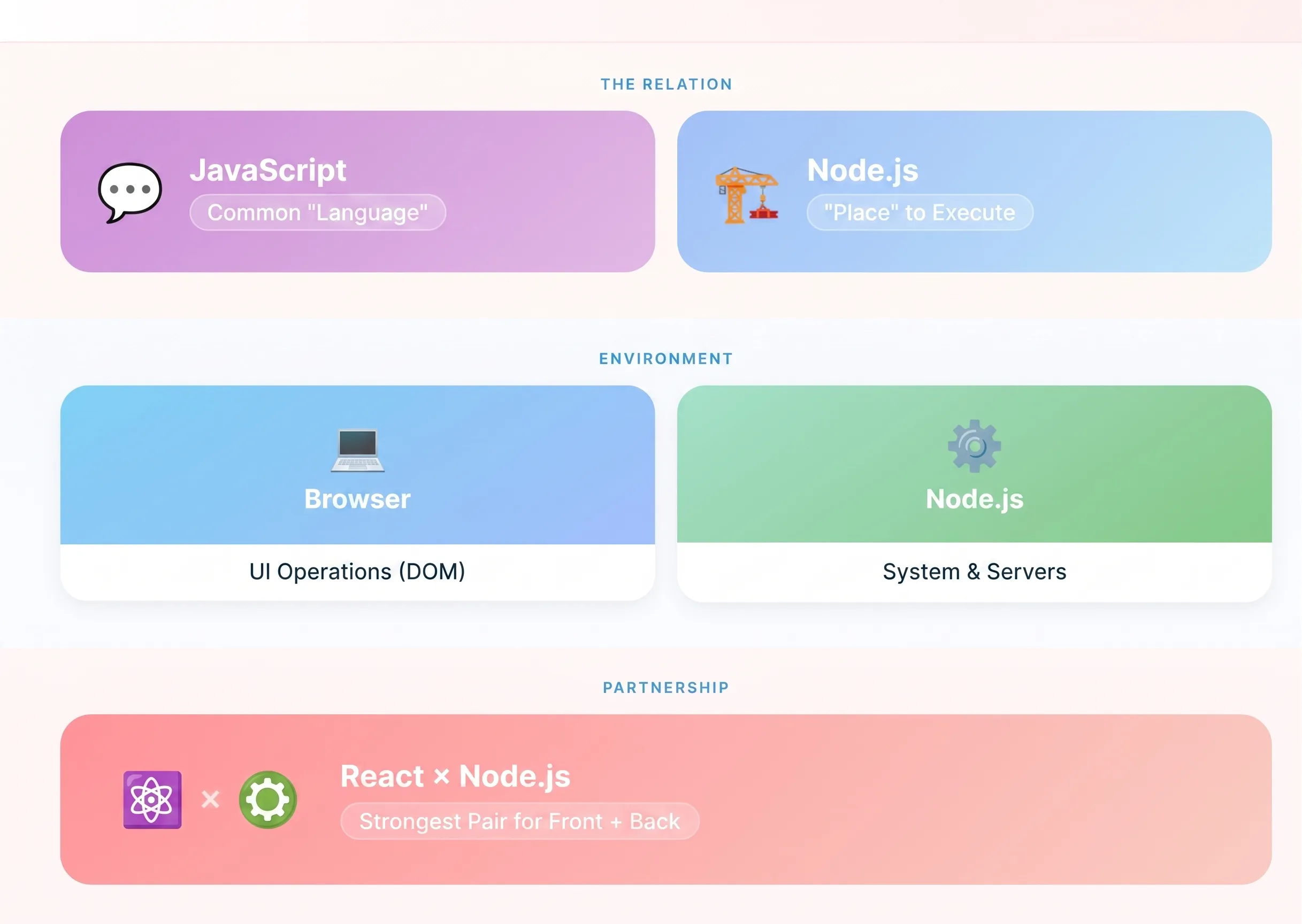
JavaScript Is the “Language” and Node.js Is the “Place Where It Runs”
The relationship between JavaScript and Node.js can be understood through an analogy: think of JavaScript as a language (say, English) and Node.js as a country or region where that language is spoken (the environment).
Just as English stays the same whether spoken domestically or abroad, JavaScript code can be written for the browser or for Node.js using the same syntax.
However, while the syntax is shared, what you can do differs between the browser and Node.js.
In the browser, the focus is on DOM manipulation and user event handling. In Node.js, you can perform server-side operations such as reading and writing files, accessing databases, and building HTTP servers.
JavaScript Differences by Runtime Environment
| Environment | Syntax | Typical Use Cases |
|---|---|---|
| Browser | Shared | DOM manipulation, UI event handling |
| Node.js | Shared | Server construction, file I/O, API handling |
Node.js and React Are Not Competitors — They Serve Different Roles
You may occasionally come across the question “Should I choose Node.js or React?” — but these two are not competing technologies.
React is a JavaScript library for building user interfaces and handles the front end (what users see). Node.js is a runtime environment that handles server-side processing.
In real-world development, using React on the front end and Node.js on the back end is a common and widely adopted architecture. Though both belong to the same JavaScript ecosystem, they function as partners at different layers of the stack.
3. How Node.js Works: Asynchronous Processing and the Event Loop Are the Secret to Its Speed

Why can Node.js handle large numbers of simultaneous connections so efficiently? The secret lies in its architecture: a single thread combined with asynchronous I/O and an event loop. Let’s break this down with a familiar analogy.
Why Node.js Stays Fast Even with a Single Thread: Asynchronous Processing That Never Wastes Idle Time
Node.js operates on a single thread — meaning there is effectively one “service window” handling all operations.
Single-threaded execution might sound slow, but Node.js compensates for that potential weakness with asynchronous processing (non-blocking I/O).
Synchronous processing (blocking) means the next operation must wait until the current one finishes. Asynchronous processing (non-blocking) means the next request is accepted without waiting for the previous one to complete.
Think of it like a restaurant server who, rather than standing idle waiting for a dish to be ready, continues taking orders from other tables in the meantime.
Even with a single worker (single thread), staying constantly active means requests get handled efficiently.
Synchronous vs. Asynchronous Processing
| Processing Mode | Waiting Behavior | Best Suited For |
|---|---|---|
| Synchronous (blocking) | Waits for each operation to complete | Tasks requiring strict sequential order |
| Asynchronous (non-blocking) | Moves on without waiting | Web workloads with heavy I/O waits |
Node.js’s Event Loop Handles Requests and Solves the C10K Problem
The “event loop” is the core mechanism driving Node.js’s asynchronous processing. The operational flow can be summarized as follows:
- Receive request: Incoming requests from clients are accepted
- Callback queue: I/O operations such as database queries and file reads are delegated to the background; a callback is queued when each completes
- Execute processing: The event loop processes queued callbacks one by one
This design is what solved the “C10K problem” — the challenge of maintaining simultaneous connections with 10,000 or more clients on a single server without significant performance degradation.
Traditional thread-based servers consume memory proportional to the number of connections, whereas Node.js’s event-driven model can handle massive concurrent connections with minimal resources.
4. What You Can Build with Node.js: Four Major Application Domains
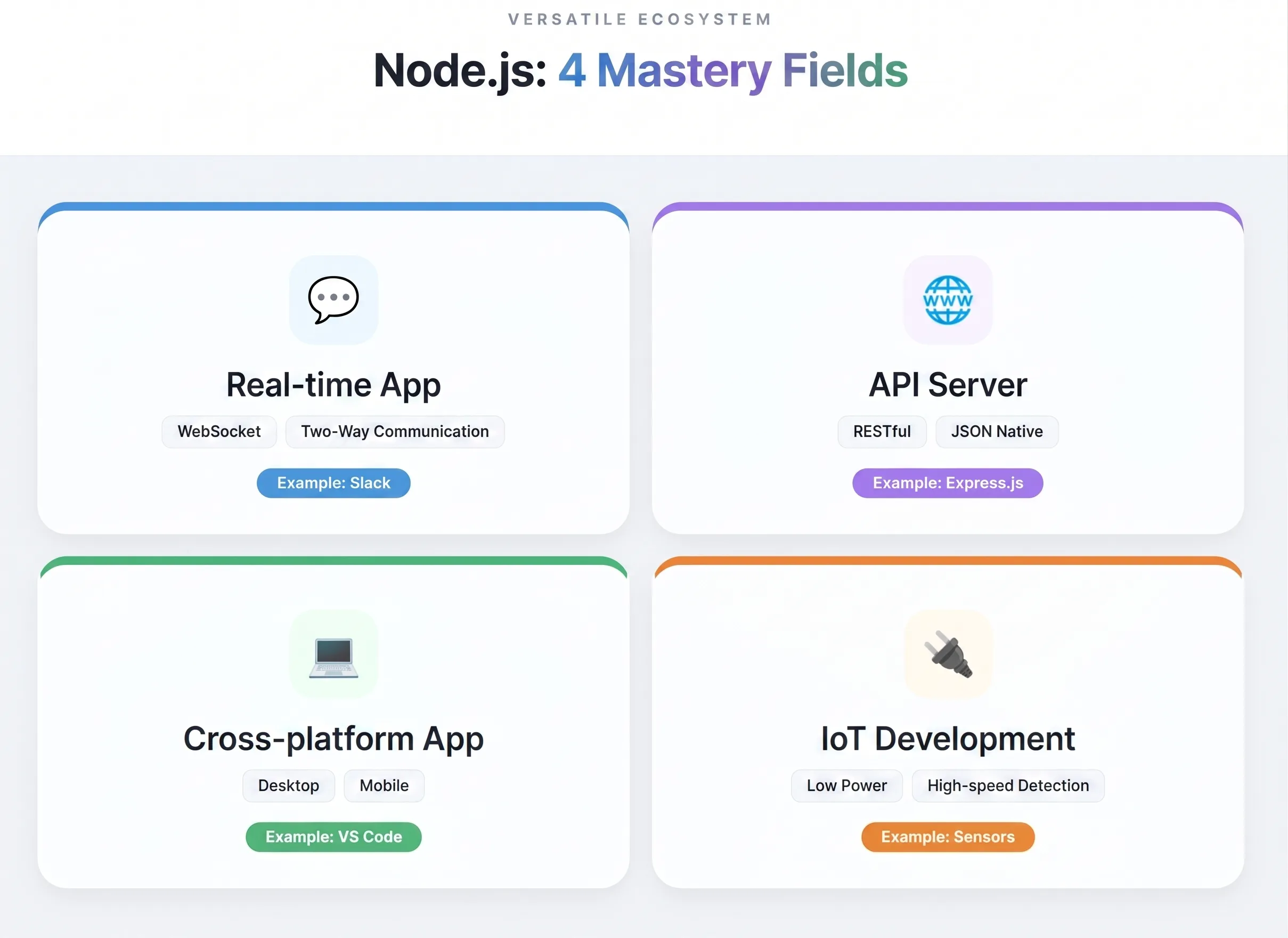
Node.js’s combination of fast asynchronous processing and a rich JavaScript ecosystem makes it a versatile choice for a wide range of application development. Here are four of the most prominent use cases.
Real-Time Web Apps: Node.js Is Ideal for Building Chat Tools and Collaborative Editing Applications
Node.js pairs exceptionally well with WebSocket, the protocol used for real-time communication. WebSocket maintains a persistent connection between server and client, enabling instant two-way data exchange.
Chat tools like Slack are a prime example. Features requiring real-time responsiveness — message delivery, read receipts, and typing indicators — can all be handled efficiently with Node.js’s event-driven architecture.
API Servers: Node.js as the Bridge Between Front End and Back End
Node.js is also widely used for building RESTful APIs.
Because JavaScript handles JSON natively, data transformation overhead is minimal, enabling smooth data exchange between the front end and back end.
It is frequently adopted as the back-end API for mobile applications, and the Express.js framework allows you to build an API server with minimal code.
Cross-Platform Development: Node.js Supports Mobile and Desktop Apps Too
The Node.js ecosystem extends well beyond web applications, reaching into mobile and desktop app development. React Native handles mobile apps, while Electron powers desktop applications.
Microsoft’s VS Code (Visual Studio Code) is one of the most prominent desktop apps built with Electron. The fact that a tool used daily by engineers worldwide is built on Node.js speaks to the real-world capability of its ecosystem.
IoT Development: Node.js Handles Real-Time Data Processing in Low-Spec Environments
Node.js’s low power consumption and lightweight footprint make it well-suited for IoT (Internet of Things) development.
It can run on sensor devices with limited processing power, and is used to aggregate real-time data — such as temperature, humidity, and acceleration — to a central server.
Its event-driven architecture allows Node.js to instantly detect and respond to changes in sensor data, making it a strong fit for this domain.
▼Related Reading
Node.js powers a wide range of web applications — and so does TypeScript, which pairs directly with it. If you’re building modern backends, understanding TypeScript is the logical next step.

■日本でエンジニアとしてキャリアアップしたい方へ
海外エンジニア転職支援サービス『 Bloomtech Career 』にご相談ください。「英語OK」「ビザサポートあり」「高年収企業」など、外国人エンジニア向けの求人を多数掲載。専任のキャリアアドバイザーが、あなたのスキル・希望に合った最適な日本企業をご紹介します。
▼簡単・無料!30秒で登録完了!まずはお気軽にご連絡ください!
Bloomtech Careerに無料相談してみる
5. Famous Services Built on Node.js: Global Companies’ Choices Prove Its Capabilities

Node.js’s capabilities are confirmed by the technology choices of companies operating services at a global scale. Understanding not just that they chose it, but why, is key.
PayPal
After migrating from a Java-based system to Node.js, PayPal saw development speed roughly double and response times improve by 35%. This case is frequently cited as an example where both developer productivity and user experience improved simultaneously.
Uber
Uber adopted Node.js to handle real-time processing demands — such as matching riders with drivers and updating location data — that generate massive numbers of requests per second. Its scalability in handling sudden spikes in traffic was a key reason for adoption.
By migrating to Node.js, LinkedIn was able to reduce its server count to one-twentieth of what it had been. Achieving the same processing capacity with far fewer server resources translated directly into cost savings.
Netflix
Introducing Node.js reduced startup time by 70%. For a streaming service used by over 200 million people worldwide, improving response speed has a direct and meaningful impact on user experience.
These cases are widely recognized as dramatic examples of performance improvements through Node.js adoption, as documented in technical blogs and learning platforms maintained by the companies themselves.
6. Node.js Pros and Cons: An Objective Comparison to Help You Evaluate
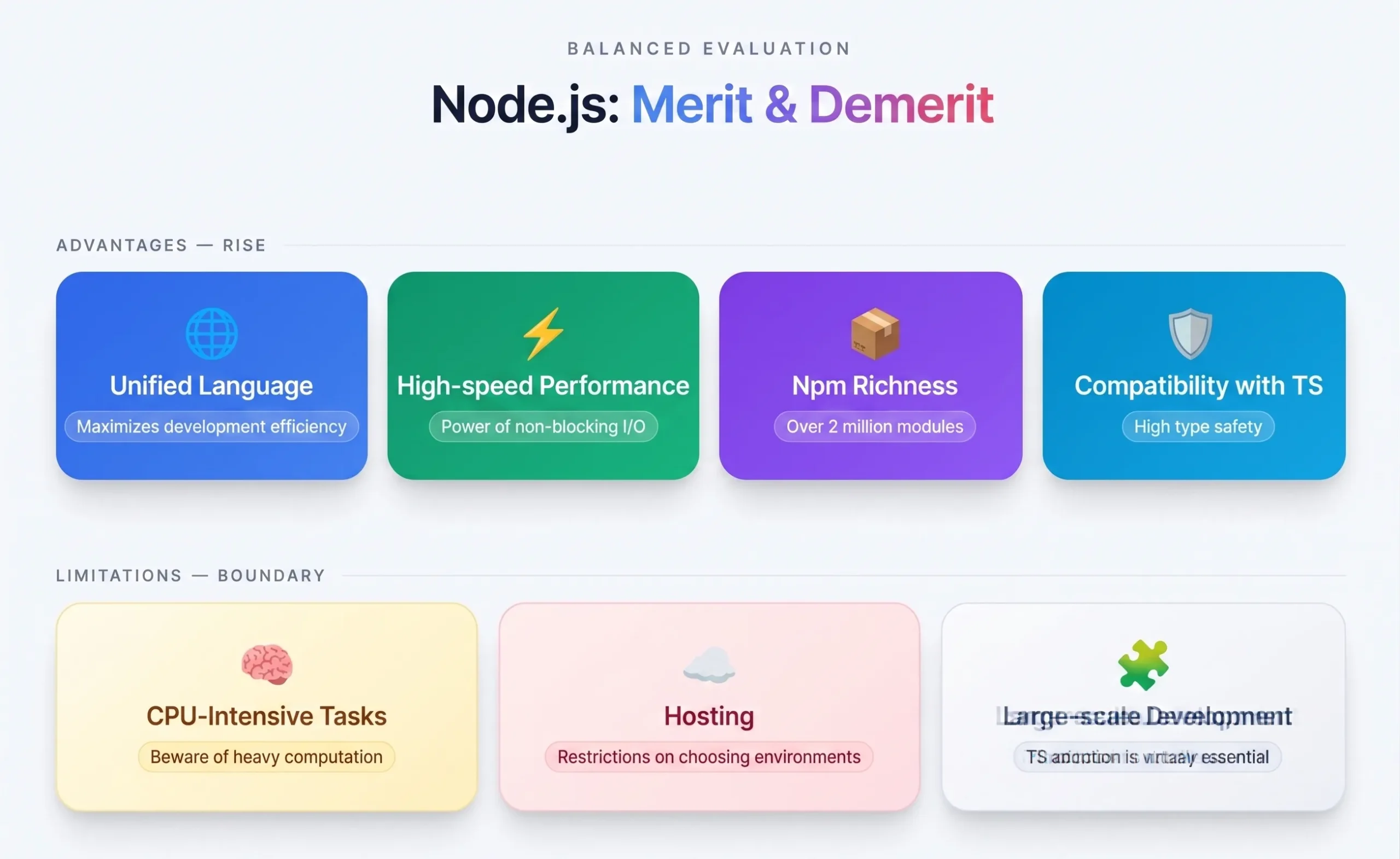
Node.js is not a universal solution for every type of development. Understanding its advantages and disadvantages objectively is essential for making the right technology choices based on your project’s requirements.
Advantages: Unifying Front-End and Back-End Language Boosts Development Efficiency
Reduced Context Switching Through Language Unification
One of Node.js’s key strengths is the ability to develop both the front end and back end using the same language — JavaScript.
Traditionally, front-end developers worked in JavaScript while back-end developers used Java or Python, creating a clear division of labor. Node.js changes this, enabling a single engineer to work across the full stack.
Eliminating the cognitive overhead of switching between languages leads to faster development cycles.
High Processing Performance (V8 Engine + Asynchronous I/O)
The combination of the V8 engine and asynchronous I/O delivers high throughput even in web applications with heavy I/O workloads.
A Vast npm Ecosystem (Over 2 Million Packages)
As of 2025, npm — Node.js’s package manager — hosts over 2 million registered packages.
Libraries covering virtually every use case are available, from web servers and authentication to ORMs and testing tools, allowing developers to dramatically accelerate their workflow.
Source: Zealous System
Strong Compatibility with TypeScript
Node.js integrates smoothly with TypeScript, making it easy to improve code quality through static typing.
According to the Stack Overflow Developer Survey 2024, TypeScript adoption has surged from 12% in 2017 to 35%, and it is becoming the de facto standard in Node.js development.
Source: Stack Overflow Developer Survey 2024
Disadvantages: Watch Out for CPU-Intensive Tasks and Large-Scale Codebases
Weakness with CPU-Bound Processing → Addressed with Worker Threads
Because Node.js runs on a single thread, CPU-intensive operations such as image processing, video encoding, and machine learning inference can block the event loop, halting the processing of other requests.
The “Worker Threads” feature introduced in Node.js v10.5 and later allows CPU-heavy tasks to be offloaded to separate threads.
Somewhat Limited Hosting Options
Compared to PHP and similar languages, the number of shared hosting providers that support Node.js tends to be smaller.
That said, VPS and cloud platforms (AWS, GCP, Azure) offer robust standard support, and this is increasingly less of a concern for production deployments.
Type Safety Challenges in Large Codebases → Resolved with TypeScript
As a dynamically typed language, JavaScript is more prone to type-related bugs in large codebases.
However, adopting TypeScript effectively resolves this concern, and Node.js is increasingly used even in enterprise-scale development.
7. Node.js vs. Other Languages: How It Compares to Python, Ruby, and PHP

Node.js is not the optimal choice for every use case — there are domains where other languages excel. Rather than debating which is superior, understanding how to choose the right tool for the job is the essence of good technology selection.
Node.js Compared to Other Languages
| Language | Strengths | How to Use Alongside Node.js |
|---|---|---|
| Python | AI, machine learning, data analysis | Python for training AI models; Node.js for API delivery and integration |
| Ruby on Rails | Rapid web application development | Rails when development speed is the priority; Node.js when performance and scalability matter |
| PHP | Legacy web systems, CMS | PHP for existing environments like WordPress; Node.js for new API servers |
The question of when to use Python versus Node.js is receiving increasing attention.
Driven by the AI boom, a pattern in which Python handles model training while a Node.js API server delivers the results to end users is fast becoming a standard architecture in modern web service development.
8. The Latest Node.js Trends: Version Updates and Technical Evolution
Node.js continues to evolve even as its ecosystem matures. Here we look at the current state of Node.js through the lens of the latest version’s performance data and emerging technical trends.
Node.js v22 Delivers API Performance Improvements of Up to 150%
The upgrade from Node.js v20 to v22 brought significant speed improvements to key APIs and internal modules, driven by an updated V8 engine.
Node.js v22 Performance Improvements (vs. v20)
| API / Module | Improvement | Impact Area |
|---|---|---|
| Buffer.equals() | Up to 150% faster | Faster streaming communication |
| fs.isAbsolute() | ~38% faster | File system processing |
| node:assert | 25% faster | Improved test execution speed |
| Diagnostic Channels | 120% faster | Reduced application monitoring overhead |
The 150% improvement in Buffer.equals() is particularly notable for video streaming services and real-time gaming applications, where it helps increase throughput while reducing server resource consumption.
Source: State of Node.js Performance 2024
TypeScript Integration and AI Connectivity Are Expanding Node.js’s Reach
TypeScript adoption has grown from 12% in 2017 to 35% in 2024, making it the de facto standard in Node.js development.
Work is also underway on an experimental flag (--experimental-strip-types) that enables TypeScript to run without transpilation, deepening the integration between the two technologies.
Node.js Is Also Growing in Importance for AI-Powered Development
According to the Stack Overflow Developer Survey 2024, approximately 62% of engineers have integrated AI tools into their development workflows. Node.js plays a central role in building API servers and orchestration tools for LLMs (large language models).
While Python handles AI model training, Node.js has become an indispensable back end for the applications that put AI to work.
Source: Stack Overflow Developer Survey 2024
9. The Future and Market Value of Node.js: Statistical Data on Engineer Demand

Before investing time in learning a technology, it is worth confirming its market value with objective data. When it comes to Node.js’s future prospects, international survey data provides clear evidence.
Node.js Ranks Among the Top Web Technologies, Used by 40.8% of Engineers According to Stack Overflow
According to the Stack Overflow Developer Survey 2024 — one of the largest annual surveys in the engineering community — Node.js ranks at the top of the web frameworks and technologies category, used by 40.8% of engineers.
What makes this figure significant is that Node.js has maintained a high share not just in a single year, but consistently across multiple years. Sustained support from the engineering community is a meaningful indicator of a technology’s maturity and long-term viability.
Source: Stack Overflow Developer Survey 2024
Node.js Roles Command an Average Annual Salary of ¥9.19 Million, with a 73.4% Remote Work Rate
According to a survey conducted by SOKUDAN, a freelance and side-job platform (proprietary research data), Node.js roles in Japan offer an average annual salary of ¥9.19 million and a remote work rate of 73.4%.
Compared to the IT industry average of ¥5–6 million cited in the Ministry of Economy, Trade and Industry’s IT Human Resources White Paper, engineers with Node.js skills command a relatively strong market premium.
The high remote work rate also suggests that Node.js roles are particularly compatible with location-independent working styles.
Source: SOKUDAN Magazine (Proprietary Research Data)
▼Related Reading
Node.js engineers command some of the highest salaries in Japan’s tech market. See how those figures compare across roles and experience levels in this detailed salary guide.

10. npm and the Node.js Development Environment: The Ecosystem and Getting Started
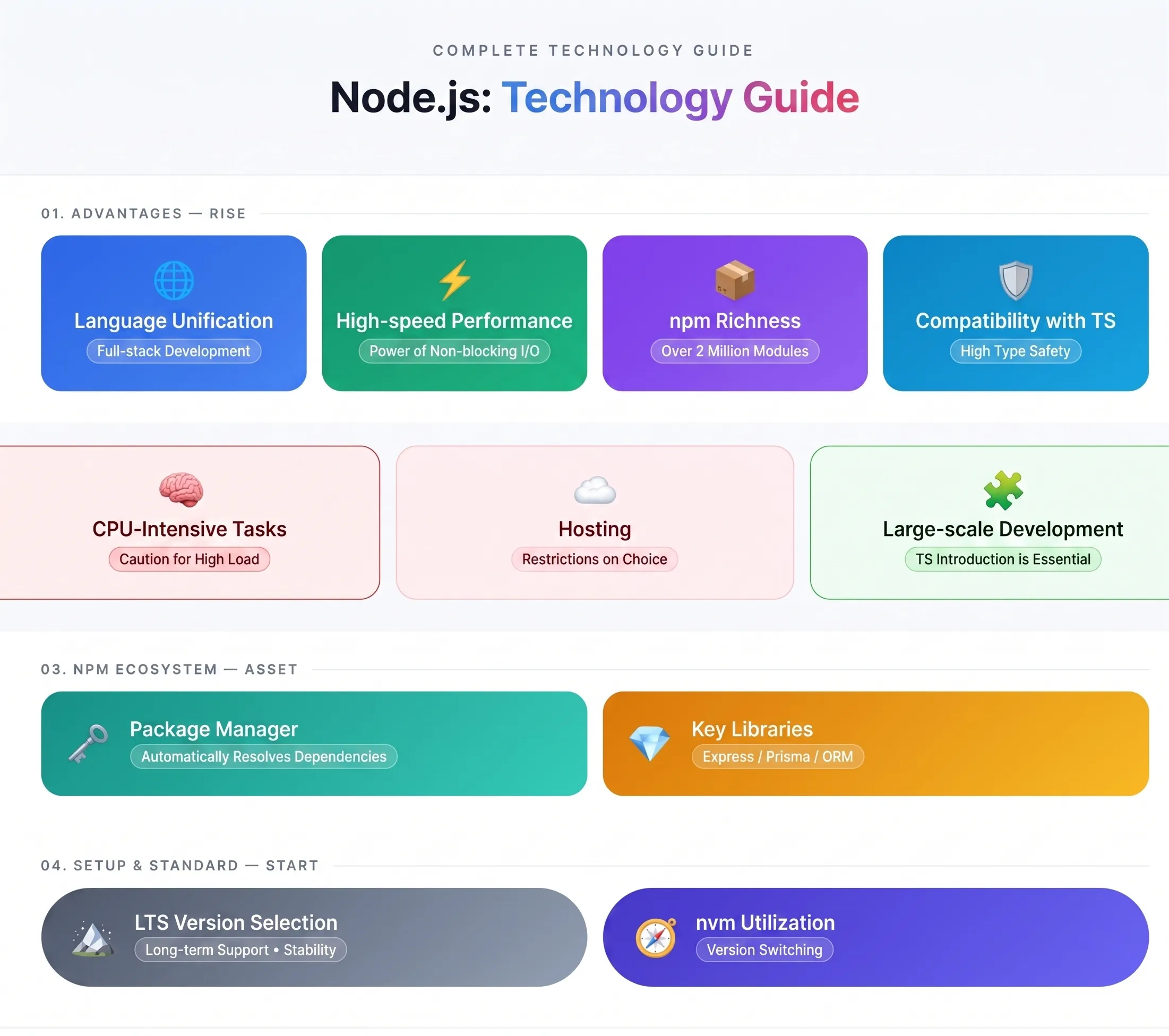
The strength of Node.js lies not only in its engine performance but also in its rich ecosystem. At the heart of that ecosystem is npm (Node Package Manager). Here we cover both the ecosystem and how to set up your development environment.
npm Is Node.js’s Dedicated Package Manager, Giving You Access to Over 2 Million Libraries
npm is the tool for managing Node.js packages (libraries). A single command is all it takes to install the libraries you need, and version management and dependency resolution are handled automatically.
As of 2025, the npm registry hosts over 2 million packages — a scale that rivals or surpasses the package managers of any other language.
Source: Zealous System
Notable npm Packages
| Package | Category | Primary Use |
|---|---|---|
| Express.js | Web server | Building API servers and web applications |
| Passport.js | Authentication | Implementing login and OAuth authentication |
| Prisma | ORM | Abstracting database operations |
Choose the LTS Version of Node.js and Use nvm for Version Management
The easiest way to install Node.js is to download it directly from the official website (https://nodejs.org/ja). After installation, run node -v in your terminal to confirm the version and verify that the installation was successful.
Node.js is available in two release types: LTS (Long Term Support) and the latest (Current) version.
The LTS version is recommended for both learning and production environments, as it guarantees stability. If you need to switch between different Node.js versions across multiple projects, nvm (Node Version Manager) is the go-to solution.
11. Frequently Asked Questions About Node.js

Q. What is the difference between Node.js and Deno?
Deno is a new JavaScript runtime developed in 2018 by Ryan Dahl, the original creator of Node.js.
Its main differences include native TypeScript support and a strengthened security model. That said, as of 2025, Node.js continues to hold an overwhelming lead in ecosystem size and adoption.
Q. Can front-end engineers learn Node.js?
Absolutely — anyone with a foundation in JavaScript can pick it up. Since the same JavaScript syntax you use on the front end carries over directly, the barrier to transitioning into back-end development is lower than with most other platforms.
Q. Should I learn Node.js or Python first?
If your goal is web application or API server development, Node.js is a natural fit. If you are aiming for AI, data analysis, or machine learning, Python is the better starting point. The right choice depends on your target career path and area of development.
Q. Is Node.js free to use?
Yes, completely free. Node.js is open-source software released under the MIT License, and can be used at no cost, including for commercial purposes.
Q. How long does it take to learn Node.js?
If you already have a foundation in JavaScript, reaching the point where you can build a basic API server typically takes one to three months. Getting to a professional level — with hands-on experience implementing Express, authentication, and database integration — generally takes around six months.
▼Related Reading
Curious how Node.js fits into the broader web development picture? This guide breaks down the front-end vs. back-end divide — including salary data and skills — to help you map out your career direction.

▼Related Reading
Node.js is a top skill in Japan’s IT market — but knowing which companies actively hire for it matters just as much. This guide covers the top 4 in-demand IT skills and where they lead in Japan’s tech industry.

■ Turn Your Node.js Knowledge into a High-Value Career in Japan
With Node.js ranking among the top web technologies used by engineers globally and commanding an average annual salary of ¥9.19 million in Japan, the market opportunity is real. BLOOMTECH Career for Global supports engineers based in Japan with Japanese language ability at JLPT N2 or above who are ready to take the next step — whether that means a first role in backend development or a move to a higher-value position.
▼Contact BLOOMTECH Career for Global here
12. Summary: Node.js Is the Runtime Environment Every Engineer in the AI Era Should Know
Node.js is a runtime environment that enables JavaScript to run on the server side. The combination of high-speed processing via the V8 engine and asynchronous I/O has made it an essential technology for modern web services that demand high concurrency.
Over 2 million npm packages, a top-ranked position in the Stack Overflow survey, and market data showing an average annual salary of ¥9.19 million all point to Node.js remaining a central technology in development for years to come.
Node.js continues to evolve as a core piece of AI-era infrastructure. The recommended first step is to check out the official LTS release and start exploring its ecosystem firsthand.