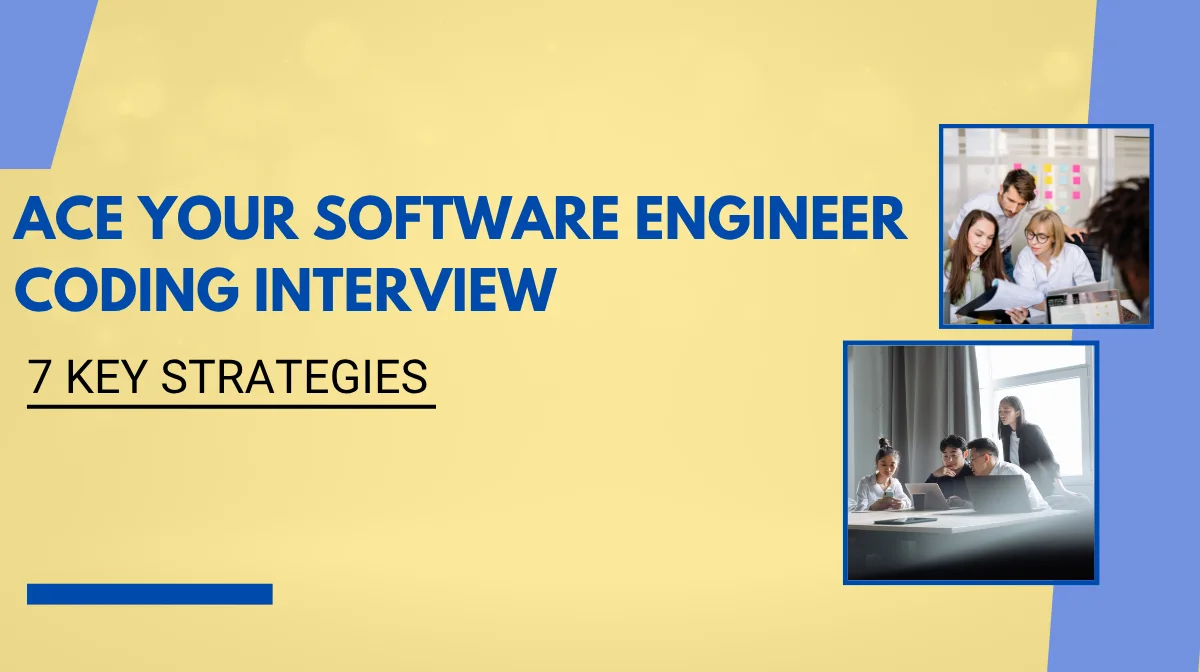
Struggling with software engineer coding interviews? Technical skills alone won’t guarantee success. Companies evaluate your problem-solving approach, communication ability, and code quality alongside programming knowledge.
This guide covers everything you need: evaluation criteria, seven preparation strategies, and the five most common failure patterns to avoid.
- Seven strategies to master algorithms and ace interviews
- Why coding interviews test more than technical skills
- Tactics for online tests and live coding formats

1. Understanding the Software Engineer Coding Interview

Software engineer coding interviews test practical programming abilities that resumes can’t measure. While your resume lists experience and qualifications, it doesn’t reveal how you code or approach problems.
Three Interview Formats
Companies use three primary assessment formats. Online platforms like TOPSIC, paiza, and HireRoo offer at-home testing with automatic grading.
Live coding sessions involve real-time problem-solving on whiteboards or shared screens while interviewers observe your process. Take-home assignments provide several days to complete complex projects mirroring actual work.
The Hiring Process Timeline
Typical screening flows through resume review, initial HR interview, coding assessment, technical team interview, and final executive interview.
Coding tests usually appear mid-process, objectively measuring technical ability before evaluating cultural fit and career alignment. Some companies add live coding after online assessments.
Interview Structure
Most coding interviews follow a standard pattern: problem presentation with constraints and time limits, implementation within deadlines, code submission for evaluation, and discussion of your approach (in live formats). Understanding this structure helps you prepare effectively.
Why Companies Prioritize Technical Validation
Japan’s Ministry of Economy, Trade and Industry projects a shortage of 790,000 IT professionals by 2030. This severe talent shortage makes skill mismatches extremely costly—when hired engineers lack expected capabilities, projects suffer delays, quality declines, and employees often leave quickly, wasting recruitment investments.
Companies verify critical competencies: programming language proficiency, algorithm and data structure knowledge, computational complexity awareness, logical thinking, code readability, and the ability to balance speed with quality.
In an era demanding digital transformation and AI integration, thorough technical evaluation directly impacts competitive advantage.
■Related Reading
Looking for positions that value technical skills? Discover how Japanese companies are actively seeking foreign engineering talent in our comprehensive analysis.

2. Software Engineer Coding Interview Evaluation Criteria
Coding interviews comprehensively evaluate three dimensions: technical skills, problem-solving process, and communication ability. Understanding common failure patterns helps you avoid critical mistakes.
Three Core Evaluation Points
Technical competence forms the foundation
Interviewers assess your grasp of fundamental algorithms (sorting, searching, dynamic programming, graph traversal) and ability to select appropriate data structures (arrays, linked lists, stacks, queues, trees, hash tables).
Companies handling large-scale data particularly value Big-O notation understanding and computational complexity awareness—code must work efficiently, not just function.
Your thought process matters as much as final solutions
Interviewers observe how you understand requirements, identify constraints, and break down challenges. Demonstrate planning before coding, organize steps methodically, and show flexibility in iteratively optimizing approaches. During live coding, explaining your reasoning—”I’m using this approach because…”—showcases analytical thinking.
Communication ability proves critical in collaborative development
Can you ask clarifying questions, explain your code clearly, and write readable code with meaningful names and comments that teammates can understand and maintain? The standard is maintainable code, not just working code.
Five Failure Patterns to Avoid
Missing requirements causes unnecessary failures
Overlooking constraints or misunderstanding output formats leads to wrong solutions despite technical skill. Example: sorting descending instead of ascending, or returning full arrays when only counts were needed. Always verify input-output relationships with concrete examples.
Perfectionism causes timeouts
Spending 30 minutes seeking optimal O(n log n) solutions while submitting nothing wastes opportunities. Complete working code first, then optimize if time permits—partial credit beats perfection.
Silent struggling creates negative impressions
Remaining quiet for 10+ minutes prevents interviewers from evaluating your thinking. Actively communicate: “I’m struggling with this part” This demonstrates collaborative ability.
Fundamental gaps prevent problem-solving
Without knowing binary search or hash tables, you’ll resort to inefficient O(n) or O(n²) implementations. Master frequently-used algorithms through advance preparation.
Ignoring edge cases produces unusable code.
Crashing on empty arrays, mishandling negative numbers, or allowing index overflows reveals insufficient rigor. Develop habits of considering boundary values and special cases.
■Ready to Find Your Next Software Engineering Role in Japan?
BLOOMTECH Career for Global specializes in connecting foreign IT engineers with companies that value your technical skills and international experience.
Our bilingual advisors understand both coding interview requirements and Japanese workplace culture, providing comprehensive support from interview preparation to visa assistance.
Let us match you with positions at companies actively seeking global talent in web development, AI, cloud computing, and more.
▼Contact BLOOMTECH Career for Global here
3. Seven Strategies to Pass Your Software Engineer Coding Interview
7 Coding Interview Strategies
Master the technical interview with these steps
Master Algorithms
Practice Daily
Simulate Limits
Verbalize Process
One Strong Language
Review Code
Mock Interviews
Systematic preparation significantly improves interview performance. These strategies work for beginners through experienced professionals.
Strategy 1: Master Core Algorithms and Data Structures
Prioritize essential data structures (arrays, linked lists, stacks, queues, hash tables, trees, graphs) and fundamental algorithms: sorting (bubble, quick, merge, heap), searching (linear, binary, BFS, DFS), plus dynamic programming, greedy algorithms, and recursive thinking.
Strategy 2: Practice Daily with Real Problems
Consistent problem-solving builds crucial pattern recognition. LeetCode offers comprehensive problems with difficulty levels. Paiza provides Japanese-language support with skill rankings.
AtCoder features 3,000+ Japanese problems. Codility mirrors company assessments. HackerRank spans multiple domains.
Beginners should solve one Easy problem daily, prioritizing consistency. Intermediate practitioners can tackle 1-2 problems daily, progressing from Easy to Medium.
Advanced users should focus on 2-3 Medium problems daily, adding 1-2 Hard problems weekly. When stuck, study solutions to understand approaches, then retry next day—this review cycle accelerates learning.
Strategy 3: Simulate Real Conditions
Practice with strict time limits: 15-20 minutes for Easy problems, 30-45 minutes for Medium, 45-60 minutes for Hard. Allocate time strategically: 20% understanding problems and constraints, 20% designing approaches and selecting data structures, 50% implementing working code, 10% testing edge cases and debugging. This prevents premature optimization and last-minute rushes.
Strategy 4: Practice Explaining Your Process
Verbalizing problem-solving improves both understanding and interview performance. Try “rubber ducking”—explaining code to inanimate objects reveals unclear thinking and logical gaps.
During interviews, communicate effectively at every stage.
- Clarifying: “What’s the input range?” “Should I handle negatives?”
- Explaining: “I’ll start with brute force, then optimize”
- When stuck: “I’m struggling here. I’m considering this approach—thoughts?”
Interviewers often provide guidance when you engage them as collaborators.
Strategy 5: Deepen Expertise in Your Strongest Language
Choose the language you know best. Python offers minimal code with fast implementation and rich libraries (ideal for beginners, slower execution). Java provides static typing and enterprise robustness (more verbose).
JavaScript suits web developers with powerful array methods. C++ offers maximum speed (for advanced users and competitive programmers).
Master one language rather than spreading yourself thin. Check company language preferences beforehand, though most allow free choice.
Strategy 6: Develop Code Review Habits
Review your code after a day or more—you’ll notice unclear variable names and unnecessarily complex logic. Study excellent code from GitHub open-source projects and highly-rated LeetCode solutions to learn clean, efficient coding styles.
Strategy 7: Get Feedback Through Mock Interviews
Partner with fellow engineers, alternating interviewer and candidate roles. Evaluating others’ code reveals what interviewers seek and highlights your blind spots. Join engineering communities to find practice partners.
Online services like Pramp and interviewing.io offer structured practice, and many recruitment agencies provide mock interviews.
■Related Reading
Master the complete interview process beyond coding tests. Learn essential strategies for every stage of Japanese tech company interviews.
4. Software Engineer Coding Interview Preparation by Skill Level
Prep by Skill Level
Maximize your interview performance
Top Tier
Speed + Hard Probs
Mega Ventures
Business Logic
SI / Contract
Fundamentals
Efficient preparation requires understanding problem difficulty and your current capabilities.
Four Problem Difficulty Levels
Level 1 (AtCoder Brown/paiza D)
Basic challenges like FizzBuzz, simple arithmetic, fundamental control structures. Tests whether you implement to specification.
Level 2 (AtCoder Green/paiza C)
Array manipulation, string processing, basic hash tables, simple sorting. Requires combining input/output with loop processing.
Level 3 (AtCoder Light Blue/paiza B)
Binary search, DFS/BFS, basic dynamic programming, stack/queue implementations. Demands selecting appropriate algorithms and data structures.
Level 4 (AtCoder Blue+/paiza A)
Advanced dynamic programming, complex graph algorithms, segment trees, mathematically intensive problems. Top-tier companies and GAFAM test at this level.
Three-Month Foundation for Beginners
Build systematically toward reliably solving Level 1-2 problems.
Month 1
Programming fundamentals—variables, data types, operators, control structures, functions, basic arrays/lists, introductory computational complexity.
Month 2
Essential data structures—array/string manipulation, hash tables, stacks, queues, basic sorting, linear and binary search.
Month 3
Advanced concepts—recursive thinking, tree basics, graph fundamentals, BFS/DFS implementations, plus extensive practical problem practice.
Company-Specific Strategies for Experienced Engineers
GAFAM and Top Foreign Companies
require solving LeetCode Medium problems within 30 minutes and handling Hard problems confidently. Study advanced dynamic programming, graph algorithms, sophisticated tree structures, bit operations, and system design.
Expect problems like shortest transformation paths (graph BFS), longest common subsequence (dynamic programming), or trapped rainwater volumes (stacks/binary search).
Mega Ventures (Rakuten, LINE, Mercari)
emphasize practical speed alongside technical knowledge. Master Easy to Medium problems with high readability and fast implementation.
Focus on efficient string/array manipulation, hash table utilization, and business-oriented challenges like calculating user login streaks or implementing shopping cart functionality.
SI and Contract Development
prioritize fundamentals and communication. Reliably solve Easy problems with highly readable code while demonstrating strong questioning and explanation abilities.
Ensure solid algorithm understanding, proper error handling, and maintainable code. Expect straightforward problems like specified sorting or pattern searching.
■Related Reading
Planning your engineering career trajectory in Japan? Explore the complete roadmap from entry-level to executive positions with salary insights.
■Ace Your Interview with Professional Career Support
Whether you’re targeting GAFAM-level positions or growing ventures, BLOOMTECH Career for Global provides personalized guidance tailored to your skill level and career goals.
Our experienced advisors offer mock interview practice, technical preparation strategies, and insider knowledge about company-specific interview processes.
We connect you with opportunities that match your expertise while providing complete support through the entire hiring process, including visa acquisition and cultural coaching.
▼Contact BLOOMTECH Career for Global here
■日本でエンジニアとしてキャリアアップしたい方へ
海外エンジニア転職支援サービス『 Bloomtech Career 』にご相談ください。「英語OK」「ビザサポートあり」「高年収企業」など、外国人エンジニア向けの求人を多数掲載。専任のキャリアアドバイザーが、あなたのスキル・希望に合った最適な日本企業をご紹介します。
▼簡単・無料!30秒で登録完了!まずはお気軽にご連絡ください!
Bloomtech Careerに無料相談してみる
5. Format-Specific Software Engineer Coding Interview Tactics
Online and live coding interviews require different approaches.
Online Interview Strategy
Taking tests from home offers comfort but demands self-management. Research policies vary—generally, consulting official documentation, checking syntax, and reviewing algorithm basics is acceptable. However, copying identical solutions, having others help, or collaborating constitutes cheating.
Research efficiently: bookmark documentation beforehand, keep library usage notes, save algorithm templates. During tests, use specific keywords, prioritize official docs, and limit each query to 3-5 minutes. Automated systems detect suspicious patterns like frequent tab switching or abnormal copy-pasting. Base solutions on your knowledge, researching only specific gaps.
Live Coding Strategy
In-person interviews evaluate technical skills alongside communication and teamwork. Whiteboard coding lacks editor conveniences—pseudocode often suffices. Focus on clear algorithmic logic and practice handwriting code beforehand.
Never code silently. Maintain ongoing dialogue: clarify requirements, explain your approach, share progress, and consult when stuck. When hitting obstacles.
- Propose brute force: “Exhaustive search would work like this”
- Work through examples: Start with small cases to identify patterns
- Solve partially: “Let me implement this component first”
- Request guidance: “Could you offer a hint?”
Constructive dialogue demonstrates professional problem-solving valued in team environments.
■Related Reading
Beyond technical skills, understanding Japanese workplace culture is crucial for interview success. Discover key cultural insights for foreign engineers.

6. Software Engineer Coding Interview FAQ
Let’s address the most common questions candidates have about coding interviews, from research policies to language selection and realistic pass rates.
Can I Research During Interviews?
Policies vary, but generally acceptable research includes language documentation, standard library usage, syntax error explanations, and Big-O notation basics.
Unacceptable actions include copying complete solutions, searching “LeetCode problem 123 solution,” posting problems for real-time help, or having others solve for you. Limit research to syntax while developing logic independently. Always confirm specific company policies.
What If My Mind Goes Blank?
Break problems into manageable pieces: clarify required output, identify necessary information, confirm implementable components. Start with brute force when optimal solutions don’t emerge—even O(n²) beats submitting nothing.
In live settings, communicate honestly: request time to organize thoughts, verify approach direction, or explain you’ll optimize after implementing basics. Verbalizing thinking often prompts helpful guidance.
Which Language Should I Choose?
Use your strongest language to focus mental energy on problem-solving, not syntax. Check company technical stacks beforehand, though most allow free choice. Web companies use JavaScript/TypeScript/Ruby/PHP/Python. Financial systems favor Java/C#. AI roles expect Python/R. Embedded systems use C/C++.
What Are Pass Rates? Can I Self-Study?
Pass rates vary dramatically
top-tier foreign companies and GAFAM show 10-20%, major ventures 20-40%, SI and smaller companies 40-60%. These are estimates—focus on improving skills rather than statistics.
Self-study works effectively—many engineers pass using online platforms and books alone. Advantages include zero cost, self-paced flexibility, extensive problem variety, and studying during work breaks. Challenges include maintaining motivation, missing blind spots, uncertainty about optimal sequences, and potential isolation.
Consider supplementing with online communities for support, programming bootcamps for structured curricula, or recruitment agency resources including mock interviews.
■Related Reading
Ready to negotiate your worth after acing the interview? Learn proven strategies for maximizing your salary as a foreign IT engineer in Japan.
7.Key Takeaways for Software Engineer Coding Interview Success
Success in software engineer coding interviews requires mastering three evaluation dimensions: technical skills, analytical thinking, and communication ability. Understanding the five common failure patterns while implementing seven systematic preparation strategies positions you for success regardless of experience level.
The path forward is clear: prepare efficiently using skill-appropriate roadmaps, practice under realistic conditions with strict time limits, develop strong communication habits for live interviews, and focus on consistent learning rather than perfection. Start your preparation today using these proven strategies, and approach your coding interview with confidence backed by thorough, deliberate practice that addresses what interviewers actually evaluate.
■Navigate Your Software Engineering Career Path with Expert Guidance
Successfully passing coding interviews is just the beginning. BLOOMTECH Career for Global offers end-to-end support for foreign engineers building careers in Japan’s thriving tech industry.
From identifying companies with international work environments to negotiating competitive compensation packages, our bilingual team guides you through every step.
Access our extensive network of companies actively hiring global talent, receive personalized job referrals matched to your skills, and benefit from comprehensive visa and cultural integration support.
▼Contact BLOOMTECH Career for Global here