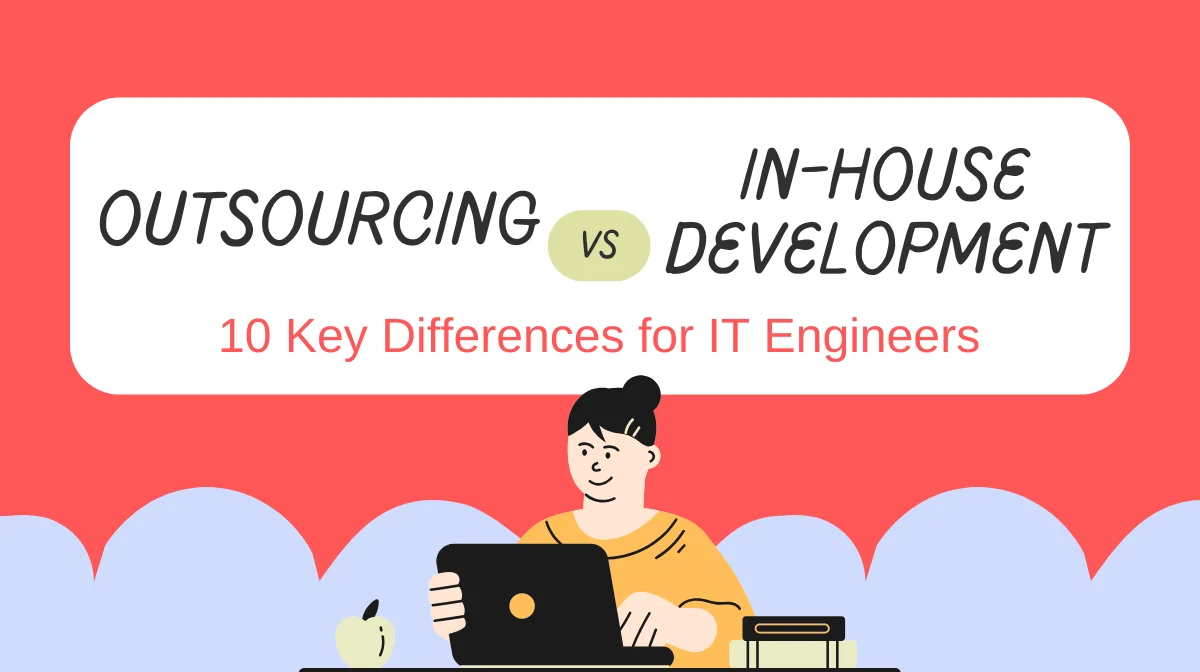
“Should I pursue contract development or in-house development?”
This critical question affects every IT engineer’s career trajectory. While both involve development work, they differ fundamentally in work style, skill formation, and compensation. This article compares both models objectively to help you make strategic career decisions based on your experience level.
- Key differences in work style, skills, and compensation
- Best career choices for each experience level
- How to evaluate employers and transition successfully

1. Understanding Outsourcing vs. In-house Development: Core Definitions
IT Work Models: 3 Paths
Contract, In-house, SES (Core Focus)
1. Contract
KEY FOCUS
- Contract: Contract for Work
- Deliverable: Final Product
- Risk: Company
ENGINEER ROLE
- Exposure: Diverse Stacks
- Goal: Solve Client Issue
2. In-house
INTERNAL SYSTEM
- Goal: Efficiency & Cost Down
- Measure: Productivity Gain
EXTERNAL SERVICE
- Goal: Market Growth (SaaS)
- Measure: Revenue & Acceptance
3. SES
CONTRACT & DIRECTION
- Contract: Quasi-Delegation (Hours)
- Focus: Skills/Time Supply
- Command: Client Direction
ENGINEER EXPERIENCE
- Exposure: Varied Sites
- Limitation: No Ownership
Key Concepts: SIer and Contract Types
Contract Difference
Contract (Contract for Work) delivers product. SES (Quasi-Delegation) provides time/skill. This defines risk/command.
SIer Connection
SIer is a company *type* (System Integrator). They often use Contract Development, but the terms are not identical.
Understanding three distinct work structures—contract development (outsourcing), in-house development, and SES—is essential for informed career decisions. Though similar on the surface, they differ significantly in contracts, responsibilities, and engineer roles.
Contract Development (Outsourcing): Definition and Model
Contract development involves building systems or software for clients under “contract for work” agreements. Development companies bear responsibility for delivering completed systems meeting specifications by deadline.
The objective is solving client business challenges through technology. Common projects include enterprise systems, e-commerce platforms, and workflow automation tools.
Companies generate revenue project-by-project, making continuous contract acquisition critical for stability.
Engineers gain exposure to diverse industries and technical environments, building broad knowledge across varied business domains and technology stacks.
Two Types of In-house Development
In-house development splits into two distinct models with different objectives.
Internal System Development
This focuses on improving operational efficiency and reducing costs. Examples include proprietary CRM systems, inventory platforms, and workflow tools.
Success is measured by productivity gains and cost savings, not external sales.
External Service Development
This targets consumers or businesses as end users, including SaaS platforms, web applications, and mobile apps.
Product market acceptance and revenue directly determine success, with engineers bearing responsibility tied to product growth and market performance.
These models differ substantially in stakeholders, development pressure, and required skills. External-facing development demands greater speed and flexibility due to market competition.
SES (System Engineering Service) vs. Contract Development
SES operates as technical staff dispatch under “quasi-delegation contracts” Unlike contract development, SES focuses on providing engineering expertise and hours without primary deliverable responsibility.
Contract development engineers work under their company’s direction, while SES engineers work under client command as integrated team members. This provides varied environment exposure but limits project ownership.
The SIer Connection
SIer (System Integrator) describes a company type, not a work structure.
SIers specialize in system integration—combining multiple systems into unified IT infrastructures. Most SIers conduct contract development as their primary business, though not all contract development companies are SIers.
2. Key Differences: Outsourcing vs. In-house Development
Ten critical dimensions impact engineering careers. This table provides comprehensive comparison, followed by detailed analysis of key factors.
| Dimension | In-House Development | Contract Development | SES |
|---|---|---|---|
| Primary Goal | Product growth and monetization | Meeting client specifications | Providing engineering hours |
| Stakeholders | Users, company leadership | Client organizations | Client teams, staffing management |
| Work Pace | Continuous iteration | Fixed deadlines | Client schedules |
| Skill Breadth | Narrow (specialized) | Broad (diverse) | Very broad (variable) |
| Skill Depth | Deep (domain expertise) | Moderate | Shallow (frequent changes) |
| Ownership | Very high | Low | Minimal |
| Technical Authority | High (team decisions) | Low (client approval) | Minimal (client protocols) |
| Revenue Model | Product sales/subscriptions | Project contracts | Hourly billing |
| Stability | Product-dependent | Relatively stable | Generally stable |
| Compensation Ceiling | High (equity potential) | Limited (fixed scope) | Low (subcontracting) |
Work Style and Scheduling
In-house development offers flexibility through continuous iteration based on user feedback. Development priorities are set internally, giving engineers significant discretion. Work continues long after initial release, creating sustained engagement.
Contract development operates within strict client deadlines. Client-driven changes and urgent requests require adaptive scheduling.
Projects follow clear completion cycles, transitioning to new contracts after delivery. IPA’s IT Human Resources White Paper 2024 reports 70% of IT companies experience frequent client specification changes, highlighting required adaptability.
Skill Development: Generalist vs. Specialist
Contract development cultivates generalist capabilities through diverse industry and technical exposure.
Engineers encounter varied requirements across finance, healthcare, manufacturing, and retail, developing broad contextual understanding and technical versatility.
In-house development enables deep specialization within specific product domains. Extended codebase engagement develops sophisticated architectural understanding, technical debt management, and performance optimization.
Engineers become domain experts but may face limited technology breadth.
IPA’s DX White Paper 2023 emphasizes that effective digital transformation requires both deep specialization and broad knowledge, with optimal strategies varying by career stage.
Ownership and Authority
In-house development positions engineers as product creators with substantial influence from planning through execution. Engineers participate in technology selection, architectural design, and feature prioritization, with opinions carrying significant weight.
Contract development centers on executing predefined specifications. While technical proposals are possible, clients hold final authority.
Engineer involvement typically begins during implementation rather than planning. IPA’s IT Human Resources White Paper 2024 identifies work discretion as critical to engineer satisfaction.
Compensation Models
In-house companies derive revenue from product sales. Market success flows to engineers through raises, bonuses, and equity. Startups may offer significant IPO returns, but product failure creates business risk.
Contract development generates project-based revenue. Client success doesn’t trigger additional compensation beyond contracts. Earnings remain stable but lack upside potential.
Ministry of Health, Labour and Welfare data (2023) shows system engineers average 5.69 million yen annually, programmers 4.26 million yen, with variation by company size and specialization.
Stability and Risk
Contract development achieves stability through consistent project acquisition. Established firms maintain long-term client relationships ensuring continuous work.
Engineers benefit from employment security as completed projects lead to new assignments.
In-house development, particularly with external products, depends entirely on market reception. Product failure threatens viability, creating high risk.
Conversely, success drives rapid growth and substantial returns—a high-risk, high-reward environment.
■Related Reading
Understanding Japan’s overall IT industry landscape helps contextualize the differences between contract and in-house development. Explore market trends, structural challenges, and career opportunities across the sector.
3. Career Stage Strategy: Choosing Between Outsourcing and In-house Development

Optimal choices evolve throughout careers. Strategic alignment between stage and model significantly impacts success.
Junior Engineers (Years 0-3): Contract Development Advantages
Early-career engineers typically benefit most from contract development for three reasons.
Diverse project exposure builds comprehensive foundational skills. Varied industries, technologies, and methodologies help identify interests and aptitudes through practice.
In-house companies, particularly competitive web firms, seek experienced professionals. Inexperienced engineers face high barriers. Contract firms more frequently offer training and recruit entry-level talent.
Contract experience creates strong foundations for career moves. Transitioning to in-house after three years represents a well-established, effective career path.
Mid-Level Engineers (Years 3-10): Strategic Transitions
Engineers with three to ten years experience face critical direction decisions. After establishing fundamentals through contract work, many pursue in-house opportunities to deepen specialization, gain product experience, and exercise greater authority.
Management Track
Management-oriented engineers find in-house development offers product manager and engineering manager roles involving strategy and team leadership. Contract development provides project manager positions developing client relations and large-scale coordination skills.
Specialist Track
Specialists can pursue tech lead or architect roles in in-house development, achieving technical depth. Contract development offers technical consultant pathways leveraging broad knowledge across diverse challenges.
Senior Engineers (Year 10+): Maximizing Value
Senior engineers deliver high value in either model, though roles differ substantially.
In-house development positions seniors as technical leads or architects determining product direction. Engineering manager or VPoE roles enable organizational strategy and team leadership within focused contexts.
Contract development utilizes experience through project manager roles overseeing client engagements, technical consultant positions addressing strategic challenges, and sales engineer functions driving business acquisition.
■Related Reading
Strategic career planning requires understanding comprehensive career paths available to IT engineers. Discover the specialist, management, and generalist tracks with detailed roadmaps for long-term success.
■Navigate Your Career Path with Expert Guidance
Choosing between contract and in-house development is a critical career decision that requires understanding both your professional goals and the Japanese IT market.
BLOOMTECH Career for Global provides personalized career counseling to help you evaluate which development model aligns with your current stage and long-term objectives. Our advisors have deep knowledge of both contract and in-house environments and can connect you with companies that match your career aspirations.
▼Contact BLOOMTECH Career for Global here
4. Industry Trends and Market Data
Industry data provides essential context for strategic career planning. Current market conditions and projections reveal opportunities in both contract and in-house development.
Market Growth
IDC Japan research shows the domestic IT services market reached 6.46 trillion yen in 2023 with continued growth projected. Corporate digital transformation drives increasing system modernization demand, sustaining healthy contract development conditions.
SaaS proliferation accelerates in-house development growth, particularly for external services. Ministry of Economy, Trade and Industry data confirms consistent information services revenue growth, validating IT sector expansion.
Skills Gap and Demand
IPA’s IT Human Resources White Paper 2024 identifies serious talent shortages, with Ministry projections estimating 790,000 professional shortfalls by 2030.
Critical shortages include AI and machine learning, cloud computing, security, and data analytics. DX roles particularly need professionals combining business acumen with technical capability, project management, and communication skills.
IPA’s DX White Paper 2023 identifies skill shortages as the primary DX challenge, with rapidly increasing demand for professionals understanding both business and technology.
Remote Work Adoption
Ministry of Internal Affairs and Communications data (2023) shows information and communications industry telework at 70%, substantially exceeding the 40% all-industry average.
In-house companies generally show higher remote adoption due to internal communication focus. Contract companies increasingly offer remote options, though client preferences influence implementation.
■Related Reading
Compensation varies significantly between contract and in-house development roles. Get comprehensive salary data across different positions and experience levels to benchmark your market value effectively.
■日本でエンジニアとしてキャリアアップしたい方へ
海外エンジニア転職支援サービス『 Bloomtech Career 』にご相談ください。「英語OK」「ビザサポートあり」「高年収企業」など、外国人エンジニア向けの求人を多数掲載。専任のキャリアアドバイザーが、あなたのスキル・希望に合った最適な日本企業をご紹介します。
▼簡単・無料!30秒で登録完了!まずはお気軽にご連絡ください!
Bloomtech Careerに無料相談してみる
5. Making the Right Choice: Evaluation and Success Factors
IT Career Path Choice
Fit & Evaluation
Ideal Fit
In-house
- Feedback
- Direction
- Deep Domain
- Risk OK
Contract
- Diversity
- Adaptability
- Deadlines
- Stability
Employer Check
Understanding your priorities and evaluating companies strategically leads to better career decisions. Consider these key factors when choosing between development models.
In-house Development Fit
Engineers thriving in in-house development typically show these characteristics: strong desire for direct market feedback and user response observation, interest in influencing product direction and feature decisions, focus on deep expertise within specific domains, tolerance for career volatility tied to product success, and satisfaction through iterative refinement based on user feedback.
Contract Development Fit
Contract development suits those valuing diverse industry exposure and varied technology experience, prioritizing adaptable problem-solving over narrow specialization, preferring consistent employment over product-dependent volatility, thriving in intensive deadline-driven cycles, and finding satisfaction solving external challenges with direct client appreciation.
Evaluating Employers
Quality companies share common characteristics regardless of model.
Development Environment
Assess technology stack modernity, development tools, code review practices, and test automation. Companies managing technical debt demonstrate sustainable engineering commitment.
Organization and Culture
Examine team structures, role definitions, decision processes, and engineer input valuation. Fair evaluation systems reward skills and contributions over tenure with clear advancement pathways.
Investment and Flexibility
Consider learning support including conferences and education programs, plus work flexibility through remote options and flexible scheduling.
Information sources include recruitment sites, technical blogs, engineer social media, and review platforms. Interviews provide direct inquiry opportunities.
■Related Reading
Making successful career transitions requires understanding Japan’s unique job search process. Learn proven strategies for changing companies effectively, from preparation to negotiation and onboarding.

6. Common Questions About Outsourcing vs. In-house Development

Here are answers to the most common questions engineers ask when choosing between these career paths.
Can inexperienced engineers enter in-house development?
While challenging, it’s achievable through strategic approaches. Popular companies typically seek experienced professionals, creating high entry barriers.
Successful strategies include building strong portfolios through personal projects or open-source contributions, aligning technology skills with target companies, and targeting early-stage startups conducting potential-based hiring.
The most reliable path involves accumulating two to three years of contract experience before transitioning.
Is contract development demanding?
Contract development involves legitimate challenges including client-driven changes, deadline pressure, and revision cycles. However, difficulty varies by employer and project. Quality companies maintain reasonable work-life balance.
Ministry of Health, Labour and Welfare data (2023) shows information and communications industry average monthly overtime at 14 hours, comparable to the 13-hour all-industry average.
In-house development can also involve intensive periods during launches or critical incidents. Intensity depends primarily on company culture, not development model.
Which model enables better technical growth?
Growth depends on objectives. Contract development excels in skill breadth through diverse industry and technology exposure. In-house development excels in depth through sustained product engagement.
Optimal strategies often vary by stage. Juniors benefit from contract breadth, while mid-level professionals gain from in-house specialization. Strategic sequencing maximizes capability.
How advantageous is transitioning from contract to in-house?
Contract experience provides substantial advantages. Diverse background demonstrates adaptability. Implementation experience translates to product problem-solving. Client negotiation enhances stakeholder management.
Optimal timing occurs after three to five years. At this stage, engineers articulate clear visions while demonstrating concrete applicable skills, improving transition success.
■Make Strategic Career Transitions
Transitioning between contract and in-house development, or entering the IT industry for the first time, requires strategic planning and expert support.
BLOOMTECH Career for Global helps foreign engineers successfully navigate career transitions in Japan’s IT sector. From building competitive portfolios to preparing for technical interviews and negotiating competitive offers, our bilingual advisors provide comprehensive guidance throughout your job search journey. Take the next step toward your ideal career today.
▼Contact BLOOMTECH Career for Global here
7. Making Strategic Career Decisions
Neither contract nor in-house development is inherently superior. Optimal choices depend on career objectives, professional stage, and personal values.
While juniors typically build breadth through contract work before pursuing in-house specialization, decisions should align with individual professional identity visions.
Use these frameworks for data-informed decisions based on technical interests, work preferences, risk tolerance, and aspirations. Both paths offer valuable experiences leading to fulfilling careers when aligned with personal goals.