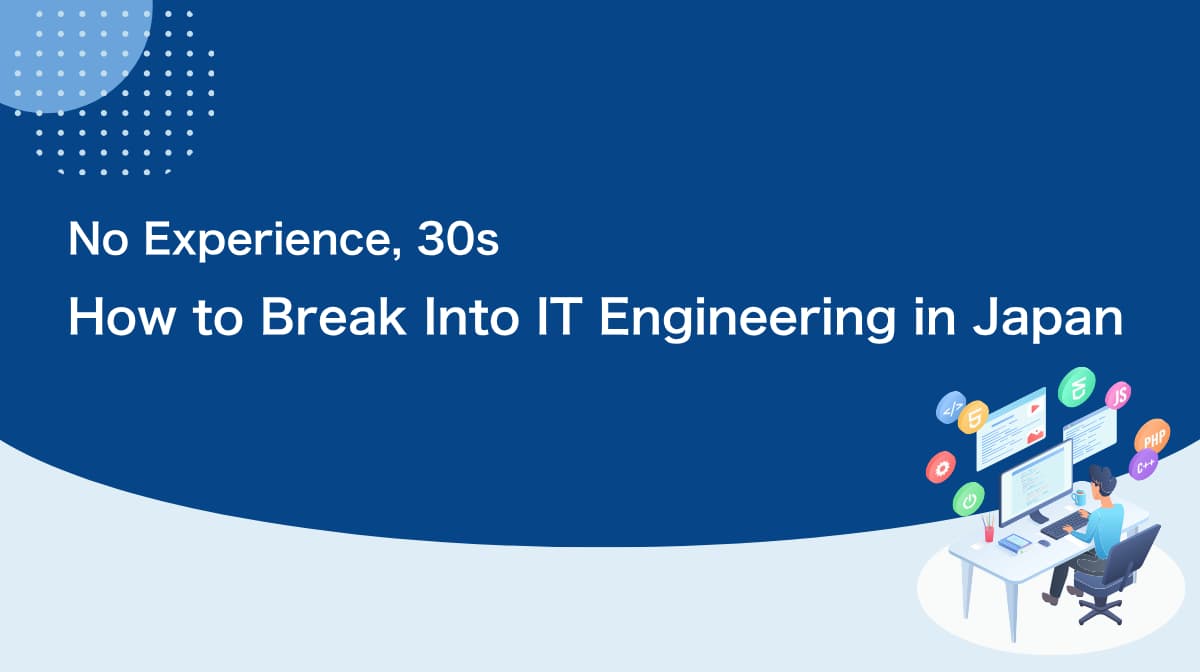
The idea that “changing careers to IT engineer in your 30s with no experience is impossible” is a common refrain found across the internet and social media.
However, the Ministry of Economy, Trade and Industry (METI) estimates a shortage of up to approximately 790,000 IT professionals by 2030 — a reality that stands in stark contrast to that narrative.
This article covers what you need to know about the realities of making a successful career change in your 30s without experience, along with concrete steps for choosing the right role, building your skills, and applying effectively.
- The real reasons why IT engineer career changes in your 30s with no experience are said to be difficult
- Recommended job types where inexperienced 30-somethings can land an offer in the shortest time
- Concrete steps for learning, applying, and interviewing to make your career change a success

1. Three Reasons Why Career Changers in Their 30s with No IT Experience Are Told It’s “Impossible”

The claim that “switching to an IT engineering career in your 30s with no experience is impossible” circulates widely online. Before accepting it at face value, however, it is worth understanding why this view exists — and examining it from the employer’s perspective.
Once you understand the reasons, you can judge whether each obstacle is actually something you can overcome.
Most job openings seek immediate contributors, making it harder for inexperienced candidates in their 30s to stand out
When companies hire engineers, what they prioritize above all is “someone who can hit the ground running.” Training a single engineer requires a dedicated mentor’s time, training costs, and a waiting period before that person becomes productive.
From a hiring manager’s perspective, it is only natural to prefer experienced candidates who can contribute quickly at minimal cost.
This is precisely why so many job listings emphasize portfolios and hands-on experience. Candidates who are still “studying” give hiring managers little basis for evaluating their readiness, and tend to be deprioritized in the screening process.
This is not a question of age — it is a question of whether the cost of developing you is worth it to the company. Flip the logic around, and if you can demonstrate the results of your learning in a tangible way, this barrier is entirely surmountable.
Candidates in their 30s cannot compete on the same “potential hire” playing field as those in their 20s
When hiring new graduates, career starters, or candidates in their early 20s, companies focus less on current skills and more on long-term growth potential.
At most companies, however, the target age range for this type of potential-based hiring is roughly 25 to 28. Candidates in their 30s fall outside that bracket.
This does not mean that people in their 30s cannot grow. It means that what companies expect from younger hires — “developing them over a long period of time” — is fundamentally different from what they expect from experienced hires in their 30s: “becoming productive sooner rather than later.”
If a 30-something applicant approaches the job search the same way a 20-something would, this mismatch in expectations often prevents them from passing the resume screening stage. Conversely, choosing the right arena to compete in can dramatically change the outcome.
Inexperienced 30-somethings from non-IT backgrounds are often seen as a question mark for engineering aptitude
It is natural for a hiring manager to wonder, “Why are they pursuing engineering now, at this stage of their career?”
When a candidate’s previous role was in sales, administration, manufacturing, or any other non-IT field, concerns tend to arise around questions like “Are they technically suited for this?” and “Will they stay long-term?” These concerns can become invisible hurdles in both resume screening and interviews.
That said, these concerns can be addressed by “crafting a compelling motivation statement” and “putting your previous skills into words.”
Clearly articulating why you want to become an IT engineer and which specific experiences from your previous role translate to engineering work can go a long way toward easing a hiring manager’s doubts.
2. Why an IT Engineering Career Change in Your 30s with No Experience Is Still Realistic: What Public Data Shows

The previous section outlined why employers can be skeptical. But looking at the broader job market, significant shifts are underway that challenge that narrative.
This section examines what official data actually shows.
A shortage of up to 790,000 IT professionals is projected by 2030: METI estimates
According to the “Survey on IT Human Resource Supply and Demand (Overview)” published by Japan’s Ministry of Economy, Trade and Industry (METI), a shortage of up to approximately 790,000 IT professionals is projected by 2030.
A government-projected labor shortage of this scale in a specific sector is an extraordinary situation.
This IT talent gap is being driven by a confluence of factors: the acceleration of digital transformation (DX), rapid growth in cloud and cybersecurity fields, and the urgent need to modernize legacy systems.
This is not a demand that will be resolved by short-term economic fluctuations — it reflects a long-term structural need. As long as companies genuinely cannot operate without filling these roles, the barriers to hiring career changers and inexperienced candidates will continue to be lowered.
Reference: METI “Survey on IT Human Resource Supply and Demand (Overview)”
Job change rates for people in their 30s are rising, and career pivots are no longer unusual
According to the Ministry of Health, Labour and Welfare’s “2023 Employment Trend Survey,” the job change rate among those aged 30 to 34 stood at 7.9% for men and 9.8% for women — reflecting how common career transitions in one’s 30s have become across society. The notion that changing jobs in your 30s is somehow unusual no longer reflects reality.
Within the IT industry in particular, an increasing number of companies are actively welcoming career changers from other industries, driven by the push for digital transformation. Employer resistance to hiring career changers in their 30s has diminished significantly compared to even a few years ago.
The feeling that “it’s too late to change careers now” is simply out of step with current market conditions.
Reference: Ministry of Health, Labour and Welfare “2023 Employment Trend Survey”
Government programs are backing career changes into IT for inexperienced candidates
As part of its response to the IT talent shortage, Japan’s Ministry of Economy, Trade and Industry has been actively promoting reskilling support for working adults as a matter of policy.
Through the Ministry of Health, Labour and Welfare’s “Educational Training Benefit System,” individuals who complete eligible programming bootcamps or information technology certification courses may receive a subsidy covering part of the course fees.
The fact that the government has built support structures to encourage career transitions into IT can be read as an affirmation that making the move from a non-IT background in your 30s carries genuine social significance.
If cost is a concern, exploring these programs is well worth your time.
Reference: Ministry of Health, Labour and Welfare “Educational Training Benefit System”
▼Related Reading
Want a deeper look at Japan’s IT job market and what it means for your career? This guide breaks down the current landscape and opportunities for foreign engineers.
3. Top 3 IT Engineering Roles That Inexperienced Candidates in Their 30s Should Target
Many people equate “IT engineer” with “programmer,” but IT engineering encompasses a wide range of roles — and not all of them require coding skills.
For inexperienced candidates in their 30s to realistically succeed in a career change, the starting point is choosing the right role — one that balances ease of skill acquisition, the number of available positions, and compatibility with your previous work experience.
Use the comparison table below to assess which option aligns best with your situation.
| Role | Coding Intensity | Ease of Entry | Estimated Average Salary | Compatibility for Inexperienced 30s |
|---|---|---|---|---|
| Infrastructure Engineer | Low–Medium | ★★★☆☆ | ¥4M–¥6M | ◎ (certifications make skills easy to demonstrate) |
| Test / QA Engineer | Low | ★★☆☆☆ | ¥3.5M–¥5M | ◎ (logical thinking from previous roles directly applies) |
| Web Coder / Front-End Engineer | High | ★★★☆☆ | ¥3.5M–¥5.5M | ○ (self-study results can be shown through a portfolio) |
Infrastructure engineering is the fastest entry point into an engineering career for inexperienced candidates in their 30s
Infrastructure engineers design, build, and manage the underlying systems that power IT environments — including servers, networks, and cloud platforms.
Unlike software development roles, infrastructure engineering involves relatively little writing code from scratch. Many entry-level positions focus on monitoring, maintaining, and operating existing systems, making it easier for career changers to build experience step by step.
Why this role suits inexperienced candidates in their 30s
One of the biggest advantages of this field is that professional certifications allow you to demonstrate your skills in a concrete, verifiable way.
The CCNA (Cisco Certified Network Associate) is a widely recognized industry credential that objectively proves your foundational networking knowledge, and carries significant weight with hiring managers. The Fundamental Information Technology Engineer Examination (FE), a national qualification administered by IPA, is broadly recognized as a benchmark for general IT knowledge covering hardware, software, networking, and security.
Being able to say “I don’t have hands-on experience yet, but I have the knowledge to pass this certification” is a compelling way to communicate your capabilities — and can meaningfully improve your resume pass rate.
Reference: IPA “Fundamental Information Technology Engineer Examination”
Test / QA Engineering: Previous Skills Transfer Directly, Even Without Coding Experience
Test and QA (Quality Assurance) engineers verify that software and systems function correctly and maintain overall product quality. Because this role sits at the end of the development lifecycle, many positions are accessible without coding experience — making it a realistic entry point for career changers.
Why Previous Skills Transfer Directly
The reason this role is particularly well suited to inexperienced candidates in their 30s is that skills from previous careers apply directly. The ability to read and write documents accurately, check procedures without missing steps, and organize information logically — all developed in sales or administrative roles — are directly useful in test design and defect reporting. For those with backgrounds in manufacturing or quality control, the alignment with QA thinking is even stronger.
Career Growth Path
The natural progression runs from test engineer → QA lead → quality manager, with salary growing incrementally at each stage. Another distinctive feature of this role is that a path toward management is relatively open, even within a technical career track.
Web Coder / Front-End Engineer: Self-Study Makes It Easy to Build a Visible Track Record
Web coders and front-end engineers build the visual interfaces of websites and web applications using HTML, CSS, and JavaScript. Learning materials are abundant — Progate, Udemy, YouTube, and other platforms offer free or low-cost access to the fundamentals — and publishing your work on GitHub allows hiring managers to directly assess your technical ability.
A Portfolio Is the Key to Getting Hired
The strength of this role for career changers is that self-built projects can meaningfully compensate for a lack of professional experience. As a practical benchmark, having 3 to 5 websites or apps published on GitHub is the minimum threshold for passing the resume screening stage. This role is also a strong fit for people with an interest in design or those who worked with web content in a previous career.
▼Related Reading
Curious about what infrastructure engineers actually earn in Japan? This guide covers salary ranges by experience level and how to grow your income over time.
■ Ready to Start Your IT Engineering Career in Japan?
BLOOMTECH Career for Global specializes in connecting IT engineers with Japanese companies. Whether you’re targeting infrastructure, QA, or front-end roles, our bilingual career advisors are here to help — available to engineers living in Japan with Japanese language proficiency of N2 or above.
▼Contact BLOOMTECH Career for Global here
4. Three Plans for Inexperienced Candidates in Their 30s to Successfully Change Careers Into IT Engineering
Making a successful career change into engineering in your 30s without experience requires a different approach from what works in your 20s.
Step off the playing field where “future potential” is the main criterion, and instead adopt an approach that concretely demonstrates the strengths specific to being in your 30s. Here are three plans that allow candidates in their 30s to play to their strengths.
Plan 1: Use Certifications Like the Fundamental Information Technology Engineer Exam to Make Your Skills Visible
The most effective way to communicate your skills without professional experience is through objective certifications. The fact of passing an exam — rather than simply saying “I’ve been studying” — gives hiring managers something concrete to evaluate.
Two Certifications Worth Prioritizing
Fundamental Information Technology Engineer Examination (FE): A national qualification administered by IPA that covers general IT fundamentals — hardware, software, networking, security, and more. It is widely recognized by hiring managers across industries and roles, and functions as a clear signal that “this person understands IT basics.” Offered twice a year (April and October).
CCNA (Cisco Certified Network Associate): An internationally recognized networking certification issued by Cisco Systems. Particularly effective for those targeting infrastructure engineering roles, it demonstrates the practical knowledge needed for network design and construction.
Certifications are not a guarantee of getting hired — but they are highly effective tools for clearing the first hurdle of resume screening. Consider pursuing a certification in parallel with your learning, even while you’re still in the middle of preparing.
Reference: IPA “Fundamental Information Technology Engineer Examination”
Plan 2: Put Your Professional Experience Into Words as Universally Transferable Skills
The greatest strength of candidates in their 30s is the professional experience accumulated in previous roles. Even if there are areas where you fall behind younger candidates on the technical side, skills like communication, progress management, client-facing work, and logical thinking — the kind that apply in any workplace — are far more abundant in someone with 30-something experience.
The problem is that most people undervalue these skills as “nothing special.” Hiring managers don’t evaluate engineering candidates on technical ability alone. What they care about is also: “Can this person work well within a team?”, “Can they accurately capture what a client needs?”, and “Will they meet deadlines?”
Use the table below as a reference to connect your previous skills to engineering work and put them into words.
Transferable Skills by Previous Role
| Previous Role | Transferable Skills | Suitable Engineering Roles |
|---|---|---|
| Sales | Client communication, needs discovery, proposal skills, deadline management | Front-end, project management, infrastructure sales |
| Administration | Document organization, accurate record-keeping, procedure management | QA engineer, support engineer, tester |
| Manufacturing / Quality Control | Quality assurance, anomaly detection, process management, standardization | QA engineer, infrastructure operations, tester |
| Education / Customer Service | Explanation skills, listening skills, multitasking, teamwork | Support engineer, education-focused IT, QA |
| Healthcare / Social Care | Documentation accuracy, risk management, multi-disciplinary coordination | Medical systems, QA, healthcare IT |
In interviews and on your resume, connecting your previous skills to engineering work and articulating that connection clearly is the most persuasive answer to the question hiring managers inevitably ask: “Why engineering?”
Plan 3: Focus on Application Quality Over Application Volume
For inexperienced candidates in their 20s, a high-volume application approach can sometimes work — but this strategy does not apply in your 30s. Hiring managers evaluating 30-something candidates place significant weight on “conviction” and “coherence of reasoning,” which means underprepared applications are spotted immediately.
A Specific Step-by-Step Plan for Focused Applications
The recommended approach is a quality-focused plan: narrow your applications to 3 to 5 companies and prepare thoroughly for each. Specifically, follow these steps:
- From no-experience-welcome listings, select 3 to 5 companies where the fit between your previous skills and the role is strong
- Research each company’s business, technology stack, and employee interviews in depth
- Customize your resume for each company and write specifically about “why you want to become an engineer at this company in particular”
- Prepare to explain the connection between your previous skills and your motivation in a logical, coherent way in interviews
Small and Mid-Size Companies and SES Firms Are the Realistic Entry Points
Rather than large companies or well-known IT ventures, small and mid-size companies and SES (System Engineering Services) firms are often the realistic first step for inexperienced candidates in their 30s. SES firms offer exposure to a wide range of environments and allow you to accumulate practical experience quickly. Even if your first workplace isn’t ideal, transitioning as an experienced hire after two to three years is a well-established route.
▼Related Reading
Not sure how to explain your motivation for switching to IT engineering? This article walks you through a proven 4-element framework with 7 role-specific examples for candidates with no IT background.
■日本でエンジニアとしてキャリアアップしたい方へ
海外エンジニア転職支援サービス『 Bloomtech Career 』にご相談ください。「英語OK」「ビザサポートあり」「高年収企業」など、外国人エンジニア向けの求人を多数掲載。専任のキャリアアドバイザーが、あなたのスキル・希望に合った最適な日本企業をご紹介します。
▼簡単・無料!30秒で登録完了!まずはお気軽にご連絡ください!
Bloomtech Careerに無料相談してみる
5. Common Failure Patterns in IT Engineering Career Changes for Inexperienced Candidates in Their 30s

Knowing what commonly goes wrong is just as important as knowing what to do right. There is a significant gap in outcomes between those who prepare carefully and those who move forward without a clear plan.
Here are three failure patterns commonly seen in career change attempts by inexperienced candidates in their 30s.
Applying Without Narrowing Down Your Target Role Lowers Your Resume Pass Rate
Applying to multiple engineering roles with a “any engineering role is fine” mindset signals to hiring managers that your goals are vague. Infrastructure, front-end, back-end, and QA engineering each require completely different skills — which means you can’t write tailored application materials for any of them, and your overall pass rate falls as a result.
“Decide on one role first” is the starting point for the entire job search. Once you have a target role, everything else falls into place — what to study, which certifications to pursue, and how to write your application materials. Without a decided role, learning, applications, and interviews all end up half-finished, and only time and motivation are lost.
Spending More Than Six Months on Study Alone Drains Motivation for Inexperienced 30-Something Career Changers
“I’ll start applying once I’m fully prepared” is the classic pattern that delays the start of an actual job search. Because technical knowledge can always be deepened further, the feeling of “I’m still not ready” tends to persist — and before you know it, six months or a year has passed with nothing but study to show for it.
According to RUNTEQ’s “2026 Survey on the Reality of Career Changes to Engineering Without Experience,” approximately 70% of candidates who received offers did so within three months of starting their job search, and the majority applied to 10 or fewer companies. Moving early with a reasonable level of preparation gets you closer to an offer faster than extended preparation alone. Running your job search and your learning in parallel is strongly recommended.
Anticipate the Salary Drop and Environmental Change That Come After Making the Switch
It is not uncommon for those who change careers to engineering without experience to earn less than their previous salary in the first year.
According to a survey on career changes without experience conducted by Axas (1,025 respondents), while a portion of respondents did see their income drop immediately after the transition, by five years out, the majority had surpassed their pre-transition salary and reported satisfaction with both their income and the nature of their work.
What matters is anticipating this “initial salary dip” and planning your finances accordingly before making the move.
Other realities worth preparing for include receiving guidance from colleagues younger than yourself, adjusting to a different workplace culture, and the mental load of constantly working to keep up with new technology.
Candidates who discuss these realities openly with their families and make the transition with shared understanding tend to experience far less post-joining shock.
Reference: Axas “Survey on Career Changes Without Experience” (private survey)
▼Related Reading
Learn the step-by-step process Japanese companies use when hiring engineers — so you know exactly what to prepare for at each stage of your job search.
6. A Learning Roadmap for Inexperienced Candidates in Their 30s Aiming to Become IT Engineers

Having a clear picture of what to study, when, and in what order gives you the foundation to start taking concrete action today.
The roadmap below outlines the standard progression that allows candidates in their 30s to make the most of limited time and reach their goal as efficiently as possible. The timeline may shift depending on your personal circumstances, but use it as a general framework for how to move forward.
Phase 1 (Months 0–3): Choose your target role and build a foundation of core IT knowledge
The most important task in the first three months is deciding which role you are targeting. Using the role profiles covered in the previous section as a guide, weigh your previous experience against each option’s learning curve and commit to a direction: “This is the role I’m going after.”
Once you have a target role, every subsequent decision falls into place.
What to study in Phase 1, by role
- Targeting infrastructure engineering: Study networking fundamentals (CCNA textbooks), Linux basics, and an introduction to cloud platforms (AWS, etc.) in parallel
- Targeting QA engineering: Learn software testing fundamentals, get an introduction to test management tools (Jira, etc.), and develop your logical thinking framework
- Targeting front-end engineering: Follow this sequence: HTML and CSS basics (Progate is recommended) → Introduction to JavaScript
Starting your preparation for the Fundamental Information Technology Engineer Examination (FE) at this stage is also recommended. It provides a comprehensive, structured overview of IT fundamentals and serves as a solid base regardless of which role you are targeting.
Phase 2 (Months 3–6): Earn certifications and build a portfolio to establish a track record
The goal of Phase 2 is to create “credentials you can show a hiring manager.” This is the phase where you convert your learning into certifications and a portfolio.
Certification targets
Set passing the Fundamental Information Technology Engineer Examination (FE) as your certification goal for this phase (add CCNA if you are targeting an infrastructure role). At a pace of one to two hours of study per day, both are achievable within this timeframe.
Minimum portfolio standards, by role
- Front-end track: Publish 3 to 5 web pages or simple web applications on GitHub
- Infrastructure track: Create documentation and setup guides for environments built using AWS, VirtualBox, or similar tools
- QA track: Produce sample test design documents and defect reports that demonstrate your understanding of testing methodology
This is also a good time to begin registering with recruitment agencies. You will start to develop a sense of the job market and can use feedback from consultants to identify what you still need to work on.
Phase 3 (Month 6 onward): Launch your job search and focus on interview preparation
In Phase 3, your job search begins in earnest. With certifications and a portfolio in hand, the focus now shifts to finalizing your application materials and preparing thoroughly for interviews.
How to write your resume
Frame your previous work experience as universally transferable skills, then combine it with your study achievements — certifications and portfolio work — to tell a coherent story. The ideal structure conveys: “I may not have direct experience, but here is the capability and evidence of learning I bring to the table.”
Three interview points to prepare for
Be ready to speak clearly and logically about three things in your interviews: “Why IT engineering?”, “Why this company in particular?”, and “Which specific experiences from your previous career are most relevant?”
When your motivation is coherent and your genuine commitment to learning comes through, a hiring manager’s impression of an inexperienced 30-something candidate can shift dramatically.
According to RUNTEQ’s “2026 Survey on the Reality of Career Changes to Engineering Without Experience,” approximately 70% of successful candidates received their offer within three months of starting their job search. Moving early is the single biggest advantage you can give yourself.
■ Get Personalized Career Advice for Your IT Job Search in Japan
Following a structured roadmap is important — but knowing how your specific background fits the Japanese job market is even more valuable. BLOOMTECH Career for Global offers free career consultations for engineers residing in Japan with Japanese language ability of N2 or higher. Let us help you turn your plan into an offer.
▼Contact BLOOMTECH Career for Global here
7. Frequently Asked Questions: IT Engineering Career Changes for Inexperienced Candidates in Their 30s

Here are answers to questions that come up consistently among people in their 30s exploring a career change into engineering without prior experience.
Can women in their 30s also make the switch to IT engineering?
The IT industry has a high proportion of remote work, and many companies have created supportive environments where women can thrive.
Roles such as QA engineer, support engineer, and tester in particular see strong representation from women.
An increasing number of companies offer flexible and reduced-hour work arrangements for those with caregiving responsibilities, making a career change entirely viable for women in their 30s.
Can I become an engineer if I’m not good at programming?
Infrastructure engineering and QA engineering are both roles that involve relatively little coding.
Being weak at programming does not disqualify you from engineering — the practical approach is to start by exploring roles where writing code is less central to the work.
In infrastructure, QA, and support-focused roles, logical thinking and procedural precision are valued over programming proficiency.
Self-study or a programming bootcamp — which gives me a better chance of getting hired?
Self-study is lower cost and lets you set your own pace, but a significant number of people drop off before completing it.
Bootcamps require a financial investment, but offer structured curricula, mentor support, and in many cases job placement guarantees — some are also eligible for the government’s educational training benefit.
There is no single right answer. The better question is which option fits your current lifestyle, financial situation, and prior experience with self-directed learning.
▼Related Reading
This companion guide covers everything from entry-level roles and salary expectations to a 6-month learning roadmap and how to avoid low-quality SES firms — a must-read before you start applying.
8. For Inexperienced Candidates in Their 30s, an IT Engineering Career Change Comes Down to Choosing the Right Role and the Right Approach
The reason IT engineering career changes in your 30s with no experience are said to be difficult is that — without a clear strategy — they often are.
Against the backdrop of the serious IT talent shortage projected by METI, choosing the right role, articulating your transferable skills, and demonstrating your capabilities through certifications: these three steps are enough to make you genuinely competitive in the job market.
Deciding which role you are targeting is the starting point for everything that follows.