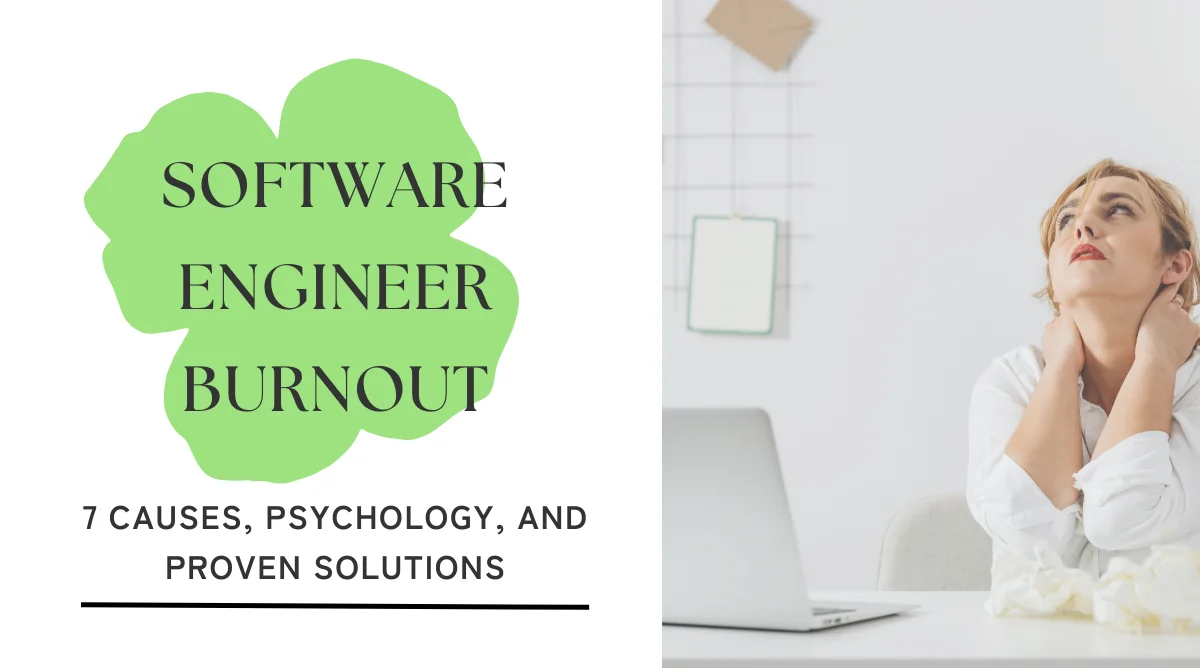
Many software engineers find themselves thinking, “Work has been really tough lately” or “I’m not sure if I can keep doing this” Long working hours, tight deadlines, and the constant pressure to keep up with new technologies—these challenges reflect systemic issues across the industry, not just individual problems.
This article draws on survey data from Japan’s Ministry of Health, Labour and Welfare to objectively analyze the reality of software engineer burnout and provide concrete solutions.
- Why software engineer burnout is an industry problem, not weakness.
- Six practical strategies to reduce stress and regain balance at work.
- Essential skills to stay valuable and avoid burnout in the AI era.

1. Software Engineer Burnout Is a Legitimate Concern

There’s an important fact that every engineer struggling with burnout should understand first.
Engineer Fatigue Is Not a Sign of Weakness
According to the Ministry of Health, Labour and Welfare’s 2023 Survey on Industrial Safety and Health, 10.4% of all workplaces across industries reported having employees who took leave for one month or longer due to mental health issues in the past year.
Multiple studies have indicated that this figure tends to be even higher in the IT industry due to stress factors unique to the field.
There is growing recognition that software engineer burnout is a legitimate issue deserving societal acknowledgment. Understanding of mental health challenges among engineers is deepening across the industry as a whole.
2. Understanding Software Engineer Burnout Through Data
To understand the reality of engineer burnout, let’s examine objective data on working conditions across the industry.
Working Conditions in the IT Industry: Insights from Government Surveys
According to the Ministry of Health, Labour and Welfare’s “Survey on Promoting Work-Life Balance in the IT Industry,” reducing long working hours has been identified as a critical challenge in the IT sector.
While many companies are actively implementing systems to accurately track working hours, fewer are proactively adopting work interval systems (mandatory rest periods between shifts).
This suggests that while time management is improving, ensuring adequate rest for workers remains a significant challenge.
The Reality of Overtime and the Roots of Anxiety
According to a 2024 survey by Geekly, a staffing service specializing in IT engineers, the average monthly overtime across all job categories was 21.0 hours. However, many cases in the IT industry significantly exceed this average. Infrastructure consultants, for example, recorded 39.4 hours of overtime per month—nearly double the overall average.
The survey also revealed that the top career concern among IT engineers is “my skills and technical knowledge becoming obsolete.” The most common anxiety engineers felt during job hunting was “whether I’ll fit in at my new workplace”
These findings show that engineer anxiety stems not only from working conditions but also from psychological factors: fear of being unable to keep pace with rapid technological advances and a lack of confidence in one’s own abilities.
■Related Reading
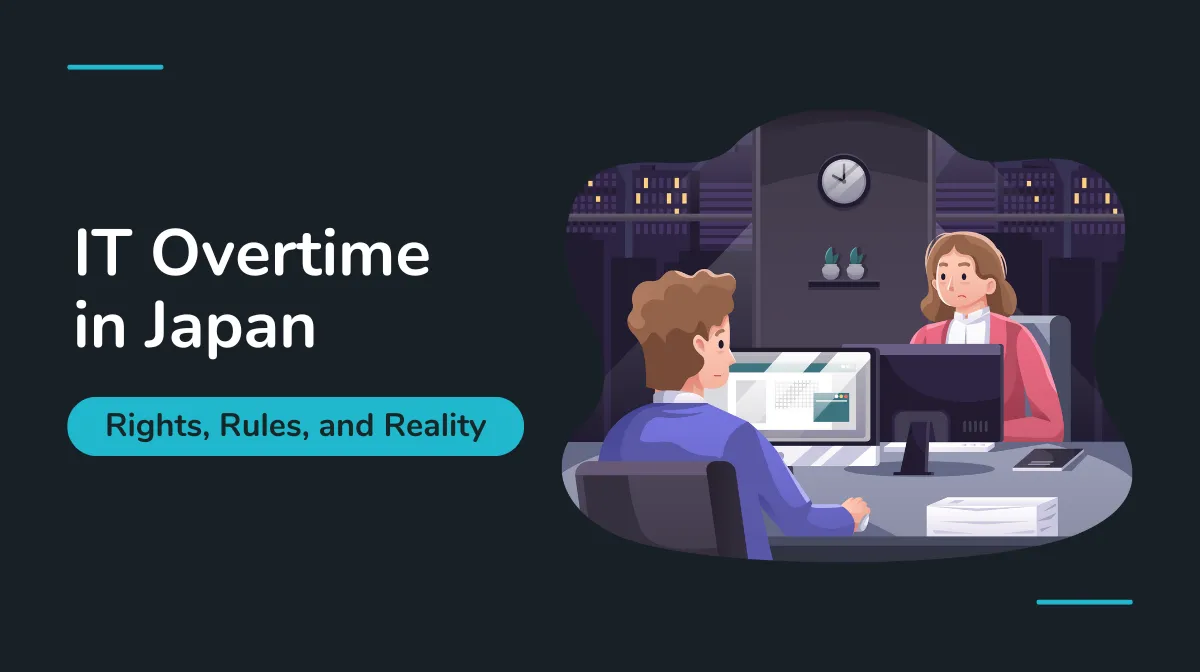
Understanding overtime regulations is crucial for managing work-life balance in Japan’s IT industry. Learn about your legal rights and how companies are addressing overtime concerns.
3. 7 Real Reasons Behind Software Engineer Burnout
Engineer Burnout: 7 Real Reasons
Structural and psychological factors behind quitting.
BURNOUT CORE
Long Hours / Overtime (150h+)
Intense Deadline Pressure
Endless Tech Catch-Up
Lack of Fair Recognition
Relationship / Communication Stress
Future Anxiety (AI Threat)
Expectation vs. Reality Mismatch
Behind engineer burnout lies a complex interplay of industry-specific structural problems and personal psychological factors.
Long Working Hours and Weekend Work
IT engineers tend to work significantly more overtime than those in other industries. In severe cases, some engineers report working 150 hours of overtime per month for extended periods.
This stems from the nature of engineering work, which is “complete only when deliverables are shipped.” Deadlines are absolute, and engineers carry the heavy responsibility of delivering on time regardless of circumstances.
Intense Deadlines and Pressure
In engineering work, missed deadlines can lead to serious consequences like compensation claims, creating a constant burden of “meeting the deadline no matter what.
” Unexpected issues arise routinely in development projects, and each time, engineers find themselves in situations where they “can’t leave until it’s fixed”
Many engineers still say, “There’s never a time without deadline pressure. As long as you’re an engineer, you’ll deal with it your entire career.” This remains an industry-wide challenge.
The Never-Ending Need to Keep Up with Technology
The industry mantra that “engineers must keep learning for life” places a heavy psychological burden on many professionals. In the IT industry, it’s not unusual for a technology trend from six months ago to already be outdated.
Engineers report encountering new technologies every week and having to rapidly cycle through catching up, mastering, and implementing new skills over and over.
This learning pressure extends beyond regular working hours into evenings and weekends, blurring the line between work and study. Many engineers find themselves unable to secure true rest time.
Lack of Fair Recognition
Technical achievements are often invisible. Important contributions like system stability, performance improvements, and security enhancements don’t translate into clear numbers like sales figures, leading to frequent cases of inadequate recognition.
IT engineers are notably more likely than other professionals to let critical attitudes toward their organization drive them to change jobs. The fact that “higher income” ranks as the top reason for job changes underscores the severity of this issue.
Interpersonal Relationships and Communication
One particularly serious issue is the working arrangement known as “on-site contracting” (客先常駐), where engineers work at client offices rather than their own company.
A study of IT engineers who took leave for one month or more due to mental health issues and then returned to work found that in all cases, the trigger for their mental health problems occurred while they were working on-site at client locations.
Additionally, communication gaps tend to emerge between engineers and non-engineers due to differences in technical knowledge and thought processes.
Engineers frequently face situations where their explanations of technical challenges are not understood or they receive unreasonable requests—all of which become significant sources of stress.
Future Anxiety: Questioning One’s Value in the AI Era
It is said that 35.2% of engineers predict that more than half of their work will be replaced by AI within four years.
The top career concern among IT engineers is “my skills and technical knowledge becoming obsolete,” revealing that fear of losing one’s value due to technological advancement is their greatest worry.
With the emergence of code-generation AI, automation of simple programming tasks is advancing, gradually encroaching on traditional engineering territory.
Mismatch Between Expectations and Reality
Many engineers enter the field with high ideals like “I want to change the world with new technology” or “I want to create innovative services” In reality, however, much of the work involves maintaining and operating legacy systems, repetitive tasks, and projects that offer little technical challenge.
This is especially true for companies at the lower tiers of Japan’s multi-layered subcontracting structure, where engineers often have no involvement in upstream design or planning and instead focus on routine coding and testing work.
■Feeling Overwhelmed? Let Us Help You Find a Better Work Environment
If these burnout factors resonate with your current situation, it might be time to explore opportunities with companies that prioritize employee wellbeing and offer supportive work cultures.
BLOOMTECH Career for Global specializes in connecting foreign IT engineers with Japanese companies that value work-life balance, professional growth, and fair recognition. Our bilingual career advisors understand the challenges you face and can help you find positions where your skills are truly appreciated.
▼Contact BLOOMTECH Career for Global here
4. The Psychology Behind Software Engineer Burnout
Behind the burnout engineers experience lies a complex interplay of occupation-specific psychological traits and social factors.
The Perfectionism Trap: A Cycle of Self-Denial
Engineering work inherently lacks a clear endpoint where one can say, “There’s nothing more to do.” For engineers with strong professional standards and passion for technology, the thought “I could make this even better” can become relentless.
When this happens, work never feels finished, ultimately leading to long hours and mental exhaustion.
Perfectionists tend to perceive a large gap between their ideal self and reality. Even when achieving objectively excellent results, they feel “it’s still not enough” and easily fall into self-denial.
Imposter Syndrome: “I’m a Fraud”
A particularly prevalent psychological issue in the engineering industry is imposter syndrome.
This refers to a psychological state where, despite having real abilities and receiving high praise from others, individuals feel “I’m a fraud” or “I’m deceiving everyone around me.”
Imposter syndrome is especially common among engineers because the rapid pace of technological change creates constant pressure to keep learning, making it easy to develop the feeling that “my knowledge isn’t enough” When caught in imposter syndrome, fear that “failure will expose my incompetence” leads to hesitation about new projects or technologies, creating a vicious cycle of missing growth opportunities.
Unfulfilled Need for Recognition and Declining Self-Efficacy
At the heart of engineer burnout lie psychological issues of unmet recognition needs and declining self-efficacy. Technical achievements are often invisible—important contributions like system stability and performance improvements don’t translate into clear numbers like sales figures.
The rapid pace of technological change means hard-won skills can become obsolete in a short time, making it easy to feel “my abilities have become outdated” When these psychological issues combine, even engineers with objectively sufficient abilities can fall into a thought loop of “I’m worthless,” experiencing severe burnout.
■Related Reading
If you’re experiencing severe burnout symptoms, it might be time to consider new opportunities. Discover how to evaluate when a job change is necessary and make the transition successfully.

■日本でエンジニアとしてキャリアアップしたい方へ
海外エンジニア転職支援サービス『 Bloomtech Career 』にご相談ください。「英語OK」「ビザサポートあり」「高年収企業」など、外国人エンジニア向けの求人を多数掲載。専任のキャリアアドバイザーが、あなたのスキル・希望に合った最適な日本企業をご紹介します。
▼簡単・無料!30秒で登録完了!まずはお気軽にご連絡ください!
Bloomtech Careerに無料相談してみる
5. Six Strategies to Combat Software Engineer Burnout at Your Current Job
6 Strategies to Combat SE Burnout
Improve your current work environment now.
COMMUNICATE OBJECTIVELY
CREATE TIME & SPACE
EFFICIENT LEARNING
BUILD CONFIDENCE
NEGOTIATE CONDITIONS
SELF-CARE & HEALTH
Here are concrete ways to improve your current work environment, presented in order of ease of implementation.
■Ready to Take Control of Your Career? We’re Here to Support You
While improving your current situation is valuable, sometimes the best solution is finding a company that aligns with your values from the start. BLOOMTECH Career for Global provides comprehensive support throughout your job search journey—from identifying companies with healthy work cultures to preparing for interviews and securing work visas. Our extensive network includes organizations actively seeking global talent and committed to creating supportive environments where engineers can thrive without sacrificing their wellbeing.
▼Contact BLOOMTECH Career for Global here
【STEP 1】Don’t Suffer Alone—Communicate Your Situation Objectively
Not keeping your struggles to yourself and seeking appropriate help is the first step toward solving problems. Preparation is key to successful consultation.
Organize the specific problems you’re facing and analyze their scope of impact. Instead of “I’m vaguely struggling,” clarify concrete situations like “I’ve been working more than two hours of overtime every day for three consecutive weeks.”
When consulting with a non-engineer supervisor, focus on business impact rather than technical details. Instead of “The deployment process is complicated” explain the problem from a business perspective: “System updates are taking longer than expected, affecting my core development work” Proposing solutions alongside problems can also facilitate constructive discussions.
【STEP 2】Create Time and Mental Space
Lack of time is a major factor in engineer burnout. The most effective efficiency technique for engineers is automating repetitive tasks. Scripting routine work like system monitoring, log analysis, and regular backups can dramatically reduce time spent on these activities.
Examples of tasks to automate
- Deployment and test execution
- Log file organization and analysis
- Regular system checks and backups
The foundation of efficiency is proper task management. Classify tasks by urgency and importance into four quadrants,
- Important and urgent
- Important but not urgent
- Urgent but not important
- Neither urgent nor important
Allocating time to “important but not urgent” tasks helps prevent future problems.
【STEP 3】Revise Your Learning Plan and Leverage Communities
Building an efficient learning strategy is crucial to reducing the pressure of keeping up with technology. A common trap many engineers fall into is “learning for the sake of learning” Rather than insisting on reading technical books from cover to cover, practice “just-in-time learning”—efficiently learning only what you need when you actually need it for work.
Efficient Technology Catch-Up Flow
- Overview (about 15 minutes): Understand the big picture through official documentation or trusted articles
- Hands-on (about 1 hour): Run through a simple tutorial
- Consider practical application (about 30 minutes): Think about how to apply it to your work
- Deep dive: Learn details when you actually use it
Technical communities are valuable resources for dramatically improving learning efficiency. Efficiently gather the latest tech information through Qiita and GitHub Trending, and quickly resolve technical questions on Q&A sites like Stack Overflow and teratail.
【STEP 4】Build Confidence Through Small Wins
To combat imposter syndrome and declining self-efficacy, it’s important to consciously accumulate small success experiences. Develop a habit of recording daily small wins.
Even seemingly minor events like “fixed one bug” “learned to use a new library” or “received thanks from a team member” add up to build confidence over time.
Ways to track your progress
- Write down “three things I learned this week” every week
- Post what you’ve learned on a tech blog or Qiita
- Review your GitHub commit history to appreciate your growth
- Save positive feedback from colleagues
【STEP 5】Negotiate for Better Working Conditions
Learning proper negotiation skills is essential for improving your working conditions at your current job. Negotiating based on objective data rather than emotions increases your persuasiveness. Aim for proposals that benefit the company, not just yourself.
Example comparison
- NG: “I want to reduce overtime”
- OK: “By improving operational efficiency, I can focus on higher-value work”
【STEP 6】Practice Self-Care to Protect Your Physical and Mental Health
Proactive mental health care is essential for dealing with engineer burnout. Identify your specific stress triggers and prepare coping strategies for each. Master techniques for refreshing quickly in short periods.
Clearly separate work and personal life, and consciously secure time to relax.
When self-care isn’t enough, consider consulting a professional. Many companies offer EAPs (Employee Assistance Programs) that provide counseling services.
6. When to Consider a Job Change for Software Engineer Burnout—and How to Succeed
Before making the major decision to change jobs, it’s important to objectively evaluate three options: improving your current situation, taking leave, or changing jobs.
Staying vs. Taking Leave vs. Changing Jobs: Choosing the Right Path
When considering a job change, evaluate whether you can expect technical and career growth at your current job, the possibility of improving working conditions, the likelihood of fair recognition, and alignment with your life plans.
When You Should Prioritize Taking Leave
- Sleep problems or loss of appetite lasting more than two weeks
- Significant decline in concentration at work
- Strong anxiety or depression when thinking about work
Ministry of Health, Labour and Welfare guidelines indicate that with appropriate rest and treatment, employees experiencing mental health issues that affect their work can return to their jobs.
Leave policies are defined in most companies’ work regulations. Start by consulting with HR or your supervisor and arranging an occupational health physician consultation.
During leave, you may be eligible for injury and sickness allowance from health insurance at two-thirds of your standard daily wage for up to 18 months.
■Related Reading
Taking time off is a legal right in Japan. Understanding the parental leave system and paid leave regulations can help you maintain better work-life balance and protect your mental health.

When You Should Hold Off on Changing Jobs
- You’ve been at your job less than a year and haven’t acquired basic skills
- You’re in a temporary busy period and making emotional decisions
- Your reasons for changing jobs aren’t clear
- You’re showing significant symptoms of mental health issues
What a Job Change Can and Cannot Solve
| Can Be Solved by Changing Jobs | Cannot Be Solved by Changing Jobs |
|---|---|
| Improving working conditions | Fundamental personality traits (perfectionism, imposter syndrome, etc.) |
| Expanding technical growth opportunities | Structural problems across the industry |
| Increasing salary and benefits | Fundamental interpersonal and communication issues |
| Changing career paths |
Particular caution is needed when mental health issues are the cause. If the root cause lies in personal psychological traits or industry-wide problems, changing jobs alone may not provide a solution.
Preparation and Strategy for a Successful Job Change
For a successful job change, you need to take inventory of your skills, understand your market value, clarify your reasons for changing jobs, and set career goals. For application materials, focus on completing your resume and preparing your portfolio.
For interviews, practice explaining your reasons for changing jobs and prepare for technical questions.
Key Practices of Successful Job Changers
- Choose timing with market trends in mind
- Apply to multiple companies simultaneously
- Continue learning and producing technical output
The key is to position a job change not as “escaping from the current situation” but as “strategic action toward achieving career goals”
If you have experience taking leave, prepare to explain your reasons for leave, treatment details, current health status, and prevention measures positively during interviews.
■Related Reading
Preparing for technical interviews is essential when changing jobs. Master the coding interview process and learn proven strategies to showcase your skills effectively to potential employers.

7. Avoiding Software Engineer Burnout in the AI Era
Avoiding SE Burnout in the AI Era
COEXIST WITH AI
Human Value Key
Business Discovery / Problem Solv
AI Tool Utilization / Efficiency
System Design / Systematization
Full-Stack Versatility / Specialization
Industry Domain Expertise
As AI technology advances rapidly, here are strategies for building a sustainable engineering career.
Understanding AI Threats Objectively: The Real Risks and Opportunities
While “AI will take engineers’ jobs” is a hot topic, it’s important to first calmly assess the current situation. While more engineers are predicting that more than half of their work will be replaced by AI within four years, in actual AI development settings, human engineers are taking on more important roles.
Scott Wu, CEO of Cognition AI (the U.S. company that developed fully autonomous AI agent “Devin”), strongly disagrees with the “engineers are obsolete” narrative. He states, “Now that we can produce 10 times as much software with AI, engineers are becoming more important than ever”
According to a Ministry of Internal Affairs and Communications survey, Japan’s AI market is projected to triple from ¥40 billion in 2019 to over ¥120 billion by 2025, and demand for AI talent clearly exceeds supply.
Three Essential Skills for Coexisting with AI
The skills required of engineers in the AI era differ from traditional technical skills.
1. Problem Discovery and Business Implementation Skills
Analysis suggests that demonstrating value in upstream processes will become increasingly important for engineers. The ability to accurately understand customer business needs and translate them into technical specifications is becoming more crucial.
AI can automate routine tasks, but discovering problems and proposing solutions through flexible human communication remains firmly in human territory.
2. Understanding and Utilizing AI Technology
Adopting an attitude of “using AI rather than fearing it” is essential. A significant productivity gap is emerging between engineers who effectively use code-generation AI like GitHub Copilot to improve development efficiency and those who stick to traditional methods without AI.
In practice, 60-70% or more of engineers use GitHub Copilot, with 30-40% of recommended code being adopted. Some companies have achieved around 20% productivity improvements.
3. Comprehensive Problem Discovery, Resolution, and Systematization Abilities
While AI can efficiently process existing problems, the ability to discover “what the problem actually is” devise fundamental solutions, and build systems to prevent recurrence remains uniquely human value.
This capability isn’t just technical skill—it’s a combination of business understanding, creativity, and logical thinking.
Long-Term Career Strategy: Balancing Specialization and Versatility
In engineering careers during the AI era, balancing specialization and versatility becomes crucial. First mastering one technology deeply is an essential foundation. Deep expertise creates value that isn’t easily replaceable. However, in the AI era, specializing in just one technology has its limits.
Broadening Your Understanding Across Multiple Technical Areas
Demand is growing for engineers with full-stack knowledge who can handle everything from frontend to backend to infrastructure. While AI makes individual tasks more efficient, the ability to design entire systems and appropriately combine various technical elements becomes even more valuable.
Understanding Non-Technical Domains
Engineers with deep knowledge of specific industries like finance, healthcare, or education can maintain strong competitiveness in the AI era. AI can provide general solutions, but human expertise remains essential for addressing industry-specific challenges and regulations.
Establishing continuous learning habits is also essential, but rather than the traditional “learn every new technology” approach, “just-in-time learning”—efficiently learning when you actually need it for work—becomes more important.
■Related Reading
Building a sustainable career in Japan’s IT industry requires understanding the work environment and growth opportunities available. Explore comprehensive insights into working conditions and career advancement paths.
8. Your Next Step Toward Resolving Software Engineer Burnout
Software engineer burnout is not a sign of weakness—it’s a structural challenge facing the entire industry. What matters is accepting this reality and finding solutions that work for you.
From improving your current situation to changing jobs to preparing for the AI era, take a step-by-step approach and make steady progress. A small step you can take today becomes the starting point for your ideal engineering career.
■Start Your Journey to a Healthier, More Fulfilling Career Today
You don’t have to navigate burnout and career challenges alone. BLOOMTECH Career for Global is dedicated to helping foreign IT engineers find meaningful work in Japan with companies that respect your time, value your contributions, and support your professional growth.
Whether you’re looking to change jobs, need guidance on improving your current situation, or want to prepare for the AI-driven future, our experienced team is ready to provide personalized support every step of the way. Take the first step toward reclaiming your passion for engineering—it only takes 30 seconds to register.
▼Contact BLOOMTECH Career for Global here