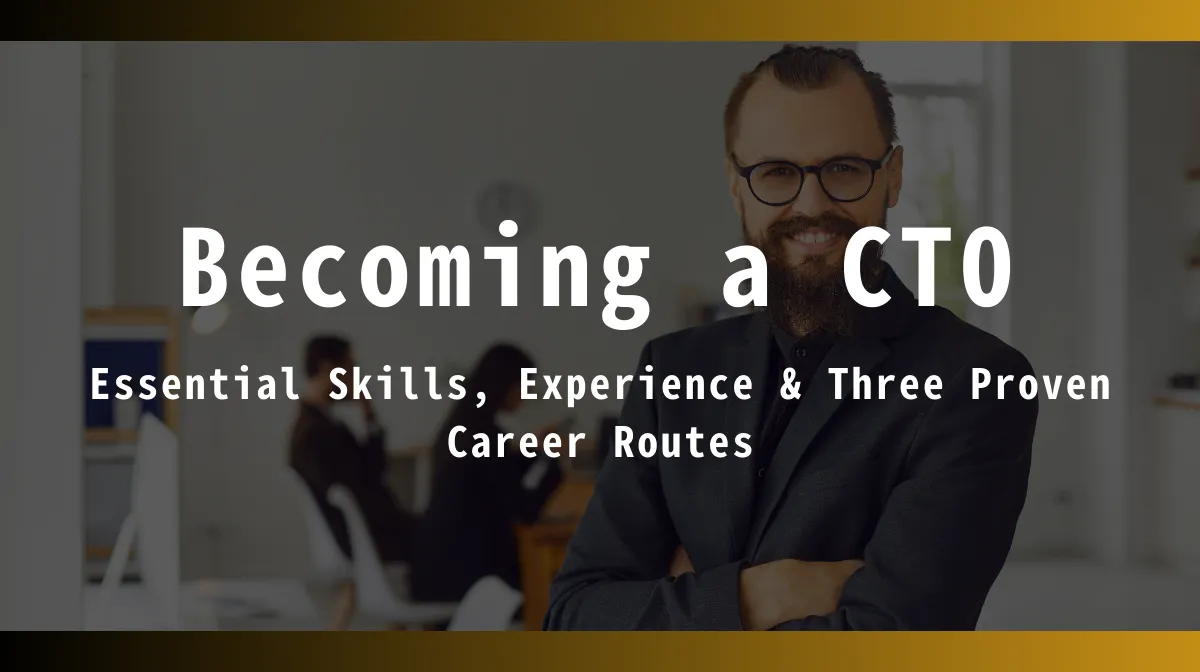
A CTO (Chief Technology Officer) is a crucial executive role that oversees a company’s technology strategy and bridges technology with business management.
As digital transformation (DX) accelerates, the CTO’s role has become increasingly important.
This article provides comprehensive coverage of everything engineers and business leaders need to know about CTOs: from definitions and specific job responsibilities to salary ranges, differences from other executive roles, career paths to becoming a CTO, and essential skills required.
- Discover what a CTO does, required skills, and salary ranges across different company sizes
- Learn three proven career paths to becoming a CTO and the experience needed for each route
- Understand how CTOs differ from CEOs, CIOs, and VPoEs in responsibilities and authority

1.What is a CTO? Definition and Position of Chief Technology Officer in Organizations

A CTO, short for “Chief Technology Officer,” is an executive-level position responsible for overseeing a company’s technology strategy.
As of 2025, 57.3% of Japanese companies have established CTO positions, with particularly high adoption rates in IT/web industries and startups.
This section explains the basic definition of CTO, its prevalence in Japanese companies, and why CTOs are gaining attention now.
Basic Definition of CTO | Meaning of Chief Technology Officer
CTO is an abbreviation for “Chief Technology Officer,” translated in Japanese as “最高技術責任者” (Supreme Technology Officer). As the top technology executive in a company, this role oversees everything from formulating to executing technology strategy.
Legal Position and Practical Role Under Corporate Law
Under Japanese corporate law, CTO is not defined as an official position. In most cases, it’s combined with legal positions such as director or executive officer, established as “Director CTO” or similar titles.
When registered as a director, the person assumes duty of care (Article 330) and duty of loyalty (Article 355) under corporate law.
Difference from Technology Department Head
Though sometimes confused with technology or development department heads, CTOs operate much closer to management and handle technology management (MOT: Management of Technology), which differs significantly.
Rather than simply managing the development site, CTOs make business decisions about how to connect technology to corporate profitability and competitiveness.
CTO Adoption Status in Japanese Companies
According to the “CTO Survey 2025” conducted by the Japan Management Association, CTO adoption rates in Japanese companies have reached 57.3%.
This figure shows an increasing trend year by year, with particularly high adoption rates in IT/web industries and startup companies.
CTO Establishment by Industry and Company Size
By industry, over 80% of information and communications businesses have established CTO positions, while manufacturing and traditional industries remain around 30-40%.
By company size, startups and small-to-medium enterprises often establish CTOs as co-founders, while large corporations typically establish the position later as organizations expand.
Compared to US companies, Japan remains in the adoption phase, but importance is expected to increase further as digitalization accelerates.
(Source: Japan Management Association “CTO Survey 2025”)
Why CTOs Are Gaining Attention Now
Three main factors drive the growing attention on CTOs.
Central Role in DX Promotion
As digital technology becomes a competitive advantage across all industries, integrating technology strategy with business strategy has become essential. CTOs lead this transformation as bridges between technology and management.
Era When Technology Determines Management
Decisions about implementing cutting-edge technologies like AI, cloud computing, and security have become executive-level strategic choices rather than operational-level decisions.
Since technology investment failures can directly threaten company survival, the need for executive leadership with advanced technical knowledge is recognized.
Response to Advanced IT Talent Shortage
According to Ministry of Economy, Trade and Industry research, Japan faces a projected shortage of up to 790,000 IT professionals by 2030.
CTOs capable of recruiting, developing, and cultivating organizational culture among excellent engineers hold the key to winning the talent acquisition competition.
(Source: Ministry of Economy, Trade and Industry “Study Group on Human Resource Policy in the Digital Age”)
2.Main CTO Responsibilities | Three Core Areas of Responsibility
CTO ROLES
CTO responsibilities are diverse but primarily divided into three core areas: “formulating and decision-making on technology strategy,” “managing engineering organizations,” and “bridging with executive leadership.”
This section details the specific duties and roles required in each area.
Technology Strategy Formulation and Decision-Making
The CTO’s most critical responsibility is formulating technology strategies that support company growth and making informed decisions.
Prioritizing Technology Investments
Within limited budgets and resources, CTOs determine which technology areas deserve investment.
For implementing cutting-edge technologies like AI, cloud computing, and security, they comprehensively evaluate not only technical advantages but also business contributions and ROI (Return on Investment).
Technical Risk Management
CTOs predict how system failures and security incidents might impact business operations and implement appropriate countermeasures.
Managing technical debt requires balancing short-term development speed with long-term maintainability.
Developing Technology Roadmaps
CTOs create technology roadmaps looking three to five years ahead, building technical foundations that maintain competitive advantages over time.
Engineering Organization Management
Building organizations that secure and support excellent engineers’ growth is also a core CTO responsibility.
Formulating and Executing Recruitment Strategies
CTOs consistently engage from defining required technical skill sets to selecting recruitment channels and designing interview processes. Particularly in startups, CTOs often directly conduct scouting activities.
Engineer Development and Organizational Culture
CTOs build systems supporting engineers’ career growth from onboarding through continuous skill development.
They shape organizational values promoting technical excellence, learning from failures, and open communication.
Optimizing Team Structure
As products grow, CTOs divide or merge teams to achieve both development efficiency and quality.
Bridging with Executive Leadership
As bridges connecting technology and management, CTOs play crucial roles in management meetings.
Accountability for Technology ROI
CTOs explain how engineering investments translate to business results in terms non-technical executives understand.
Using quantitative indicators like improved development velocity, quality improvements, and cost reductions, they justify technology investments.
Technical Contributions to Business Strategy
CTOs evaluate technical feasibility of new businesses and present technical differentiation points versus competitors.
They propose new businesses based on technology trends and suggest technical approaches for improving and advancing existing businesses.
■Advance Your IT Career to Executive Level in Japan
Already working as an engineer in Japan and ready for the next step? BLOOMTECH Career for Global specializes in helping foreign IT professionals transition to senior and executive roles.
Our bilingual advisors understand your unique position and provide strategic career guidance, company introductions with strong leadership tracks, and negotiation support to help you reach CTO-level positions.
▼Contact BLOOMTECH Career for Global here
3.CTO vs Other Executive Roles | Comparing CEO, CIO, and VPoE
CTO ROLE DEFINITION
While CTOs are part of executive leadership, their roles clearly differ from other positions like CEO, CIO, and VPoE.
Understanding these differences in responsibility scope and authority clarifies the CTO’s unique importance.
This section provides detailed comparisons with each role.
CTO vs CEO | General Management vs Technology Specialization
Both CTOs and CEOs (Chief Executive Officers) are executive positions, but their responsibility scopes differ significantly.
CEO’s Role
CEOs hold final decision-making authority over entire company management, overseeing all management areas including business strategy, finance, human resources, and marketing.
In Japanese companies, “Representative Director and President” often corresponds to CEO, who also serves as the company’s public face.
CTO’s Role and Collaborative Relationship
CTOs are specialists responsible for technology domains. While they hold strong authority in formulating technology strategies and making technology investment decisions, CEOs make final management decisions.
The ideal collaborative relationship involves CTOs providing technical proposals and analyses while CEOs position these within overall company strategy for decision-making.
In startups, technical co-founders commonly serve as CTOs while business-oriented founders serve as CEOs.
CTO vs CIO | Technology Development vs Information Systems Management
Though both CTOs and CIOs (Chief Information Officers) relate to technology, their coverage areas clearly differ.
CTO’s Coverage Area
CTOs handle “product development and technological innovation.” Their main responsibilities include improving technical quality of products and services delivered to customers, research and development of new technologies, and formulating technology strategies that create competitive advantages.
CIO’s Coverage Area
CIOs handle “internal IT and information systems.” They oversee establishing and operating internal business systems, information security, and IT infrastructure—managing information and improving operational efficiency within companies.
Recently, under the Economic Security Promotion Act, CIOs at critical infrastructure operators face requirements for cybersecurity risk management across entire supply chains.
Actual Role Division
Companies with both positions sometimes divide responsibilities as CTOs handling “offensive IT” and CIOs handling “defensive IT.”
However, in small-to-medium enterprises and startups, one person often handles both CTO and CIO roles.
CTO vs VPoE | Strategy vs Execution
VPoE (Vice President of Engineering) is one of the most confusing roles to distinguish from CTO.
CTO’s Role: What
CTOs decide technology’s “What.” They make strategic decisions about which technologies to adopt, what technology stack to use for development, and what long-term technology vision should guide the company.
VPoE’s Role: How (Execution)
VPoEs handle engineering’s “How (execution).” They specialize in operating engineering organizations, including improving development processes, enhancing team productivity, project management, and recruitment and training.
Usage Based on Salary and Organization Size
Generally, CTOs tend to earn higher salaries. While VPoE salary ranges from ¥12-20 million, CTOs typically earn ¥15-25 million.
In small startups, CTOs handle both roles, but as organizations grow beyond 50 engineers, companies increasingly separate CTO and VPoE positions.
Relationships with Other CxO Roles
CTOs also collaborate with other CxOs (Chief X Officers) to support company management.
Main Collaborative Relationships:
- COO (Chief Operating Officer): Cooperating on business operation efficiency
- CFO (Chief Financial Officer): Coordinating technology investment budget planning
- CPO (Chief Product Officer): Discussing product direction
- CMO (Chief Marketing Officer): Exploring marketing utilization of technical differentiation points
Through such cross-functional collaboration, systems are built where technology contributes to company-wide value creation.
4.CTO Roles by Company Size and Growth Phase

CTO roles change significantly with company growth stages.
During startup phases, CTOs are playing managers who write code themselves; during growth phases, they focus on scaling organizations; in mature phases, they oversee large organizations and deeply engage with management.
This section explains specific CTO roles and required abilities at each phase.
Startup Phase (Founding to Seed/Early Stage) CTO
Early-stage CTOs must stand at the development frontlines as playing managers.
Hands-On Development
At this stage, with only a few engineers, CTOs actively write code while building initial product versions.
Technology Selection and Initial Design
Technology selection and initial architecture design are critical decisions affecting future scalability.
Balance is required in choosing technology stacks that are currently feasible while anticipating future growth.
Co-Founder Role
In many startups, business-focused CEOs and technology-focused CTOs launch ventures together.
They participate in fundraising pitches and investor dialogues, explaining technical feasibility and scalability.
Initial Team Recruitment
Since engineers gathered during founding create cultural foundations, recruitment emphasizes value alignment alongside technical skills.
Growth Phase (Series A-C) CTO
During growth phases, CTO roles shift from “building themselves” to “building through organizations.”
Scaling Development Organizations
As engineers grow from 10 to 50 and then 100, team structure reorganization, manager layer development, and development process standardization become necessary.
CTOs reduce time spent writing code, allocating time to organizational design and management.
Managing Technical Debt
Parts developed prioritizing speed during founding can become bottlenecks during scaling.
Repaying technical debt without stopping business growth requires planned refactoring and balancing with new development.
Recruitment and Branding
CTOs develop systematic recruitment activities including collaboration with dedicated recruiters, creating referral recruitment systems, and increasing recognition through technical public relations.
Through operating technical blogs, speaking at conferences, and contributing to OSS, they build company images attracting excellent engineers.
Mature Phase (Pre-IPO to Large Enterprise) CTO
In mature phases, CTOs assume more management-oriented roles as large organization leaders.
Large Organization Oversight
Overseeing engineering organizations exceeding 100 people requires delegating authority to multiple VPoEs and department heads while showing overall direction.
Though distance from development sites increases, CTOs maintain ultimate responsibility for important technical decisions.
Governance and Compliance
Public companies require establishing information security systems, building internal controls, and responding to audits—meeting legal compliance and shareholder accountability.
M&A and Technology Standardization
CTOs evaluate technical assets of acquisition targets and formulate post-integration system integration plans. They organize technology stacks held by multiple business divisions and subsidiaries, balancing efficiency with governance.
Innovation Creation
CTOs promote measures for continuous innovation, preventing organizational stagnation through new technology demonstrations, internal venture systems, and collaborative research with external parties.
■日本でエンジニアとしてキャリアアップしたい方へ
海外エンジニア転職支援サービス『 Bloomtech Career 』にご相談ください。「英語OK」「ビザサポートあり」「高年収企業」など、外国人エンジニア向けの求人を多数掲載。専任のキャリアアドバイザーが、あなたのスキル・希望に合った最適な日本企業をご紹介します。
▼簡単・無料!30秒で登録完了!まずはお気軽にご連絡ください!
Bloomtech Careerに無料相談してみる
5.CTO Salary Ranges | Compensation Structures and Determining Factors
CTO Compensation Range
CTO salaries vary significantly by company size, industry, and degree of management involvement.
Ranges include ¥8-15 million for startups, ¥12-20 million for mid-sized companies, and ¥20-35 million for large enterprises.
This section details salary ranges, factors determining compensation, and stock option mechanisms.
Salary Ranges by Scale and Industry
CTO salaries vary greatly depending on company scale and industry.
Salary by Company Size
Startup Companies (under 50 employees)
- Salary Range: ¥8-15 million
- Characteristics: Conservative base pay with future returns expected through stock options
Mid-Sized Companies (50-500 employees)
- Salary Range: ¥12-20 million
- Characteristics: Stable revenue foundations with substantial base pay and bonuses
Large Enterprises (500+ employees)
- Salary Range: ¥20-35 million
- Characteristics: Systematic design based on executive compensation regulations, incorporating performance-linked bonuses and stock compensation
Foreign IT Companies
- Salary Range: ¥30+ million
- Characteristics: High compensation aligned with US headquarters standards
Comparison with General Engineers
According to the Ministry of Health, Labour and Welfare’s “Basic Survey on Wage Structure” (2023), average programmer salaries are approximately ¥4.25 million, while system engineers average about ¥5.68 million.
CTOs earn 2 to 6 times these occupation levels.
(Source: Ministry of Health, Labour and Welfare “Basic Survey on Wage Structure“)
Five Elements Determining Compensation
1. Depth and Breadth of Technical Expertise
Both deep expertise in specific technology domains and comprehensive full-stack understanding of broad technologies are valued.
CTOs with specialized knowledge in high-demand fields like AI or security tend to command higher compensation.
2. Degree of Management Involvement
CTOs participating as board directors in management meetings and engaging in business strategy formulation are valued more highly than those merely overseeing technology departments.
3. Organization Size and Management Scope
Leading 10-person teams versus overseeing 100-person organizations requires different management capabilities. Larger numbers of managed people and budget sizes correlate with higher compensation.
4. Industry and Business Phase
High-growth IT/web industries and startups with successful fundraising tend to offer higher compensation.
5. Company Financial Status and Growth Potential
Highly profitable companies with anticipated future growth can offer higher compensation to CTOs.
Stock Options and Equity Compensation Mechanisms
Particularly in startups and private companies, stock options (company stock purchase rights) comprise important compensation components.
How Stock Options Work
These are rights to purchase shares at predetermined prices when companies go public or get acquired through M&A. If companies succeed and stock prices rise, values can reach tens to hundreds of millions of yen.
Long-Term Incentives Through Vesting
“Vesting”—where rights gradually accrue over several years—is common. This prevents CTOs from leaving shortly after joining, promoting long-term commitment.
Proportion of Total Compensation
In startups, base pay and stock option expected values are roughly equal, or stock options can be larger. In mature companies, base pay and bonuses are central, with stock compensation playing supplementary roles.
Salary Differences from General Engineers
Viewing salary progression by career steps, new graduate engineers start around ¥4 million, senior engineers at ¥6-8 million, engineering managers at ¥8-12 million, and CTOs at ¥10+ million in typical step-wise increases.
Reaching CTO typically requires 10-15 years of career experience.
■Find Companies That Value Your Leadership Potential
If you’re a mid-level or senior engineer in Japan looking to step into management or executive roles, BLOOMTECH Career for Global can connect you with companies actively seeking foreign talent for leadership positions.
We work exclusively with organizations that offer clear career progression, competitive executive compensation, and international work cultures where you can thrive as a technical leader.
▼Contact BLOOMTECH Career for Global here
6.Three Career Paths to Becoming a CTO

Three main routes lead to becoming a CTO: gradual promotion within current companies, transferring or being headhunted into CTO positions, and founding companies or joining startups.
Each route has unique advantages and challenges, with optimal paths depending on individual situations and career visions.
Route 1: Promotion Within Current Company
The most common career path involves gradually advancing within existing companies to reach CTO positions.
Typical Promotion Route
Climbing steps from Engineer → Tech Lead → Engineering Manager → VP of Engineering → CTO.
Spending 2-3 years at each step suggests approximately 10-15 years of career development is necessary.
Advantages of This Route
Becoming CTO with deep understanding of company business content and organizational culture. Additionally, established internal trust relationships facilitate smooth collaboration with executive teams and other departments.
Points for Increasing Internal Evaluation
Beyond technical achievements, clearly demonstrating business contributions is important.
Engineers who show results through business metrics like revenue increases, cost reductions, and user satisfaction improvements tend to advance more easily. Building relationships with executive leadership is also essential.
Route 2: CTO Position Transfer or Headhunting
Transferring to other companies’ CTO positions or being headhunted is another method.
Job Market Demand
CTO demand is increasing. Particularly startups and rapidly growing companies actively recruit experienced CTOs capable of establishing or scaling technology organizations.
Characteristics of Scouted Talent
Key characteristics:
- CTO/VPoE experience at well-known companies
- Large-scale organizational management track records
- High expertise and recognition in specific technology domains
- External achievements like technology conference presentations and OSS activities
Utilizing Recruitment Agencies
Registering with high-class/executive-focused agencies is effective.
General job sites have few CTO position listings, with most opportunities coming through agent referrals as non-public listings.
Interview Evaluation Points
Evaluations cover not only technical depth but also management perspectives, communication abilities, and cultural fit.
Being able to explain past achievements with specific numbers and articulate lessons from failures is valued.
Route 3: Founding Companies or Joining Startups
Founding companies and becoming CTOs as co-founders, or joining early-stage startups as technology leaders.
CTO as Co-Founder
Partnering with business-focused CEOs, handling all product development. Technically validating business idea feasibility and developing initial products personally. Holding appropriate equity stakes as founding members.
Formal Appointment from Technical Advisor
Starting as advisors providing technical advice 1-2 days weekly, then formally joining as full-time CTOs as businesses grow. This approach allows risk mitigation while confirming company fit.
Early-Join Advantages
Designing organizational culture and technical foundations from founding stages personally. Regarding stock option grants, advance consideration of future exercise conditions and tax treatments is practically important.
Risk and Return Considerations
Startups have high failure rates and lower salary levels compared to stable large enterprises. However, success returns (financial and experiential) are very large, with high management involvement degrees offering significant fulfillment.
Is Becoming a CTO Possible Without Experience?
From conclusions, becoming a CTO without experience is extremely difficult. CTOs require essential hands-on technical experience, with minimum 5-10 years engineering practice and 3+ years management experience needed.
While nominally becoming CTOs as small startup co-founders is possible, fulfilling substantive roles requires appropriate skills and experience.
External CTO/advisor options exist, allowing experience accumulation while supporting multiple companies.
■Related Reading
Career advancement strategies for software engineers mirror the CTO career path in many ways. Discover proven roadmaps from entry-level positions to executive leadership roles in Japan’s tech industry.
7.Five Essential Skills and Experience Required for CTOs
CTO 5-CORE SKILLS
Required Experience Guidelines
CTOs require not only technical skills but also five key competencies: business/management understanding, organizational management, communication skills, and problem-solving abilities.
This section explains why each skill matters and how to acquire them, including practical experience benchmarks.
Skill 1: Broad Technical Knowledge and Architecture Design Capabilities
CTOs need broad technical knowledge spanning entire systems, not just specific technology domains.
Understanding Frontend, Backend, and Infrastructure
For web applications, understanding user interfaces, server-side logic, database design, and network configurations—grasping complete pictures—is necessary.
While deeply implementing everything isn’t required, knowledge enabling equal discussions with specialists in each domain is essential.
Staying Current with Cloud, AI, and Security Trends
Understanding characteristics of cloud services like AWS, Azure, and GCP; potential machine learning and AI applications; and cybersecurity risks and countermeasures requires constant technology trend monitoring and judging applicability to own companies.
Technology Selection Criteria
Rather than just “new” or “trendy,” multifaceted evaluations considering long-term maintainability, team proficiency, costs, and compatibility with existing systems are necessary.
System Architecture Design Capabilities
Designing to meet non-functional requirements like scalability, availability, security, and performance determines systems’ long-term success.
Skill 2: Management and Business Understanding
Technical skills alone are insufficient; understanding management and business significantly influences CTO value.
Reading Financial Statements
Essential as executive team members. Understanding company financial situations through income statements, balance sheets, and cash flow statements enables judging appropriate timing and scales for technology investments.
Alignment with Business Strategy
Even technically superior solutions are meaningless without contributing to business objectives. Constantly being conscious of “how this technology investment leads to revenue increases or cost reductions” is necessary.
Calculating Technology ROI
Quantitatively demonstrating development costs, operational costs, and expected revenue or efficiency improvement effects. Decision-making and explanation based on “business value” rather than “technical interest” is required.
Market and Competitive Analysis Capabilities
Objectively evaluating companies’ technical strengths and weaknesses, clarifying differentiation points versus competitors. Understanding industry-wide technology trends and supporting companies’ market positioning from technical perspectives.
Skill 3: Organizational Management and Leadership
Overseeing engineering organizations from dozens to hundreds requires advanced management skills.
Designing and Implementing Recruitment Interviews
Defining required skill sets for companies and building interview processes to identify them.
CTOs often conduct final interviews, evaluating not only candidates’ technical abilities but also cultural fit and growth potential.
Development Through One-on-Ones
Understanding members’ career goals and supporting growth. Providing not only technical advice but also empathizing with career concerns, developing talent from long-term perspectives.
Forming Technical Organizational Culture
Clarifying and practicing organizational values promoting technical excellence, failure-embracing challenge cultures, and open communication.
Team Motivation Management and Conflict Resolution
Enhancing engineer retention through appropriate evaluation systems, growth opportunities, and comfortable workplace environments.
When conflicts arise within teams or with other departments, calmly analyzing situations and finding constructive solutions.
Skill 4: Communication and Presentation Skills
CTOs require abilities to clearly convey complex technical content to people without technical understanding.
Explaining Technology to Non-Engineers
Particularly important in management meetings and board sessions. Making technical proposals and reports from business impact perspectives while avoiding jargon.
For example, rather than “migrating to microservices architecture,” explanations like “dividing systems doubles development speed and limits failure impact scopes” prove more effective.
Management Meeting Presentations
Skills conveying key points concisely within limited time are required. Using data and charts effectively, providing necessary decision-making information without excess or deficiency.
Stakeholder Coordination Capabilities
Listening to requests from various departments like sales, marketing, and customer support; balancing with technical constraints while deciding priorities. Sometimes requiring courage to clearly say “we cannot do this.”
Document Creation Abilities
Logically creating various documents including technical proposals, budget applications, and business reports. Recording decision-making processes so reasons for judgments remain clear for future reference is also important.
Skill 5: Problem-Solving and Flexible Thinking
CTOs daily face complex problems without clear answers. Making optimal judgments within these situations requires specific abilities.
Trade-Off Judgments
Maximizing quality, speed, and cost simultaneously is impossible. Where to place emphasis differs depending on business phases and market environments.
Judgment balancing risks of delayed market entry from perfectionism versus losing user trust from quality deficiencies is necessary.
Handling Uncertainty
Complete information rarely exists when deciding on new technology adoption.
Making decisions while reducing uncertainty through experimental approaches and prototyping with limited information and risk evaluation.
Crisis Management and Risk Management
Predicting various risks like system failures, security incidents, and key member departures; implementing advance countermeasures. Also requiring rapid decision-making and responses when problems actually occur.
Balancing Strategic Thinking and Execution
Drawing long-term visions while addressing immediate challenges. Pursuing ideals while accepting realistic constraints. Such flexible thinking enhances CTO effectiveness.
Required Years and Content of Practical Experience
Practical experience benchmarks necessary for becoming CTOs:
Required Practical Experience:
- Engineering practice: Minimum 5-10 years (comprehensive experience from design through review to operations)
- Management experience: 3+ years (recruitment, development, evaluation, project management)
- Complete product development process experience: From requirements definition through operations and maintenance
- Multiple technology stack and domain experience: Holding broad perspectives
8.CTO Hiring and Appointment Criteria | Guide for Business Leaders and HR Managers

For business leaders and HR managers, “when to establish CTO positions,” “full-time employees vs external CTOs,” and “how to screen candidates” are important judgment points.
This section explains CTO establishment judgment indicators, choosing employment formats, and points to evaluate in interviews and selection from practical perspectives.
When Should CTOs Be Appointed? Three Judgment Indicators
CTO position establishment timing varies by company growth stages and business characteristics, but three main judgment indicators exist:
Indicator 1: Engineering Teams Exceed 20 People
At this scale, dedicated leaders responsible for overseeing entire technology departments and formulating technology strategies become necessary.
While VPoEs or engineering managers can manage until then, larger organizations inevitably require talent capable of making management-level technical judgments.
Indicator 2: Technical Decisions Influence Management Results
When product quality and development speed directly impact sales and customer satisfaction, positioning technology at management cores becomes necessary.
For SaaS companies, platform businesses, manufacturing DX promotion, and other cases where technology serves as competitive advantage sources, CTO establishment is strongly recommended.
Indicator 3: Technical Debt Obstructs Business Growth
When system aging, frequent failures, and development speed declines manifest, fundamental technology strategy reviews become necessary.
Establishing CTOs enables creating technical debt repayment plans and building sustainable development systems.
According to Japan Management Association research, higher-performing companies show higher CTO establishment rates, indicating technology-management collaboration contributes to corporate results.
(Source: Japan Management Association “CTO Survey 2025”)
Choosing Between Full-Time CTOs vs External CTOs (Advisors/Spot)
Methods for securing CTOs include hiring as full-time employees or contracting as external CTOs/advisors. Understanding advantages and disadvantages of each enables informed selection.
Comparing Full-Time and External CTOs
Full-Time CTO Advantages and Disadvantages
Advantages:
- Full commitment dedicated to company growth
- Enables organizational culture formation and long-term technology strategy promotion
- Deep management involvement including management meeting participation
Disadvantages:
- Annual personnel costs exceeding ¥20 million
- Difficult and time-consuming recruitment
- Resolving mismatches is challenging
External CTO/Advisor Advantages and Disadvantages
Advantages:
- Access to specialized knowledge for approximately ¥0.5-1.5 million monthly
- Access to experienced talent observing multiple companies
- Flexible contract formats enabling easy trials
Disadvantages:
- Approximately 1-2 days weekly involvement limits deep organizational operations
- Separate talent needed for daily development management
- Difficult obtaining long-term commitments
Cost Comparison
Full-time CTOs cost ¥20-30 million annually (including salary, benefits, stock options) while external CTOs cost approximately ¥0.5-1.5 million monthly, ¥6-18 million annually.
Suitable Company Phases
Companies Suited for External CTOs:
- Early-stage startups with limited budgets
- Companies with limited technical challenges wanting specialized advice
- Companies struggling with full-time CTO recruitment
Companies Recommended for Full-Time CTOs:
- Companies with engineering organizations exceeding 30 people
- Companies where technology is core competitiveness
- Companies preparing for IPO requiring governance system establishment
Actual Use Cases
Increasing numbers of companies initially engage external CTOs, then recruit them as full-time CTOs as businesses grow and organizations expand.
Five Points to Evaluate in Interviews and Selection
CTO candidate interviews should focus intensively on these five points:
Point 1: Technical Depth and Breadth
Ask candidates to discuss past project involvement, technical selection reasoning, challenges faced, and resolution methods specifically.
Asking not just “what was built” but “why that technology was chosen” and “what trade-offs were considered” reveals thinking depth.
Point 2: Management Perspective Presence
Effective questions include “How do you prioritize technology investments?” and “How do you handle technically excellent but business-questionable proposals?”
Evaluate whether judgments consider not only technical correctness but also business contributions.
Point 3: Communication Abilities
During interviews, confirm whether candidates can explain complex technical content understandably to non-engineer interviewers.
Also ask about handling opinion conflicts and team conflict resolution experience to evaluate interpersonal skills.
Point 4: Cultural Fit with Company
Determine whether candidates’ values, work styles, and decision-making styles match company cultures. Poor cultural fit risks early departures even with high capabilities.
Point 5: Past Achievements and Learning from Failures
Ask not only about successes but also failure experiences and lessons learned. People openly discussing failures and growing from them tend to demonstrate adaptability in new environments.
CTO Recruitment Cautions
CTO recruitment requires attention to several pitfalls:
Key Cautions:
- Excessive technology bias: Value not only technical skills but also management perspectives and communication abilities
- Distance from workplaces: Balance understanding executive roles while grasping on-site realities
- Short-term vs long-term orientation: Balance delivering immediate results with building long-term technical foundations
9.Five Actions to Start Today for Aspiring CTOs
CTO ROADMAP: 5 ACTIONS
Becoming a CTO requires not only acquiring technical skills but also learning management knowledge, accumulating leadership experience, building human networks, and setting clear career visions.
This section introduces five specific actions you can implement starting today.
Action 1: Inventory Technical Skills and Identify Gap Areas
The first step toward becoming a CTO is accurately understanding your current position.
Creating Self-Evaluation Sheets
Evaluate your skill levels across major technology domains including frontend, backend, infrastructure, databases, security, and AI/machine learning.
Classify into stages like “experienced in practical use,” “understand basic concepts,” and “completely unfamiliar.”
Visualizing Strengths and Weaknesses
This clarifies which domains to strengthen and which to supplement. CTOs need both deep expertise in specific domains and broad knowledge enabling system-wide perspectives.
Prioritizing Learning
Prioritize technology domains directly relating to company businesses while watching future-necessary technology trends (AI, cloud native, security, etc.).
Perfect mastery of everything isn’t necessary; balance “broad and shallow” with “narrow and deep.”
Action 2: Learning Roadmap for Acquiring Management Knowledge
Technical skills alone are insufficient; systematically learning management and business knowledge is necessary.
Whether to Pursue MBA
Not mandatory, but effective means for systematic management learning. Given time and cost constraints, increasing numbers choose weekend, evening, or online MBA programs.
Conversely, some argue learning through practical experience is more effective, requiring judgments based on individual situations.
Recommended Books
Books addressing technology-management intersections like “Management for Engineers,” “Technology Management,” “Lean Startup,” and “HIGH OUTPUT MANAGEMENT” prove useful.
Also acquire general business knowledge including reading financial statements, marketing basics, and organizational theory.
Utilizing Online Courses
Platforms like Coursera and Udemy offer foundational courses in management strategy, finance, and marketing.
Short intensive programs provided by Japanese business schools like Globis also offer options.
Action 3: Accumulating Leadership Experience Internally and Externally
Management skills aren’t acquired through classroom learning but polished through practice.
Small Team Leadership Experience
Volunteer to lead 3-5 person project teams in current workplaces, experiencing management basics like task management, progress reporting, and member development.
Hosting Technical Study Sessions
Planning and operating internal study sessions enables demonstrating leadership in gathering people, creating spaces, and sharing knowledge. Presenting also polishes presentation skills.
Contributing to OSS Communities
Contributing code or maintaining documentation for open source projects enables involvement with global engineering communities.
This not only enhances technical credibility but also provides collaborative experience with people from diverse backgrounds.
Disseminating Through Technical Blogs and Presentations
Sharing technical insights through blogs and conferences increases external recognition. This connects to future CTO transfer opportunities and headhunting possibilities.
Action 4: Building Human Networks
As careers progress, “who you know” becomes increasingly important.
Participating in CTO Exchange Meetings and Communities
Joining organizations like Japan CTO Association and regional CTO/VPoE communities enables information exchange with peers. Understanding what challenges other companies’ CTOs face and how they resolve them significantly contributes to personal growth.
Finding Mentors
Consult company CTOs or respected engineer executives to build relationships enabling regular advice. Mentors provide not only specific problem advice but also valuable perspectives for considering long-term career directions.
Gathering Information at Industry Events
Actively attend technology conferences, startup events, and executive seminars to understand latest trends.
At post-event networking sessions, rather than just exchanging business cards, deepen conversations with specific topics to create memorable relationships.
Action 5: Articulating Career Visions and Regular Reviews
Vaguely thinking “I want to become a CTO” is insufficient; specific goal-setting is necessary.
Setting 3-Year and 5-Year Goals
Set concrete milestones like “become engineering manager within 3 years” and “oversee 50-person organizations within 5 years.”
Also clarify directions like “what type of company CTO to become (startup or large enterprise)” and “which industry to work in.”
Semi-Annual Reviews
Confirm progress toward set goals, adjusting plans as needed.
Setting small goals like “write technical blog monthly” and “read 3 management books quarterly” and executing steadily is important.
Career Plan Course Corrections
Career directions change due to various factors including market environment changes, family circumstances, and shifting personal interests.
Rather than rigid adherence, flexibly adjusting while ultimately heading toward final goals matters most.
■Related Reading
Building a successful career path toward CTO requires comprehensive career planning. Explore detailed guidance on career advancement strategies specifically designed for foreign engineers in Japan.

■Take Your Next Career Step Toward CTO
Living in Japan and planning your path to executive leadership? BLOOMTECH Career for Global helps foreign engineers like you make strategic career moves toward CTO and VP-level positions.
Whether you’re ready to change companies for a leadership role or seeking your first management position, our advisors provide personalized support including market insights, company matching, interview preparation, and salary negotiation—all at no cost to you.
▼Contact BLOOMTECH Career for Global here
10.CTOs as Chief Technology Officers Bridging Technology and Management
CTOs are Chief Technology Officers overseeing corporate technology strategies, with Japanese company establishment rates reaching 57.3%.
Salary ranges span ¥8-35 million, determined by company scale and management involvement degrees.
Becoming CTOs follows three routes: promotion within current companies, CTO position transfers, or founding companies—all requiring minimum 5-10 years engineering practice experience plus technology, management, and interpersonal skills.
As DX promotion accelerates, CTO importance bridging technology and management will increasingly grow.