
Many engineers have come across the name “Hadoop” at work or in technical books without really understanding how it works.
This article walks you step by step through what Hadoop is, the roles of its three core components, how it compares with Apache Spark, real-world use cases in Japan and abroad, and its future value as a career skill.
- How Hadoop works and the roles of its three core components (HDFS, MapReduce, and YARN)
- The differences between Hadoop and Apache Spark, and how to choose the right one for each use case
- The market value of Hadoop engineers and the career path toward becoming a data engineer

1. What Is Hadoop? A Clear Explanation of Its Definition and the Origin of Its Name
Hadoop is open-source middleware that links multiple computers together to process big data in a distributed way.
Managed by the Apache Software Foundation, it is designed to handle petabytes of data at low cost and with high fault tolerance by combining many general-purpose servers instead of relying on a single high-performance machine.
In a nutshell, it is a technology that “splits a huge amount of data across many computers, processes it in parallel, and combines the results.”
Even now that the cloud has become mainstream, many companies still use Hadoop as the foundation for large-scale batch processing, making it one of the key technologies to understand when learning data engineering.
Hadoop Was Named After a Yellow Toy Elephant
The name Hadoop comes with a charming story that has nothing to do with technology.
It came from a yellow stuffed elephant that the child of lead developer Doug Cutting had named “Hadoop.”
That elephant went on to become the project’s official mascot.
The developer community loves the image because elephants are strong, long-lived, and work together in herds, which mirrors how Hadoop uses many cooperating servers to process massive amounts of data.
Doug Cutting originally started developing Hadoop in 2004 as a subproject of Apache Nutch (a full-text search engine), and it became a top-level Apache project in 2008.
(Source: Apache Hadoop – Wikipedia)
Why Hadoop Was Created: The Era of the Big Data Explosion
Rapid Data Growth and the Limits of Existing Technology
When Hadoop appeared in the early 2000s, the rapid spread of the internet was generating web logs, social media posts, e-commerce purchase histories, and other data on a scale that traditional relational databases (RDBMS) could no longer handle.
According to IDC Japan, the Japanese big data and analytics market is forecast to grow at a compound annual growth rate (CAGR) of 14.3% through 2027.
Statistics from Fortune Business Insights also estimate that the amount of data generated worldwide will reach 181 zettabytes by the end of 2025.
Faced with this “data explosion,” it became clear that continually upgrading a single server would drive costs far too high.
The Trigger Behind Hadoop: Google’s Research Papers
This is where Hadoop’s approach came in: lining up large numbers of inexpensive servers and dividing the data processing among them.
The direct trigger for Hadoop’s creation was the set of papers Google published on GFS (Google File System) and MapReduce in 2003–2004.
(Sources: IDC Forecasts the 2024 Japanese Big Data and Analytics Market – CodeZine / Fortune Business Insights – Big Data Analytics Market)
■ Looking for Data Engineering Jobs in Japan?
As data volumes keep growing, Japanese companies are actively looking for engineers who understand distributed processing technologies like Hadoop.
BLOOMTECH Career for Global supports engineers living in Japan with Japanese proficiency at JLPT N2 level or higher, introducing data engineering, infrastructure, and cloud positions that match your skills and career goals.
▼Contact BLOOMTECH Career for Global here
2. How Hadoop Works: Understanding Its Three Core Components

Hadoop is not a single piece of software but a framework in which multiple components work together.
At its core are three components, HDFS, MapReduce, and YARN, which you could call Hadoop’s “three pillars.”
- HDFS
The storage layer that stores data in a distributed way - MapReduce
The processing engine that handles distributed data in parallel - YARN
The control center that manages resources (CPU and memory) across the entire cluster
In broad terms, the processing flow works like this: for the large volumes of data stored in HDFS, YARN decides how to allocate resources, then assigns MapReduce jobs to each node and runs them.
Working together, these three components make petabyte-scale data processing possible.
(Source: Apache Hadoop Official Website)
HDFS: How Data Is Distributed and Stored Safely
The Basic Structure of HDFS
HDFS (Hadoop Distributed File System) is a distributed file system that splits large files and stores them across multiple servers (nodes).
While a typical file system writes data to a single disk, HDFS divides files into units called “blocks” (128 MB by default) and automatically distributes them across multiple nodes in the cluster.
Fault Tolerance Through Replication
A key feature of HDFS is “replication.” By default, each block is copied and stored on three nodes.
Even if one server fails, copies remain on other nodes, so data can be recovered automatically. This delivers high reliability at low cost without the need for expensive dedicated storage.
NameNode and DataNode
HDFS consists of two types of nodes: the “NameNode” and the “DataNode.”
The NameNode manages metadata (something like a table of contents) that records which blocks are stored on which DataNodes, while the DataNodes store the actual data.
To retrieve data, a client first queries the NameNode to find out where it is located, then accesses the relevant DataNode.
(Source: Apache HDFS Architecture Guide)
MapReduce: How Massive Data Is Split, Aggregated, and Processed at High Speed
The Three-Step MapReduce Processing Flow
MapReduce is a processing model that “splits large amounts of data, processes each part, and combines the results.”
It proceeds in the following three steps.
| Step | What Happens | Word Count Example |
|---|---|---|
| Map | Splits the input data into small units and generates key-value pairs | Extracts each word and generates a “(word, 1)” pair |
| Shuffle | Groups data with the same key and sends it to the Reduce nodes | Collects pairs for the same word on the same node |
| Reduce | Aggregates the values for each key and outputs the final result | Totals and outputs the number of occurrences of each word |
Faster Processing Through Parallelism
The strength of MapReduce is that Map and Reduce tasks can be run simultaneously across many nodes.
For example, when processing a log file with one billion lines, running Map tasks on 1,000 nodes at once can, in simple terms, cut processing time to roughly one-thousandth.
However, because it writes intermediate results to disk at each stage, it can be slower than Apache Spark, which processes data in memory.
(Source: Apache MapReduce Tutorial)
YARN: The Control Center That Manages Cluster Resources
The Role of YARN
YARN (Yet Another Resource Negotiator) is a resource manager that centrally manages CPU and memory across an entire Hadoop cluster.
It accepts job execution requests, tracks the available resources on each node, and assigns tasks to the most suitable nodes.
The Upgrade from MRv1 to YARN
In Hadoop 1.x (MRv1), resource management and job management were built into MapReduce itself, which meant the cluster could only run MapReduce.
With YARN (MRv2), introduced in Hadoop 2.x, resource management was separated into its own layer, making it possible to run a variety of frameworks such as Apache Spark and Apache Tez alongside MapReduce on the same cluster.
This upgrade greatly expanded the range of what Hadoop could be used for.
(Source: Apache Hadoop – Wikipedia (YARN section))
3. Five Advantages of Hadoop: Why It Became the Standard for Large-Scale Data Processing
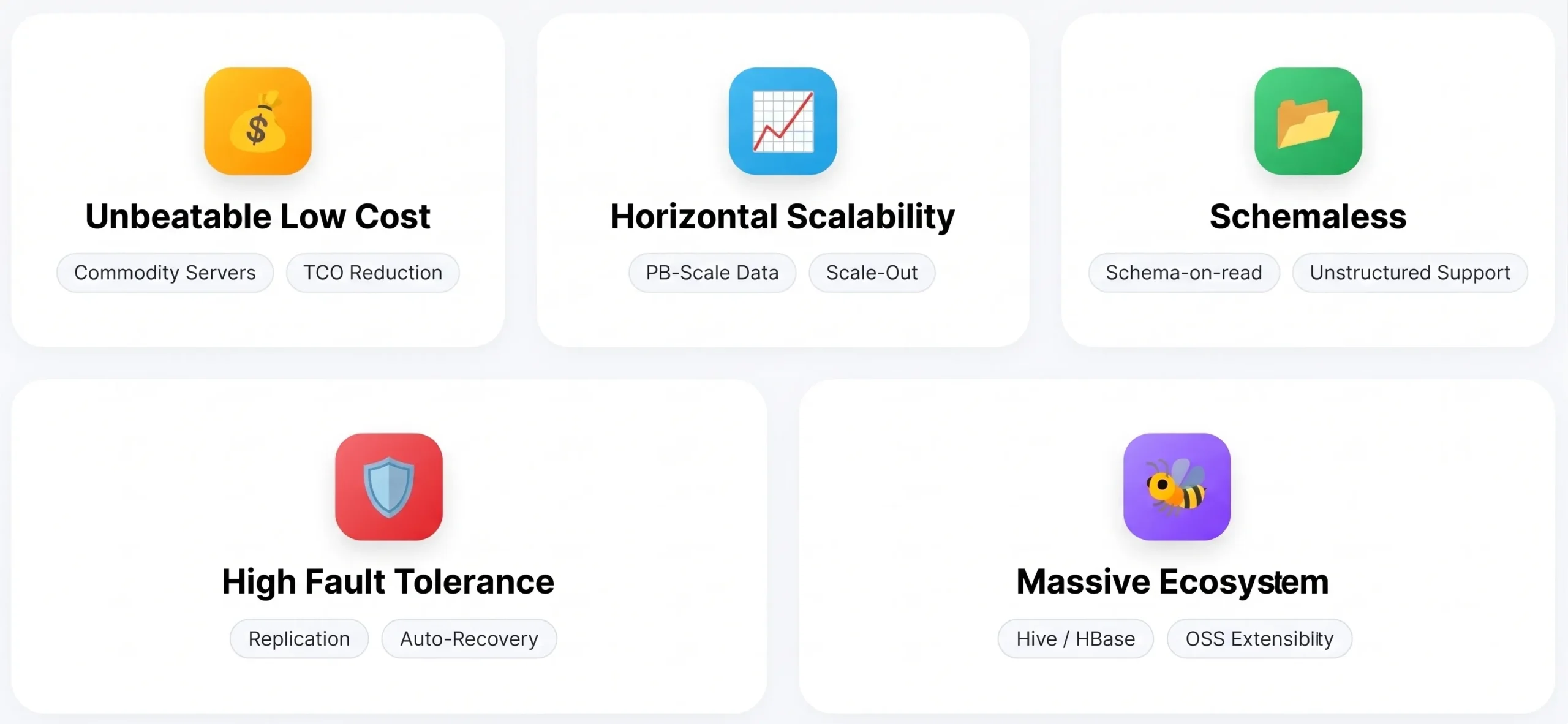
Hadoop became the mainstream choice for big data processing from the late 2000s through the 2010s thanks to five advantages that were hard to achieve with earlier technologies.
Advantage 1: Low-Cost Hadoop Deployment on Commodity Servers
A Cost Structure That Requires No Specialized Hardware
One of Hadoop’s defining features is that you can build a cluster with commodity servers (off-the-shelf, general-purpose servers) instead of expensive specialized hardware.
Traditional large-scale data processing required hardware such as Oracle Exadata or IBM enterprise storage, costing anywhere from tens of millions to hundreds of millions of yen.
Replace-on-Failure Operations and a TCO Advantage
With Hadoop, simply lining up many PC servers costing a few hundred thousand yen each can deliver equal or greater processing power.
Because each node is inexpensive, a “replace-on-failure” approach, where broken servers are simply swapped out, is entirely practical. Hadoop is advantageous not only in initial costs but also in long-term total cost of ownership (TCO).
Advantage 2: Hadoop’s Scalability Handles Even Petabyte-Scale Data
Flexible Expansion Through Scale-Out
Hadoop uses a “scale-out (horizontal scaling)” design, so when you run short of processing power or capacity, you can respond simply by adding more servers.
In theory, clusters can grow to thousands of machines, allowing you to handle data well beyond a petabyte (1 petabyte ≈ 1 million gigabytes).
A Proven Track Record at Global Companies
With the approach of “upgrading a single server,” further expansion becomes difficult once you hit the hardware’s limits.
With Hadoop, you just add servers as data grows, enabling flexible expansion that keeps pace with business growth.
In fact, Facebook and Yahoo! have long track records of running Hadoop clusters with thousands of nodes.
Advantage 3: Hadoop’s Schema-Less Design Handles Unstructured Data
Schema-on-Write vs. Schema-on-Read
Traditional relational databases (RDBMS) use a “schema-on-write” approach, in which table column names and data types must be strictly defined before data is stored.
This becomes inconvenient when handling large volumes of unstructured or semi-structured data such as logs, images, audio, and sensor data.
HDFS’s Flexible Storage Approach
Hadoop (HDFS), on the other hand, uses a “schema-on-read” approach: data is stored as-is first, and a schema is applied to interpret it when it is read.
Because data in many different formats can be gathered in one place and analyzed, Hadoop is highly practical in environments that deal with diverse data.
Advantage 4: High Fault Tolerance Backed by HDFS Replication
Automatic Replication to Prepare for Failures
HDFS replication copies each data block to three nodes. Even if one or two servers fail at the same time, no data is lost and processing can continue.
Autonomous Data Recovery Through Heartbeat Monitoring
The NameNode regularly checks the status of every node (heartbeat monitoring), and when it detects a failure, it automatically redistributes the data to other nodes.
Because data stays protected without manual intervention, this helps keep large clusters running stably.
Advantage 5: A Rich Ecosystem Born from Apache Hadoop’s Open-Source Nature
Hadoop is released under the Apache License 2.0, so you can use it without paying any license fees.
It also has a wide range of subprojects that integrate with Hadoop itself, making it easy to extend for your specific needs. The main subprojects, also introduced in IBM’s official materials, are summarized below.
| Project | Main Use |
|---|---|
| Apache Hive | Queries Hadoop data using a SQL-like language (HiveQL) |
| Apache Pig | Describes ETL processes in a data flow language (Pig Latin) |
| Apache Sqoop | Streamlines data transfers between RDBMS and HDFS |
| Apache HBase | A NoSQL, column-oriented database that runs on HDFS |
| Apache Flume | Collects, aggregates, and transfers log data |
| Apache ZooKeeper | Manages configuration and coordinates nodes in distributed systems |
(Source: What Is Hadoop? | IBM)
4. Four Disadvantages and Challenges of Hadoop: Limitations to Know Before Adopting It
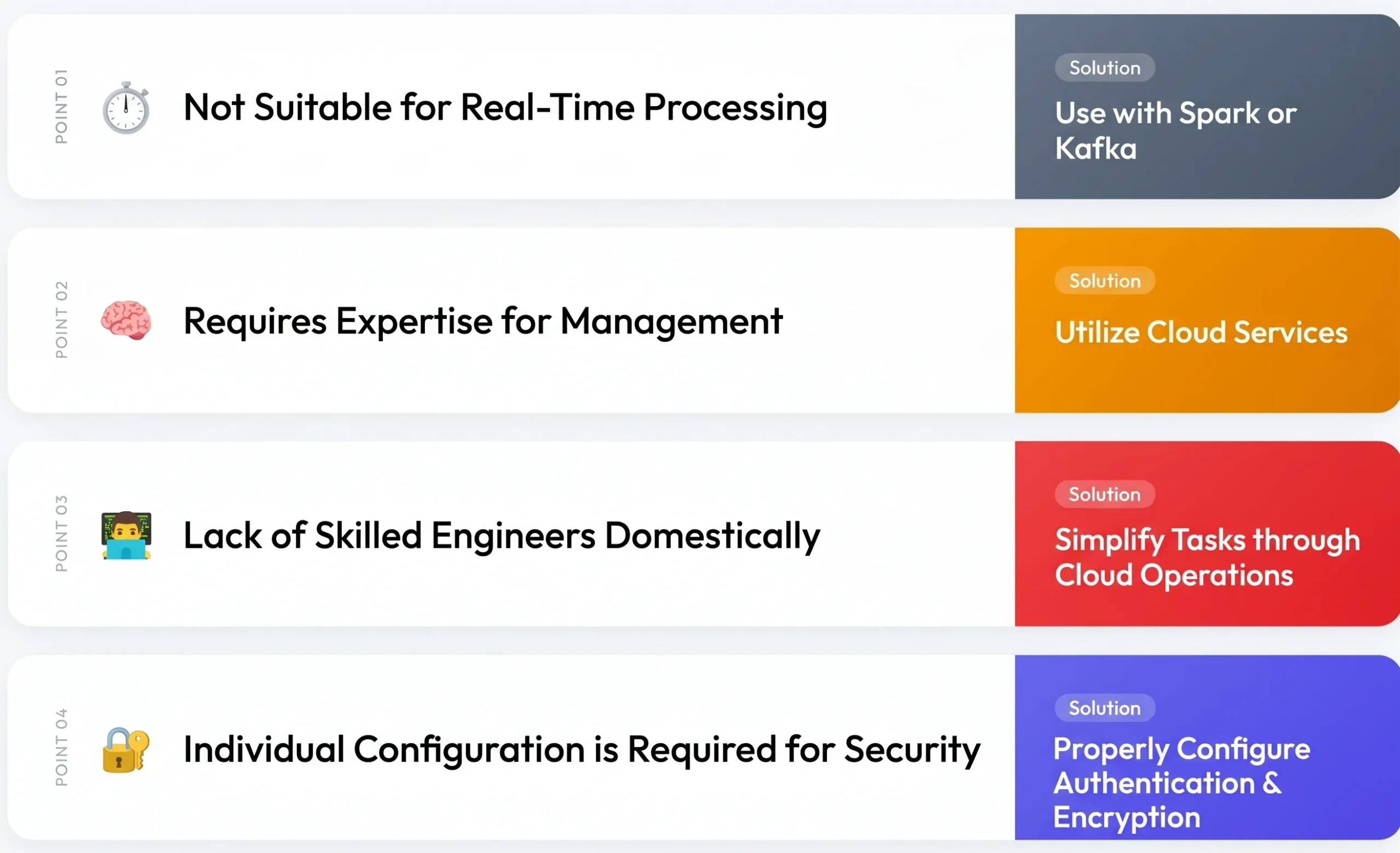
While Hadoop offers many advantages, it also has technical limitations and operational caveats. Before considering adoption, make sure you understand the following four challenges.
Challenge 1: Hadoop Is Built for Batch Processing and Is Not Suited to Real-Time Workloads
Latency Caused by Disk Writes
Hadoop was originally designed for batch processing (processing data in bulk all at once).
Because MapReduce writes data to disk at each stage of processing, jobs can take anywhere from tens of seconds to several minutes to complete.
As a result, it is not suitable for scenarios that require millisecond-level responses, such as payment processing, fraud detection alerts, or stock trading.
Real-Time Processing Requires Combining Other Technologies
When real-time processing is needed, it is common to combine Hadoop with Apache Spark, which is fast thanks to in-memory processing, or Apache Kafka, which can process streaming data in real time.
The key is to divide roles, positioning Hadoop as the foundation for large-scale batch processing and long-term data storage.
Challenge 2: Managing a Hadoop Cluster Requires Specialized Skills
Running a Hadoop cluster reliably requires broad knowledge, including designing the number of nodes and network configuration, tuning memory allocation and block size, monitoring cluster health, and configuring Kerberos authentication.
Engineers with these skills are scarce in Japan, which makes hiring difficult.
A practical way to solve this problem is to use cloud managed services such as AWS EMR or Google Cloud Dataproc.
Because the cloud provider takes care of cluster setup, scaling, and patching, the burden on operations teams can be greatly reduced.
Challenge 3: Engineers with Hadoop Skills Are Scarce in the Japanese Market
The Wide Range of Skills Required
Mastering Hadoop requires skills across multiple technical areas, including Linux fundamentals, Java programming, distributed systems knowledge, and cluster design.
Few engineers in Japan can work with Hadoop at a professional level, so hiring costs tend to be high.
Practical Measures for Small and Mid-Sized Organizations
Running Hadoop in-house brings not only hiring and training costs but also the risk of losing engineers to turnover.
For smaller organizations, migrating to cloud managed services to reduce dependence on specialists is a realistic option.
Challenge 4: Hadoop’s Default Settings Do Not Provide Sufficient Security
Risks of the Default Configuration
With its default settings, Hadoop does not provide adequate user authentication or communication encryption.
Communication within the cluster may flow unencrypted, and there is a risk of unauthorized access through impersonation.
Security Settings Required for Production
To run Hadoop safely in production, you need to implement Kerberos authentication, encrypt HDFS communication (TLS/SSL), and set up access control and audit logging with Apache Ranger or Apache Knox.
These settings require specialized knowledge, a challenge directly tied to Hadoop’s high management costs.
(Source: What Is Apache Hadoop? | Google Cloud)
■日本でエンジニアとしてキャリアアップしたい方へ
海外エンジニア転職支援サービス『 Bloomtech Career 』にご相談ください。「英語OK」「ビザサポートあり」「高年収企業」など、外国人エンジニア向けの求人を多数掲載。専任のキャリアアドバイザーが、あなたのスキル・希望に合った最適な日本企業をご紹介します。
▼簡単・無料!30秒で登録完了!まずはお気軽にご連絡ください!
Bloomtech Careerに無料相談してみる
5. Hadoop and Apache Spark: How They Differ and How They Coexist

You may hear people say that “the Hadoop era is over” or that “Spark has replaced Hadoop,” but that is not accurate.
In today’s large-scale data processing environments, the two often coexist with divided roles, so it is important to understand them correctly before choosing a technology.
Spark Is Not Hadoop’s “Successor” but a “Complementary Technology”
Spark’s In-Memory Processing and Speed
Apache Spark is an in-memory distributed processing framework developed at AMPLab at the University of California, Berkeley.
Because it keeps data in memory (RAM) during processing, it can be up to 100 times faster or more than MapReduce for machine learning and analytics that repeatedly access the same data.
A Complementary Relationship That Shares HDFS
However, Spark is only a “processing engine.” As a storage foundation for keeping large volumes of data for long periods at low cost, Hadoop’s HDFS is still used in many environments.
“Store data in HDFS and process it with Spark” is one of the most common architectures today. Spark is not a “replacement” for Hadoop; the two complement each other.
(Source: Spark vs Hadoop | IBM)
Choosing by Use Case: Hadoop for Batch Processing, Spark for Real-Time Analytics
| Criteria | Hadoop (MapReduce) | Apache Spark |
|---|---|---|
| Processing Model | Disk-based (batch) | In-memory (batch + streaming) |
| Processing Speed | Low to medium (disk I/O is the bottleneck) | Fast (excels at iterative in-memory processing) |
| Cost | Low storage cost per unit, advantageous for large-scale storage | Requires large amounts of memory, so server costs tend to be higher |
| Learning Curve | Java-centric, with complex configuration | Easy to use, with rich APIs for Scala, Python, and R |
| Main Use Cases | Large-scale ETL, log aggregation, batch aggregation | Machine learning, real-time analytics, interactive analytics |
| Real-Time Capability | Not suitable (batch only) | Supports stream processing via Structured Streaming |
| Storage | HDFS (built-in) | Relies on external storage such as HDFS, S3, and GCS |
6. Key Use Cases of Hadoop: Track Record in Finance, Healthcare, Manufacturing, and Retail

Hadoop is not limited to any one industry; it is used across a wide range of sectors that need to store large volumes of data long term and process it in batches. Here are use cases from four representative fields.
Finance: Large-Scale Transaction Analysis and Fraud Detection with Hadoop
Making Use of Massive Transaction Data
Financial institutions generate hundreds of millions of records every day from card payments, bank transfers, securities trades, and more.
By collecting this data in Hadoop and comparing it against historical data, they improve the accuracy of fraud detection and identify signs of money laundering.
Adoption in Japan and Abroad
JPMorgan Chase and others are known to have adopted Hadoop, which is also used to store training data for credit scoring models.
In Japan, too, major banks have reportedly introduced Hadoop as a data analytics platform separate from their core banking systems. Batch analysis that processes large volumes of historical data at once is one of the areas where Hadoop shines most.
(Source: What Is Hadoop? | primeNumber)
Healthcare and Life Sciences: Petabyte-Scale Genomic Data Analysis with Hadoop
Genomic Research and the Challenge of Data Volume
In genomics (genetic analysis), the sequencing data for a single person’s genome alone can reach about 200 GB (uncompressed).
Studies involving tens of thousands of people require handling data on the petabyte scale. Hadoop has become an indispensable foundation for processing data at this scale.
Examples from Medical and Research Institutions
Research institutions overseas have used Hadoop to analyze cancer genome data at scale to discover biomarkers and to screen new drug candidates.
It is also used for large-scale analysis of electronic health records (EHR), helping make epidemiological research more efficient.
(Source: What Is Hadoop? | FLEXY)
Retail and E-Commerce: Clickstream Analysis and Recommendation Optimization with Hadoop
Large-Scale Processing of Clickstream Data
E-commerce sites and retailers accumulate huge amounts of clickstream data that records which pages users viewed, which products they added to their carts, and where they left the site.
Hadoop processes these massive access logs in bulk, and the results are used to analyze purchasing patterns and power recommendation engines.
A Japanese Example: ASKUL Corporation
As a Japanese example, an official Tableau article describes how ASKUL Corporation adopted Hadoop for large-scale clickstream analysis and personalization based on customer behavior.
The ability to store large volumes of logs long term at low cost while analyzing them is one of Hadoop’s strengths.
(Source: What Is Hadoop? | Tableau)
Manufacturing: Sensor Data Processing and Supply Chain Optimization with Hadoop
Consolidating Sensor and SCM Data
In manufacturing, sensors on production lines continuously send data such as temperature, vibration, and current at high frequency. Data on procurement, inventory, shipping, and logistics is also generated across multiple sites and systems.
By consolidating this data in Hadoop and processing it in batches, manufacturers have achieved results such as the following.
- Detecting equipment anomalies early to reduce unexpected downtime
- Statistically analyzing defect rates to improve manufacturing processes
- Optimizing inventory based on demand forecasts to reduce waste
Adoption by Japanese Manufacturers
In Japan, major automakers and electronics manufacturers have adopted Hadoop as a big data analytics platform, and NEC has published its own use cases.
With the spread of IoT devices, data volumes in manufacturing keep growing, and demand for Hadoop as a large-scale storage foundation is expected to continue.
(Source: What Is Hadoop? | Tableau)
7. Hadoop on AWS EMR and GCP Dataproc: Comparing Cloud Services with On-Premises

There are two main ways to run Hadoop: “on-premises,” where you set up servers in your own data center, and in the cloud, where you use a Hadoop cluster as a managed service.
It is important to understand the cost, operational burden, and scalability of each before choosing.
Running Hadoop on AWS EMR or GCP Dataproc Greatly Reduces Infrastructure Management
Features of AWS EMR (Elastic MapReduce)
AWS EMR is a service from Amazon that provides Hadoop clusters as a managed service.
You can launch a cluster with Hadoop (HDFS and YARN) and Apache Spark in just a few clicks, and AWS handles setup, configuration, patching, and scaling.
On the cost side, it uses a pay-as-you-go model in which you run clusters only when you need them, so by deleting the cluster after a batch job finishes, you can bring the cost of idle time down to zero.
Because Amazon S3 can be used in place of HDFS, you can also build flexible architectures that separate storage from compute.
(Source: What Is Hadoop? | AWS)
▼Related Reading
Building data platforms on AWS? See why AWS engineering is called tough and who thrives in the role.

Features of GCP Dataproc (Google Cloud Dataproc)
Google Cloud Dataproc is a managed Hadoop/Spark service offered by GCP.
Clusters start up quickly, within 90 seconds, and Google recommends an “ephemeral cluster” pattern in which you delete the cluster after processing and keep only the data in Google Cloud Storage (GCS).
It also integrates easily with other GCP services such as BigQuery and Cloud Storage.
(Source: What Is Apache Hadoop? | Google Cloud)
▼Related Reading
Want a wider view of Google Cloud? Explore GCP’s key services, pricing, and how it compares with AWS.

On-Premises Hadoop Remains a Strong Option Where Data Governance Is a Priority
Cloud managed services are convenient, but there are cases where it is better to keep Hadoop on-premises. The main reasons are as follows.
When On-Premises Is the Better Fit
Regulatory and compliance constraints:
Cases where laws or industry regulations prevent data from being entrusted to a cloud provider, such as personal information held by financial institutions, medical records at healthcare providers, or public infrastructure data
Long-term cost optimization:
For workloads that keep a cluster running 24/7, purchasing and operating dedicated servers can cost less than pay-as-you-go pricing
Network bandwidth constraints:
In environments where frequently transferring large volumes of data to the cloud is impractical, processing data close to where it lives is more efficient
Which option suits you best depends on a combination of factors, including data sensitivity, the need for always-on operation, your operations team’s skills, and your budget.
8. The Future and Market Value of Hadoop Engineers: Reading Demand Trends for Data Professionals

Some engineers may wonder, “Isn’t Hadoop an outdated technology?” This section uses public data to review the current state of the big data market and the career value of Hadoop skills.
Japan’s Big Data Market Is Growing at a 14.3% CAGR, and Demand for Data Engineers Is Rising
According to IDC Japan, the Japanese big data and analytics market is forecast to reach a compound annual growth rate (CAGR) of 14.3% through 2027.
Driven by digital transformation (DX), the spread of IoT devices, and growing demand for data to feed generative AI, the need for professionals who can collect, store, and process large volumes of data is increasing over the medium to long term.
Japan’s Ministry of Economy, Trade and Industry (METI) has also repeatedly pointed out in its “DX Report” that a shortage of talent capable of driving data utilization is a challenge for Japanese companies, and the market value of engineers with data engineering skills is expected to remain high.
(Source: IDC Forecasts the 2024 Japanese Big Data and Analytics Market – CodeZine)
▼Related Reading
Which IT skills are Japanese employers hiring for now? See the top skills, salary trends, and a roadmap.

Hadoop Is Not a “Legacy Technology” but a Foundational Technology for Large-Scale Processing That Is Still in Use
The view that “Hadoop has been replaced by Spark and cloud data warehouses” is partly true but wrong as a whole. Hadoop is still running in production at many companies. The main reasons are as follows.
- Many organizations continue to use HDFS to store multiple petabytes of data at the lowest possible storage cost
- Migrating existing Hadoop-based ETL pipelines to Spark or the cloud takes significant cost and time, so migrations are happening gradually
- Spark often runs together with HDFS, so knowledge of Hadoop infrastructure is also essential for engineers who use Spark
It is premature to dismiss Hadoop as “a technology nobody uses anymore.” The concepts and operational know-how of large-scale distributed processing remain valuable foundational knowledge for working as a data engineer.
Skills to Learn Alongside Hadoop and How to Broaden Your Career Path
Recommended Skill Roadmap
| Phase | Skills to Learn | Goal |
|---|---|---|
| Introductory | Linux basics / Python / SQL | Build a solid foundation in data engineering |
| Foundational | HDFS, YARN, MapReduce / Apache Hive | Learn how Hadoop works and how to run basic queries |
| Advanced 1 | Apache Spark (PySpark) / Apache Kafka | Gain the ability to handle high-speed and stream processing |
| Advanced 2 | BigQuery / Amazon Redshift / Snowflake | Handle modern data processing with cloud data warehouses |
| Applied | MLflow / Airflow / dbt / Terraform | Automate ML pipelines and data orchestration |
Expanding Your Career Path
Knowledge built on Hadoop can be applied not only to the data engineer role but to a variety of other careers.
- ML engineer (building data platforms for machine learning models)
- Data architect (designing the overall data platform)
- Cloud infrastructure engineer (operating data platforms on AWS/GCP)
These and other in-demand roles in data-driven organizations are all realistic career moves.
In particular, engineers who understand both Spark and Hadoop are rare and highly valued on large-scale data platform design and migration projects, and they tend to be well regarded in the job market.
▼Related Reading
Drawn to the analytics side of data? Learn data analyst salaries, key skills, and a beginner roadmap.

9. Summary: Hadoop Is an Essential Distributed Processing Platform Supporting Engineers in the Big Data Era

Hadoop is a distributed processing platform in which three components work together: HDFS (distributed storage), MapReduce (distributed processing), and YARN (resource management).
Its strengths are low cost, high scalability, and fault tolerance, while its challenges include limited real-time capability and operational complexity.
It complements Spark and cloud services, and it remains in active use as a foundational technology for data engineering.
Backed by the 14.3% CAGR that IDC projects for Japan’s big data market, a data engineering career that starts with Hadoop skills holds strong promise over the medium to long term.
■ Build Your Data Engineering Career in Japan with Expert Support
Whether you want to deepen your Hadoop and Spark experience or move into data architecture or cloud infrastructure, the right next role makes all the difference. BLOOMTECH Career for Global offers career support for engineers living in Japan with Japanese proficiency at JLPT N2 level or higher, from job matching to interview preparation.
▼Contact BLOOMTECH Career for Global here