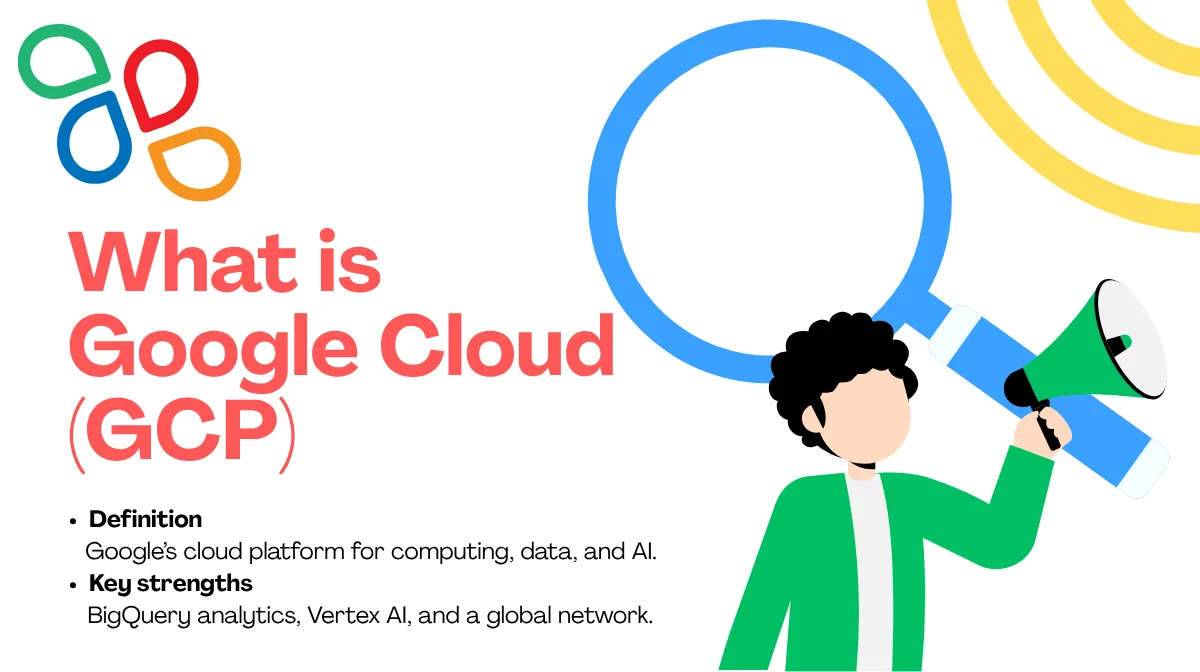
GCP (Google Cloud Platform) is the umbrella name for the cloud computing services provided by Google.
Google has since unified the brand under the name “Google Cloud,” but most engineers on the ground still call it “GCP.”
This article explains GCP from the ground up, covering the basic concepts, key services, pricing, and how it differs from AWS, so that even first-time learners can follow along.
- What GCP really means and how it relates to Google Cloud
- The key features of GCP’s flagship services, such as BigQuery and Vertex AI
- The differences between AWS and GCP, and how to choose the right cloud for your goals

1. What Is GCP? Official Name, Differences from Google Cloud, and Basic Meaning

To understand GCP accurately, it helps to start by clarifying its definition and the history behind its name.
In practice, both “GCP” and “Google Cloud” are used, but the two names differ slightly in scope and in the situations where they appear.
GCP Is the Collective Name for the Cloud Services Google Offers on Its Own Infrastructure
GCP (Google Cloud Platform) is the collective name for the cloud computing services that Google provides to external users through its own data centers and network infrastructure.
It consists of more than 200 services spanning computing, storage, databases, AI, networking, and more.
The Three Cloud Models: IaaS, PaaS, and SaaS
Cloud computing falls into three broad models.
IaaS provides infrastructure (servers, networks, and storage), PaaS provides an application development environment, and SaaS provides the software itself.
GCP covers all three models and supports a wide range of use cases, from startups to large enterprises.
Google has long run global services such as Google Search, Gmail, and YouTube on its own infrastructure.
One of the biggest differences between GCP and other cloud providers is that GCP makes that very same infrastructure available to ordinary businesses and developers.
GCP Has Been Rebranded as “Google Cloud,” but “GCP” Is Still the Common Term in the Field
Google has reorganized the names of its cloud-related services and unified them under the “Google Cloud” brand. This was a naming change to consolidate the brand, not a change in technical specifications.
However, the abbreviation “GCP” is still widely used in job postings, technical documentation, and engineering communities such as Qiita.
Many certification exams and learning materials also still use the “GCP” label, so in practice you need to be familiar with both names.
■ Looking for Cloud Engineering Jobs in Japan?
Demand for engineers with GCP and other cloud skills keeps rising across Japan. BLOOMTECH Career for Global supports engineers living in Japan with Japanese proficiency at JLPT N2 level or higher, introducing cloud, infrastructure, and data positions that match your experience and career goals.
▼Contact BLOOMTECH Career for Global here
2. Key GCP Services: An Overview by Category
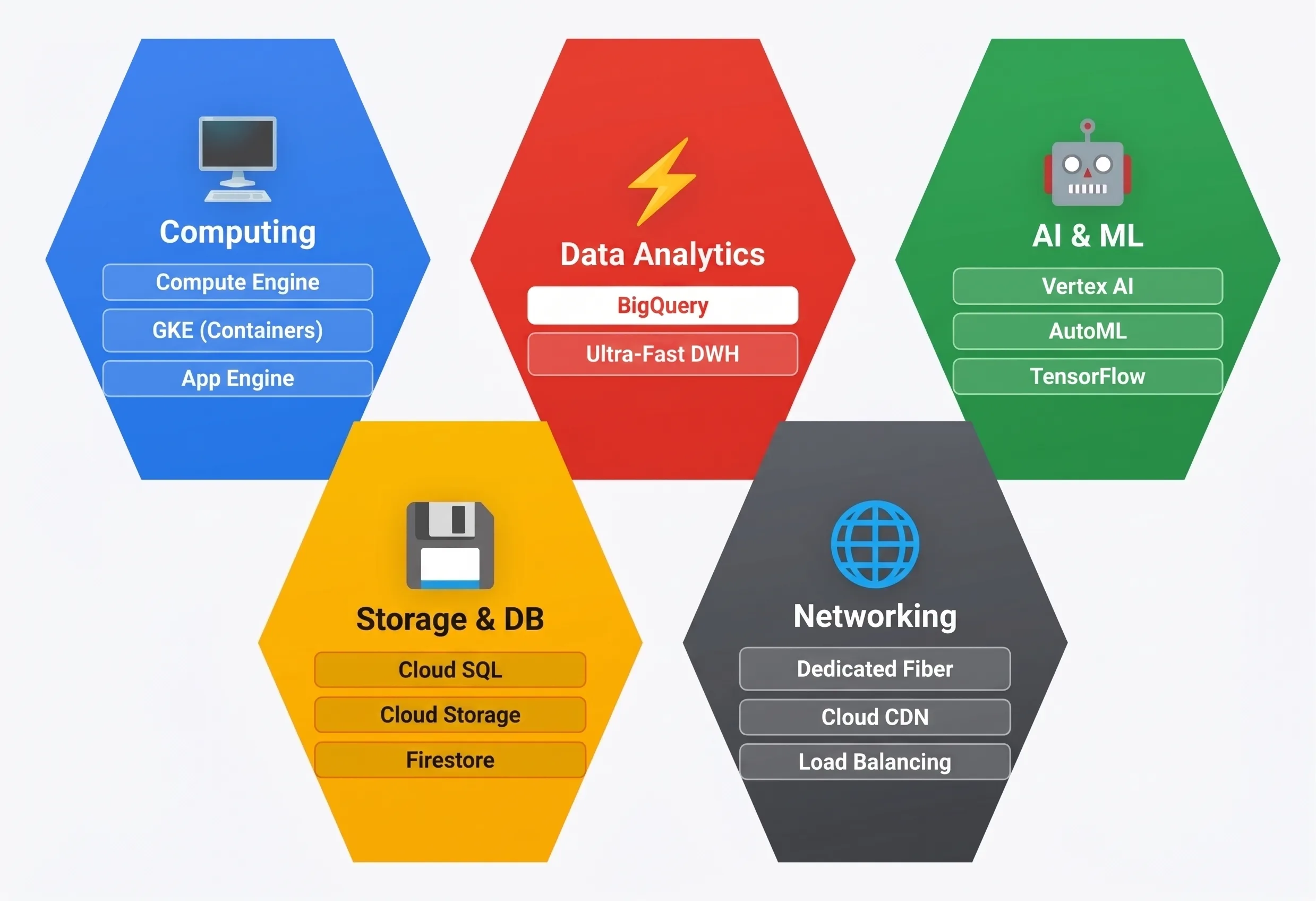
GCP is made up of more than 200 services, so the quickest way to get started is to learn the representative services in each category.
Here, we introduce them in five categories: computing, data analytics, AI/machine learning, storage/databases, and networking.
Computing: Choose Anything from Virtual Machines to Serverless Depending on Your Needs
GCP offers several computing options to suit the scale of your application and how you want to operate it.
Compute Engine
An IaaS service that provides virtual machines (VMs). You can freely customize the OS and middleware, which also makes it well suited to migrating existing on-premises environments.
Google App Engine
A PaaS that requires no infrastructure management. Simply upload your code and it scales automatically, making it ideal for developing and running web applications.
Google Kubernetes Engine (GKE)
A managed Kubernetes (container orchestration) service. It is used to manage containerized applications and build microservice architectures.
Data Analytics: BigQuery Is GCP’s Biggest Differentiator
Data analytics is where GCP has its strongest edge over AWS and Azure, and BigQuery sits at the center of it.
BigQuery is a serverless data warehouse known for its speed, processing terabytes of data in seconds.
It is built on technology from Dremel, a parallel query engine Google developed in-house, and because there is no infrastructure to manage, you can focus entirely on analyzing your data.
It is used for a wide range of business purposes, including marketing analysis, demand forecasting, and user behavior analysis.
▼Related Reading
Want to turn BigQuery skills into a career? See the salary, essential skills, and roadmap for becoming a data analyst.
AI and Machine Learning: Manage Everything from AI Development to Operations on GCP with Vertex AI
Backed by the AI research of Google, the company that created TensorFlow, GCP offers a rich lineup of machine learning services.
Vertex AI is an ML platform that lets you train, deploy, manage, and monitor machine learning models in a single environment.
It stands out for AutoML, which lets you build models without writing code, and for its close integration with Google’s own AI infrastructure. It also works seamlessly with TensorFlow.
It supports a wide variety of AI use cases, such as image classification, natural language processing, and demand forecasting. Being able to use the same AI foundation that powers Google Search, Gmail, and YouTube is a strength no other cloud can match.
▼Related Reading
Interested in AI work like Vertex AI projects? Learn about AI engineer salaries, visas, and job hunting in Japan.
Storage and Databases: The Right Option for Every Use Case
GCP provides multiple storage and database services depending on the nature of your data and how you use it.
Cloud Storage
An object storage service for unstructured data such as images, videos, and backup files.
Cloud SQL / Cloud Spanner
Managed relational database (RDB) services. Cloud SQL supports MySQL, PostgreSQL, and SQL Server, while Cloud Spanner can process global-scale transactions with ACID compliance.
Firestore / Bigtable
NoSQL databases. Firestore is suited to real-time data synchronization for mobile and web apps, while Bigtable is designed for large-scale, low-latency workloads such as IoT and financial data.
Networking: Google’s Own Fiber-Optic Network Powers GCP’s Low Latency
GCP’s network performance is supported by Google’s own global fiber-optic network and submarine cables.
By choosing the “Premium Tier network,” which transfers data over Google’s private network instead of the public internet, you get fast and stable connectivity.
Cloud CDN caches content at edge locations to speed up responses to users, and Cloud Load Balancing delivers global load balancing and high availability.
Together, these networking services make it possible to deliver low-latency services to users around the world.
3. GCP Regions and Zones: Understanding the Basic Structure of the Infrastructure

Regions and zones are among the most fundamental concepts when using GCP.
Where you place your data and how you build in redundancy directly affect system stability, so both engineers and corporate IT staff should understand how they work.
A Region Is a Geographic Location Where GCP Data Centers Are Located
A region is a geographic area in which GCP data centers are located.
Regions are spread across the world, and Japan has two of them: Tokyo (asia-northeast1) and Osaka (asia-northeast2).
Choosing a region lets you process and store data close to your end users, which reduces latency and makes it possible to keep data within the country (data residency).
For global deployments, a multi-region configuration that combines several regions is the common choice. GCP operates more than 40 regions worldwide and continues to add new locations.
(Source: Google Cloud Official: Regions and Zones)
A Zone Is an Independent Failure Domain Within a Region
A zone is a group of data centers within a region that is physically independent, with its own power and network.
Each region usually has three or more zones, and they are designed so that a failure in one zone does not affect the others.
This redundancy through zone separation is the foundation of GCP’s high-availability design.
Using a multi-zone configuration that distributes resources across multiple zones eliminates single points of failure (SPOF) and makes it easier to keep services running. Multi-zone configurations are generally recommended for production environments.
GCP’s SLA Availability Level Depends on Your Region and Zone Configuration
SLA Guidelines by Configuration
The service level agreement (SLA) values GCP provides vary depending on the region and zone configuration you adopt.
For example, Compute Engine guarantees a monthly uptime of 99.5% for a single-zone configuration, while a multi-zone configuration qualifies for a high-availability SLA of 99.99%.
Choosing a multi-region configuration gives you the highest level of availability, including protection against geographic disaster risks.
Choosing a Configuration by Environment
As a general rule of thumb, use a single zone for development and testing environments to keep costs down, and choose multi-zone or multi-region configurations for critical production environments.
(Source: Google Cloud SLA List)
▼Related Reading
If designing for SLAs and high availability interests you, explore SRE vs. DevOps careers, skills, and salary trends.
4. GCP Features and Benefits: Five Strengths That Set It Apart from Other Cloud Services
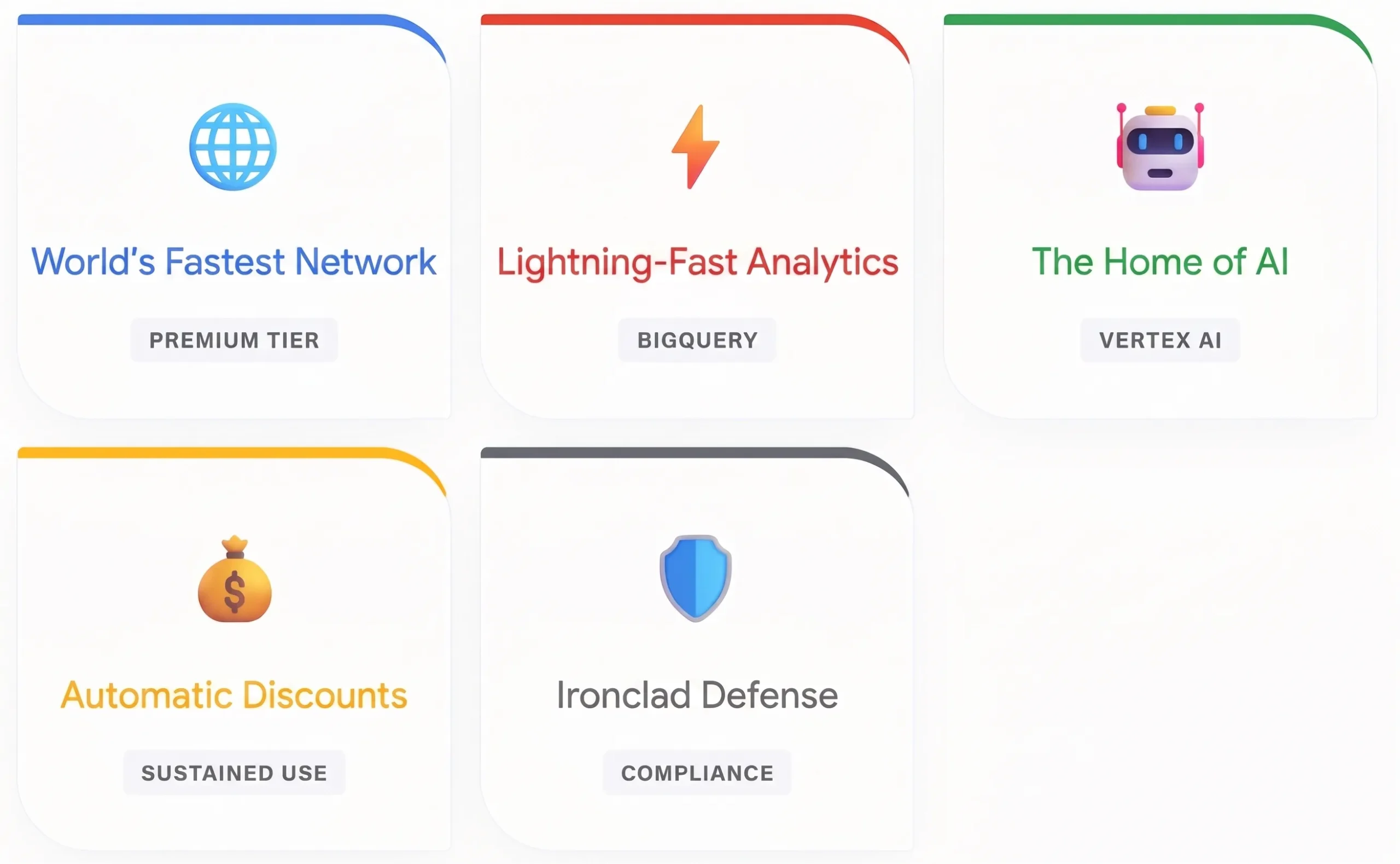
Behind GCP’s popularity with so many companies and engineers lies technology that Google has built up over many years.
Here, we summarize the five strengths that distinguish GCP from other clouds, along with the drawbacks you should know about before adopting it.
World-Class Network Performance Delivers Low-Latency, High-Speed Communication
GCP’s network performance is supported by the dedicated fiber-optic network and submarine cables that Google has laid itself.
By using the “Premium Tier network,” which exchanges data over Google’s private network rather than the public internet, you get stable communication with minimal latency.
Because Google connects its data centers around the world with its own network, GCP’s network quality is a major advantage for globally deployed web services and applications that require real-time performance.
BigQuery Offers Some of the Fastest Data Analytics Processing in the Cloud
BigQuery is a serverless data warehouse that can process terabytes of data within seconds, without any infrastructure management.
It dramatically shortens aggregation jobs that used to take hours on traditional data warehouses, helping businesses make faster decisions in areas such as marketing analysis and sales forecasting.
This processing speed is based on Dremel, a parallel query engine developed by Google, and it remains highly competitive against the data warehouse services of other cloud providers.
As the Birthplace of TensorFlow, GCP Offers the Most Complete AI and Machine Learning Environment
Google is one of the world’s leading AI research organizations, and the machine learning framework TensorFlow is also an open-source project created by Google.
GCP’s Vertex AI works well with TensorFlow and handles the entire workflow, from model training to deployment and monitoring, in a single environment.
With AutoML for building custom models without code and Generative AI Studio (Gemini API) for working with large language models, ease of AI development is one of GCP’s greatest strengths.
Access to the same AI foundation used by Google Search, Gmail, and YouTube is something unique to GCP.
Pay-as-You-Go Pricing Plus Sustained Use Discounts Means GCP Costs Optimize the More You Use It
GCP’s pricing model includes mechanisms that benefit cost-conscious organizations.
Sustained Use Discounts
When you use Compute Engine for more than 25% of a month, a discount of up to 30% is applied automatically, with no action required.
Committed Use Discounts
By committing in advance to one or three years of usage, you can receive discounts of up to 57% off standard pricing.
Always Free Tier
Major services such as Compute Engine, Cloud Storage, and BigQuery include a free usage tier, so you can start small projects or learn at no cost.
GCP’s Security, Backed by International Certifications, Meets Enterprise Requirements
GCP holds international security certifications including ISO/IEC 27001 (information security management) and SOC 1/2/3 (service organization controls), meeting the security standards that enterprises require.
It applies defense in depth, from data center access control through the network and application layers, maintaining a high level of data security and availability.
Compliance status is published on Google Cloud’s official pages, where you can also check how it meets regulatory requirements for each country and industry.
(Source: Google Cloud Compliance / Google Cloud Trust Center)
GCP Drawbacks: Japanese Documentation and Region Count Lag Behind AWS
While GCP has clear strengths, there are also drawbacks you should be aware of before adopting it.
Japanese Documentation Is Updated Later Than the English Version
After the official English documentation is updated, it can take some time for the changes to appear in the Japanese version, so you may need to refer to English resources to keep up with the latest information.
Fewer Domestic Regions and Edge Locations Than AWS
GCP has two locations serving Japan, Tokyo and Osaka, whereas AWS also operates multiple edge locations, putting AWS a step ahead in terms of redundancy options.
Fewer Engineers in Japan Have GCP Experience Than AWS Experience
It is also worth considering that there are fewer engineers with GCP experience than AWS experience in Japan’s hiring market. When operating GCP as a team, hiring and training may take longer.
■日本でエンジニアとしてキャリアアップしたい方へ
海外エンジニア転職支援サービス『 Bloomtech Career 』にご相談ください。「英語OK」「ビザサポートあり」「高年収企業」など、外国人エンジニア向けの求人を多数掲載。専任のキャリアアドバイザーが、あなたのスキル・希望に合った最適な日本企業をご紹介します。
▼簡単・無料!30秒で登録完了!まずはお気軽にご連絡ください!
Bloomtech Careerに無料相談してみる
5. GCP vs. AWS vs. Azure: Choosing Among the Big Three Clouds by Purpose

When choosing a cloud, GCP, AWS, and Azure each have different strengths.
To help you choose the cloud that fits your goals, tech stack, and team structure, we summarize the characteristics of all three.
AWS Leads in Market Share, and GCP Ranks Third but Is Growing Rapidly in AI
In the global IaaS public cloud market, AWS has held the top share for many years.
According to Gartner (published in 2025), the worldwide IaaS market grew 22.5% year over year in 2024, with AWS remaining in first place, Microsoft Azure in second, and Google Cloud in third.
(Source: Gartner “Worldwide IaaS Public Cloud Services Market Grew 22.5% in 2024”)
In Japan as well, IDC Japan expects the domestic cloud market to keep growing, with demand for generative AI and system modernization providing a particular tailwind for GCP.
GCP adoption is rising quickly in AI and data analytics, and more and more companies are choosing GCP when considering how to use AI.
(Source: IDC Japan Domestic Cloud Market Forecast)
AWS Excels in Versatility, Azure in Microsoft Integration, and GCP in AI and Data Analytics
The comparison table below summarizes the characteristics of the three providers.
| Category | GCP (Google Cloud) | AWS | Azure |
|---|---|---|---|
| Global Market Share | 3rd | 1st | 2nd |
| Main Strengths | AI, data analytics, networking | Versatility, number of services, ecosystem | Microsoft product integration, enterprise |
| Data Analytics | BigQuery (top tier) | Redshift | Synapse Analytics |
| AI / Machine Learning | Vertex AI, AutoML, Gemini | SageMaker | Azure Machine Learning |
| Containers | GKE | EKS | AKS |
| Main Databases | Cloud SQL, Spanner, Firestore | RDS, DynamoDB, Aurora | Azure SQL, Cosmos DB |
| Pricing Features | Sustained use discounts applied automatically | Reserved Instances | Hybrid Benefit (Windows Server, etc.) |
| Japanese Documentation | Translations may lag behind | Extensive | Extensive |
| Engineer Hiring Market in Japan | Relatively small | Largest | Large |
When GCP Is the Best Choice
GCP outperforms other clouds in cases like the following.
When you want large-scale data analysis with BigQuery
If you need to process terabytes of data quickly, BigQuery’s speed and cost performance surpass those of competitors.
When you want to develop and operate machine learning models with Vertex AI
GCP is a great fit if you want to take advantage of TensorFlow integration or no-code AI development with AutoML.
When you need integration with Google services such as Google Analytics and Google Ads
If you value data integration between Google services, such as exporting marketing data directly to BigQuery for analysis, GCP offers the smoothest experience.
When AWS Is the Better Fit
When you prioritize the number of services and quality of documentation
AWS offers more than 200 services and outperforms GCP in the depth and update speed of its Japanese documentation.
When you prioritize a large engineer hiring pool
AWS certification holders are the most numerous in Japan, making it easier to hire and train engineers with AWS experience.
When Azure Is the Better Fit
When you need integration with a Microsoft product environment
Azure is highly compatible with Microsoft products such as Office 365 and Active Directory, so companies already using Windows Server, Exchange, or Teams can migrate to and integrate with Azure smoothly.
▼Related Reading
Weighing AWS against GCP for your career? Find out why AWS engineering is considered tough and who it suits.
6. GCP Pricing: Understanding Pay-as-You-Go, Free Tier, and Discounts

When considering GCP, understanding how its pricing works is the foundation of cost management.
Like AWS and Azure, GCP is based on pay-as-you-go pricing, but it also offers its own discount programs that make it easier to keep costs down.
GCP Uses Pay-as-You-Go Pricing, So You Only Pay for What You Use
GCP’s pricing is fundamentally pay-as-you-go. You are charged only for the resources you use, so you can start with no upfront costs and control spending according to your usage.
Compute Engine is billed per second. Because you pay only for the seconds a virtual machine runs, it is especially cost-effective for short batch jobs and development or testing.
Note that there is a minimum billing period of one minute.
Try GCP’s Main Services for Free with the Always Free Tier
GCP offers an Always Free tier that incurs no charges up to a certain amount of usage each month.
It has no expiration date, so small projects and learning can effectively be done for free. The main free tier allowances are as follows.
- Compute Engine
720 hours per month of an f1-micro instance (in select US regions) - Cloud Storage
5 GB of storage per month (US regions) - BigQuery
1 TB of query processing and 10 GB of storage per month - Cloud Functions
2 million invocations per month
These free tier allowances are provided separately from the 90-day free trial ($300 in credits) and remain available after the trial ends.
(Source: Google Cloud Always Free Program)
Sustained Use and Committed Use Discounts Lower GCP Costs as You Scale
GCP automatically applies discounts once usage reaches a certain level, so the more you use it, the more cost-efficient it becomes.
- Sustained Use Discounts
When a Compute Engine instance runs for more than 25% of a month, a discount is applied automatically based on usage. No action is required, and you can receive up to 30% off. - Committed Use Discounts
By committing in advance to a one- or three-year term, you receive discounts of up to 57% off standard pricing. This is a strong option for companies and teams that plan to use GCP over the long term.
7. GCP Certifications and Learning: First Steps for Engineers to Master GCP
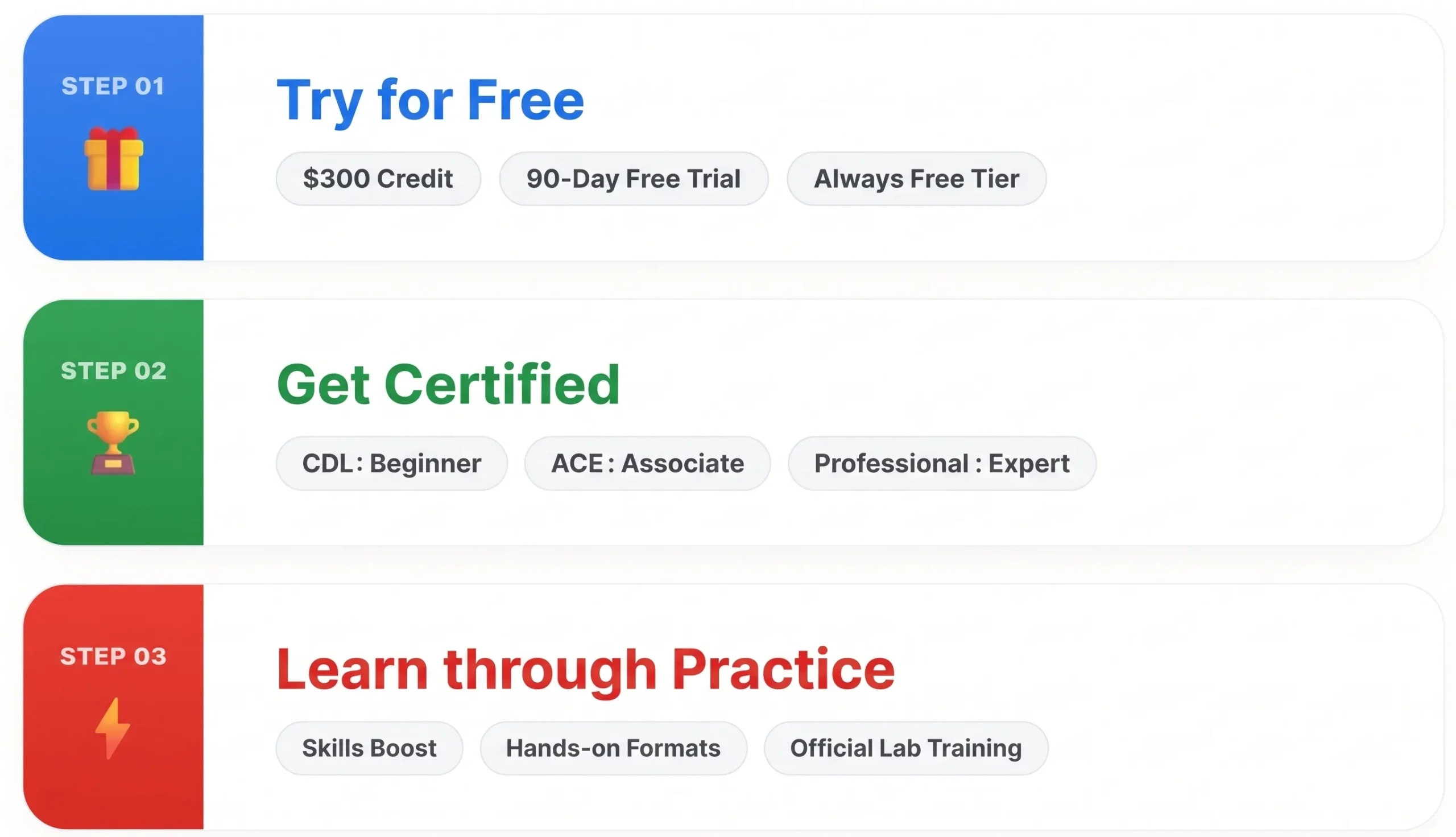
Building GCP skills can be a powerful asset for IT engineers looking to advance their careers or change jobs.
Here, we introduce environments where you can learn by actually using GCP, and the certification system that lets you prove your skills objectively.
Start by Trying GCP with an Official Google Cloud Free Trial Account
The fastest way to start learning GCP is to create an official Google Cloud free trial account.
Right after signing up, you receive $300 in free credits valid for 90 days, so you can learn hands-on with a wide range of services, including paid ones such as Compute Engine and BigQuery.
Even after you use up your credits, services in the Always Free tier remain free. Rather than trying to cover everything from the start, experimenting with services close to your work or learning goals will help you keep learning over time.
(Source: Google Cloud Free Trial)
Google Cloud Certifications Prove Your GCP Skills in the Engineering Job Market
GCP offers official certifications tailored to different skill levels and specialties.
Cloud Digital Leader (Foundational Level)
This certification tests basic cloud concepts and an overview of Google Cloud services. It is open to non-engineers in business roles as well, making it a good entry-level certification for anyone who wants to grasp the big picture of GCP.
Associate Cloud Engineer (Intermediate Level)
This certification tests practical skills in building, operating, and managing systems on GCP. It is the most commonly used certification for engineers to demonstrate hands-on GCP ability, and we recommend treating it as your first milestone in learning GCP.
Professional Certifications (Advanced Level)
These certifications cover specialized fields such as cloud architect, data engineer, and machine learning engineer. They are challenging to earn, but they are highly valued for job changes, promotions, and winning projects.
In Japan’s IT engineer job market, fewer people hold GCP certifications than AWS certifications, so earning one makes it easier to stand out.
Demand for GCP-related skills is growing especially in job postings for data engineers and machine learning engineers.
(Source: Google Cloud Certifications)
▼Related Reading
See which IT skills, including cloud, are most in demand in Japan and how to plan your career around them.

Build Practical GCP Skills Efficiently with Google Cloud Skills Boost
On Google Cloud Skills Boost (formerly Qwiklabs), Google’s official learning platform, you can learn GCP by working with it directly through hands-on labs.
Instead of just watching videos, you learn by practicing in a real GCP environment, which makes it easier to build skills you can use on the job.
Learning paths are organized by role and skill level, so you can study systematically toward your target career, whether that is data engineer, infrastructure engineer, or AI/ML engineer.
Some content is available for free, so start with the free labs.
(Source: Google Cloud Skills Boost)
8. GCP Is a Cloud Service That Lets You Fully Leverage Google’s AI and Data Infrastructure

GCP, also known as Google Cloud, is a cloud platform offering more than 200 services, from computing to AI development.
Its strengths in data and AI, represented by BigQuery and Vertex AI, clearly set it apart from AWS and Azure.
With pay-as-you-go pricing and a generous free tier, the best first step is to create an official trial account and explore the world of GCP for yourself.
GCP skills also help you stand out in the engineering job market. Keep certifications in mind as you build your skills step by step.
■ Take Your Cloud Career to the Next Level in Japan
Ready to put your GCP knowledge and certifications to work? BLOOMTECH Career for Global supports engineers living in Japan with Japanese proficiency at JLPT N2 level or higher, from career consultations and resume reviews to interview preparation for cloud, data, and AI positions.
▼Contact BLOOMTECH Career for Global here