

Many engineers are curious about what Go is — its features, salary levels, and future prospects.
This programming language, developed by Google, combines simple syntax, fast execution, and lightweight concurrency, and has been adopted by large-scale services such as Mercari and Docker.
This article covers everything from the basics of Go to how to learn it effectively.
- The definition and origins of the Go programming language, plus its 5 key technical features
- What you can build with Go and the major services that use it
- Salary benchmarks in the job market, future prospects, and an efficient learning roadmap

1. What Is Go? A Simple, Fast Programming Language Developed by Google
Go is an open-source programming language publicly released by Google in 2009.
It was released as open source in 2009, but the project itself began inside Google in 2007.
The official website (go.dev) describes it as “a language that makes it easy to build simple, reliable, and efficient software” — a philosophy that defines the language’s character.
Go has been adopted across a wide range of domains, from cloud-native system development to CLI tooling.
Go Was Designed by Google to Solve the Shortcomings of C
The origins of Go trace back to 2007.
Three renowned engineers at Google — Robert Griesemer, Rob Pike, and Ken Thompson — began designing the language to address three key challenges in large-scale system development.
Those challenges were: (1) growing complexity of system code, (2) slow build speeds, and (3) difficulty handling concurrent processing on multi-core CPUs.
Challenges with Existing Languages
At the time, Google was struggling to manage massive codebases written in C++ and Java.
C++ offered fast execution but required lengthy compile times and manual memory management.
Java handled memory automatically but required the JVM (Java Virtual Machine), adding significant startup overhead. Python was simple and easy to write, but its slow execution speed became a problem at scale.
No single language fully satisfied the requirement of developing and maintaining large, high-performance systems efficiently.
Go was designed to bring together the execution speed of C, the readability of Python, and easy concurrency — all in one language.
It was released as open source in November 2009 and continues to be developed by a community that extends well beyond Google.
Why Go’s Official Domain Was “golang.org” and What the Language Is Officially Called
Go’s official name is simply “Go,” but searching for “Go” alone in a search engine returns many unrelated results — including the board game Go.
As a result, the community adopted the informal name “Golang,” and the official domain was set to “golang.org.” The primary domain has since moved to go.dev, but golang.org still redirects there.
When searching for technical information, using “golang” as your search term will get you to the right results quickly.
▼Related Reading
Wondering which backend language gives you the best career ROI? Here’s a data-driven breakdown of the most in-demand options in Japan’s tech market.

2. Five Key Features of Go: Understanding Its Strengths Over Other Languages
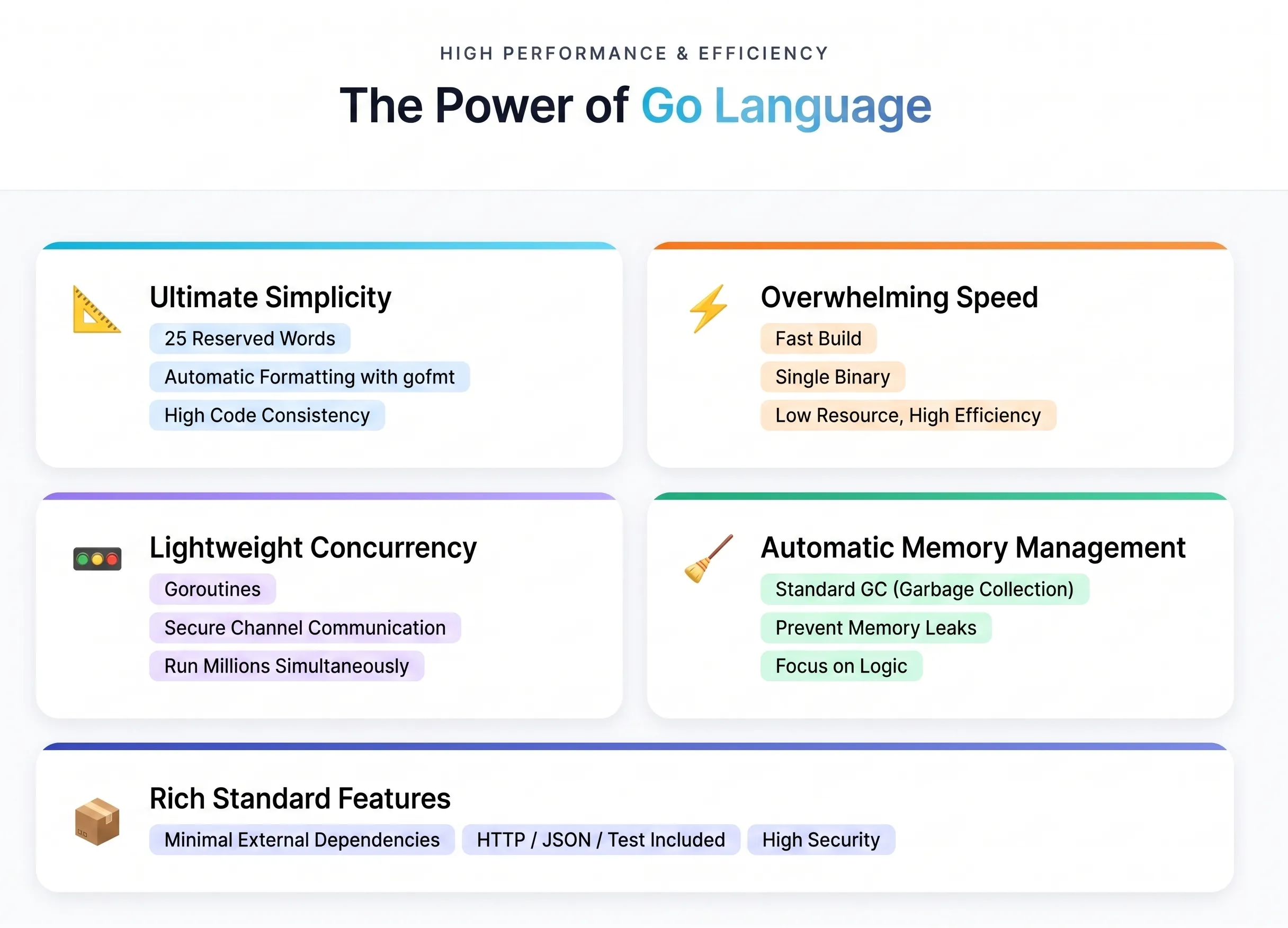
Go’s popularity in large-scale development environments comes from the combination of several well-balanced strengths.
Here we break down those strengths across five dimensions: syntax simplicity, execution speed, concurrency, memory management, and the standard library.
Go’s Simple Syntax Reduces Maintenance Costs in Team Development
Go has only 25 reserved keywords — the keywords with fixed meanings in the language.
Key Characteristic
Compared to other major languages like Python and Java, this low keyword count means a shorter learning curve for the syntax.
Type inference allows variable declarations to be written more concisely in many situations, making it possible to write readable code with less verbosity.
Notable Feature
gofmt is Go’s official automatic code formatting tool.
Running gofmt automatically standardizes indentation and spacing, eliminating stylistic differences between individual developers. This reduces the burden of code reviews within a team and makes maintenance much easier.
This philosophy is known as Idiomatic Go — a built-in mechanism at the language level that naturally guides all developers toward writing “Go-like” code.
Even in projects involving large numbers of engineers, code consistency is maintained, creating an environment that is easy to hand off and maintain.
Go Is a Compiled Language That Delivers Fast Execution and Handles High-Volume Processing
Go is a statically typed compiled language.
What Is a Compiled Language?
A compiled language converts source code into machine code before execution. Compared to interpreter-based languages like Python, which translate code line by line at runtime, this approach results in dramatically faster execution.
Advantages
Go’s compile speed is extremely fast even compared to other compiled languages like C++, meaning less waiting during builds and better day-to-day productivity.
Another major advantage is that Go programs compile to a single binary. The resulting executable is self-contained, making deployment straightforward and reducing the risk of dependency-related issues.
High-traffic web servers and API servers demand the ability to handle large volumes of requests quickly. In these scenarios, Go excels — delivering high performance with minimal server resources.
Go’s Goroutines Make Concurrent Processing Lightweight and Easy to Write
One of Go’s defining features is its concurrency model built around goroutines.
Concurrent Processing
Concurrent processing is the technique of running multiple tasks simultaneously — for example, handling User A’s request while simultaneously handling User B’s request.
Traditionally, concurrency in most languages relied on OS-managed “threads.” Threads carry significant overhead for creation and context-switching, and running thousands of them simultaneously puts a heavy load on the system.
Go’s goroutines, by contrast, operate through a much lighter internal mechanism, allowing tens of thousands of goroutines to run simultaneously with minimal memory usage.
Go also provides channels as a safe mechanism for passing data between goroutines.
Channels help reduce the risk of “race conditions” — situations where multiple concurrent processes try to write to the same data at the same time — enabling safe and structured concurrent programming.
Go’s Garbage Collector Minimizes the Burden of Memory Management
Programs consume memory (working space) during execution. If memory that is no longer needed is not released, the system gradually consumes more and more — a problem known as a “memory leak.”
In C and C++, programmers had to manually allocate and free memory, which was a common source of bugs.
In Go
Go includes built-in garbage collection (GC) — an automatic memory management system.
It automatically detects and frees memory that is no longer in use, allowing developers to focus on implementing logic without worrying about memory management.
Go’s GC is designed to minimize its impact on performance, operating reliably even in scenarios that require high-speed processing.
Go’s Rich Standard Library Minimizes External Dependencies
Go ships with a comprehensive standard library — a set of built-in functionality included with the language itself.
HTTP server construction, encryption, JSON processing, and testing tools are all available out of the box, covering most of what you need to build web applications.
Fewer dependencies on external frameworks (third-party libraries) means a lower risk of security vulnerabilities being introduced and fewer version compatibility issues during upgrades.
When new team members join, there is no need to onboard them on a specific framework’s proprietary conventions, reducing ramp-up costs.
3. What You Can Build with Go: Development Areas and Notable Adoption Examples

Go’s strengths are most pronounced in backend and infrastructure domains.
From globally used infrastructure tools like Docker and Kubernetes to large-scale web services like Mercari, Go is being used across a wide range of contexts.
Here is an overview of Go’s primary development domains and representative adoption examples.
Go’s Strongest Domain Is Backend Web Application and API Server Development
The area where Go is most widely used is web application backend and API server development.
According to the official Go Developer Survey 2025 (5,379 respondents), API and web service development ranked as the most common use case for Go, alongside CLI tooling.
A well-known domestic example is Mercari, the Japanese flea market app, which migrated its backend to Go.
Mercari originally ran on PHP, but adopted Go as part of its shift to a microservices architecture, significantly improving both processing speed and scalability.
Internationally, Uber also uses Go as a primary backend language, processing tens of thousands of requests per second with it.
Key Reasons Go Is Chosen for Backend and API Development
- High request throughput (concurrent processing via goroutines)
- Simple deployment (runs as a single binary)
- Readable code that is well-suited for team development
Go Is the Foundation Behind Infrastructure and Cloud Tools Like Docker and Kubernetes
Docker, the standard for container technology, and Kubernetes, the leading container orchestration tool, are both written in Go.
The fact that the infrastructure tools at the heart of modern cloud-native development are implemented in Go is a powerful testament to Go’s reliability and capability.
For infrastructure engineers, SREs (Site Reliability Engineers), and cloud engineers, the ability to read and write Go code is increasingly becoming an essential skill.
Reading Docker source code to understand container behavior, or writing custom Kubernetes controllers in Go, are real-world tasks that come up regularly in practice.
Go’s Strength in CLI Tool Development Lies in the Ease of Distributing a Single Binary
Because Go programs compile to a single executable binary, Go is exceptionally well-suited for distributing CLI (command-line) tools.
Users can download the binary and start using it immediately, with no need to install a specific runtime or additional libraries.
Notable Examples
GitHub CLI (the gh command) and Terraform (an infrastructure automation tool) are both written in Go.
Terraform is widely used for managing cloud infrastructure on AWS and GCP as code, making it an indispensable tool for infrastructure engineers.
Go’s Use Is Also Expanding into Embedded Systems and IoT/Drone Development
Go’s applications extend beyond server-side development. The Gobot framework makes it possible to write control programs for robots, drones, and IoT devices in Go.
Gobot supports a variety of hardware platforms, including Raspberry Pi and Arduino.
That said, the embedded and IoT space still has a smaller community and fewer production examples compared to server-side and infrastructure use cases. This is best understood as a promising direction rather than an established mainstream.
▼Related Reading
Go powers tools like Docker and Kubernetes — and SRE roles sit at the center of that ecosystem. Here’s what a career in SRE actually looks like in Japan.

4. Go Engineer Salaries and Demand in the Job Market

Understanding how Go expertise is valued in the job market is an important factor for engineers considering the language.
Drawing on private survey data and global developer surveys, here is an honest look at Go engineer salary levels and real-world demand.
※ Salary data is based on surveys by companies including paiza, Inc. (2025 edition) and is provided for reference only. Actual compensation varies depending on individual skills, experience, and contract terms.
Go Has Ranked #1 in Offered Salary for Three Consecutive Years
According to a programming language survey (2025 edition) conducted by paiza — an engineering job platform — Go ranked #1 in average offered salary for three consecutive years.
The 2025 results showed Go at ¥7.23M, followed by TypeScript at ¥7.14M in second place and Ruby at ¥6.89M in third.
In the same survey’s enterprise demand ranking (languages most sought in practice), JavaScript came first, Java second, and PHP third — Go did not place in the top rankings there.
In other words, Go’s market position is that of a language that is not the most commonly used in general practice, but is strongly sought after in high-salary roles.
Because engineers proficient in Go are relatively scarce, the supply-demand imbalance is thought to drive salaries upward.
(Source: paiza “Programming Language Survey (2025 Edition)”)
▼Related Reading
Go consistently tops salary rankings — but how does it compare across all IT roles in Japan? This guide covers compensation benchmarks from entry level to senior positions.

Reference: Top 3 Languages by Average Offered Salary (2025 Edition)
| Rank | Language | Average Offered Salary |
|---|---|---|
| 1st | Go | ¥7,230,000 |
| 2nd | TypeScript | ¥7,140,000 |
| 3rd | Ruby | ¥6,890,000 |
※ Based on paiza “Programming Language Survey (2025 Edition).” For reference only.
Go Consistently Ranks Among the Most Admired Languages Globally
Go’s strong reputation extends well beyond Japan — it is highly regarded in the global developer community as well.
In the Stack Overflow Developer Survey 2024, Go ranked among the top “Admired” languages, reflecting broad support from developers worldwide.
Mastering a language that is respected on the global stage opens doors to a wider range of opportunities. From the perspective of working with international companies or remote roles abroad, proficiency in Go can be a genuine advantage.
Go Engineers Are in Demand Across a Wide Range of Roles, from Backend to SRE
Go skills are valued across many roles. Here are four representative examples.
Key Roles Where Go Skills Are Valued
① Backend Engineer
This role involves server-side development for API servers and web applications using Go. Go’s concurrency capabilities are directly valued in implementing high-throughput APIs and handling large request volumes.
② SRE (Site Reliability Engineer)
This role focuses on system stability, automation, and performance improvement. SREs frequently work with Go-based tools like Kubernetes and Prometheus, and the ability to read and write Go significantly expands the scope of work you can take on.
③ Cloud Engineer
This role involves designing and operating cloud infrastructure on AWS, GCP, Azure, and similar platforms. Proficiency with Go-based tools like Terraform and Helm is commonly expected.
④ Infrastructure Engineer
This role covers server and network design and operations. A deep understanding of Docker and Kubernetes, combined with the ability to implement custom operators in Go, can significantly increase your market value.
■日本でエンジニアとしてキャリアアップしたい方へ
海外エンジニア転職支援サービス『 Bloomtech Career 』にご相談ください。「英語OK」「ビザサポートあり」「高年収企業」など、外国人エンジニア向けの求人を多数掲載。専任のキャリアアドバイザーが、あなたのスキル・希望に合った最適な日本企業をご紹介します。
▼簡単・無料!30秒で登録完了!まずはお気軽にご連絡ください!
Bloomtech Careerに無料相談してみる
5. The Future of Go: Growing Demand as the Infrastructure Language of the AI Era

Go’s future prospects can be demonstrated with concrete data and trends, not just intuition.
Here we examine the case for learning Go now from three angles: developer satisfaction, Go’s role in AI infrastructure, and the rise of cloud-native development.
The Go Developer Survey 2025 Points to High Satisfaction and Steady Growth
According to the official Go Developer Survey 2025, 91% of respondents reported being satisfied with Go, with roughly two-thirds of those selecting the highest rating of “very satisfied.”
This high satisfaction level has been consistently maintained since the survey began in 2019.
The same survey confirms that Go’s primary use cases — APIs, web services, and CLI tools — remain stable, indicating that Go is supported by genuine, practical demand rather than transient trends.
With 5,379 respondents, the size and activity level of the community itself is further evidence of Go’s long-term viability.
Go’s Role in AI Service Backends and Serving Infrastructure Is Expanding
With the rise of generative AI and machine learning, some might wonder: “Isn’t Python enough?”
In reality, Go’s role in AI service development is expanding rather than shrinking.
How Python and Go Divide Responsibilities in AI Services
Python handles the model training phase, while Go handles the inference and serving infrastructure — the part that actually delivers results to users.
Processing large volumes of requests quickly and returning AI results with low latency requires Go’s concurrency capabilities and lightweight deployment.
As more web services integrate AI features, Go’s demand in the backend infrastructure powering those services will only grow.
In the AI era, Go is not a rival to Python — it is a language that works alongside Python, each filling a distinct role, and its importance continues to increase.
The Spread of Cloud-Native and Microservices Architectures Is Structurally Driving Go Demand
Cloud-native technologies represented by Docker and Kubernetes have become the de facto standard in modern system development.
The “microservices” approach — breaking large systems into smaller, independently deployable services — is also gaining traction, and Go is particularly well-suited for this environment.
Containerized applications demand fast startup times, and Go’s lightweight binaries — which require no heavy runtime like the JVM — are an excellent fit.
Because Go-based tools like Docker, Kubernetes, Terraform, and Prometheus have become infrastructure standards, Go skills are recognized and valued across the cloud-native ecosystem broadly.
▼Related Reading
Go is increasingly used in AI service infrastructure — and AI engineering careers in Japan are growing fast. Here’s what that path looks like for foreign engineers.

6. Go’s Limitations and Where It Falls Short: Comparing Go with Python and Java
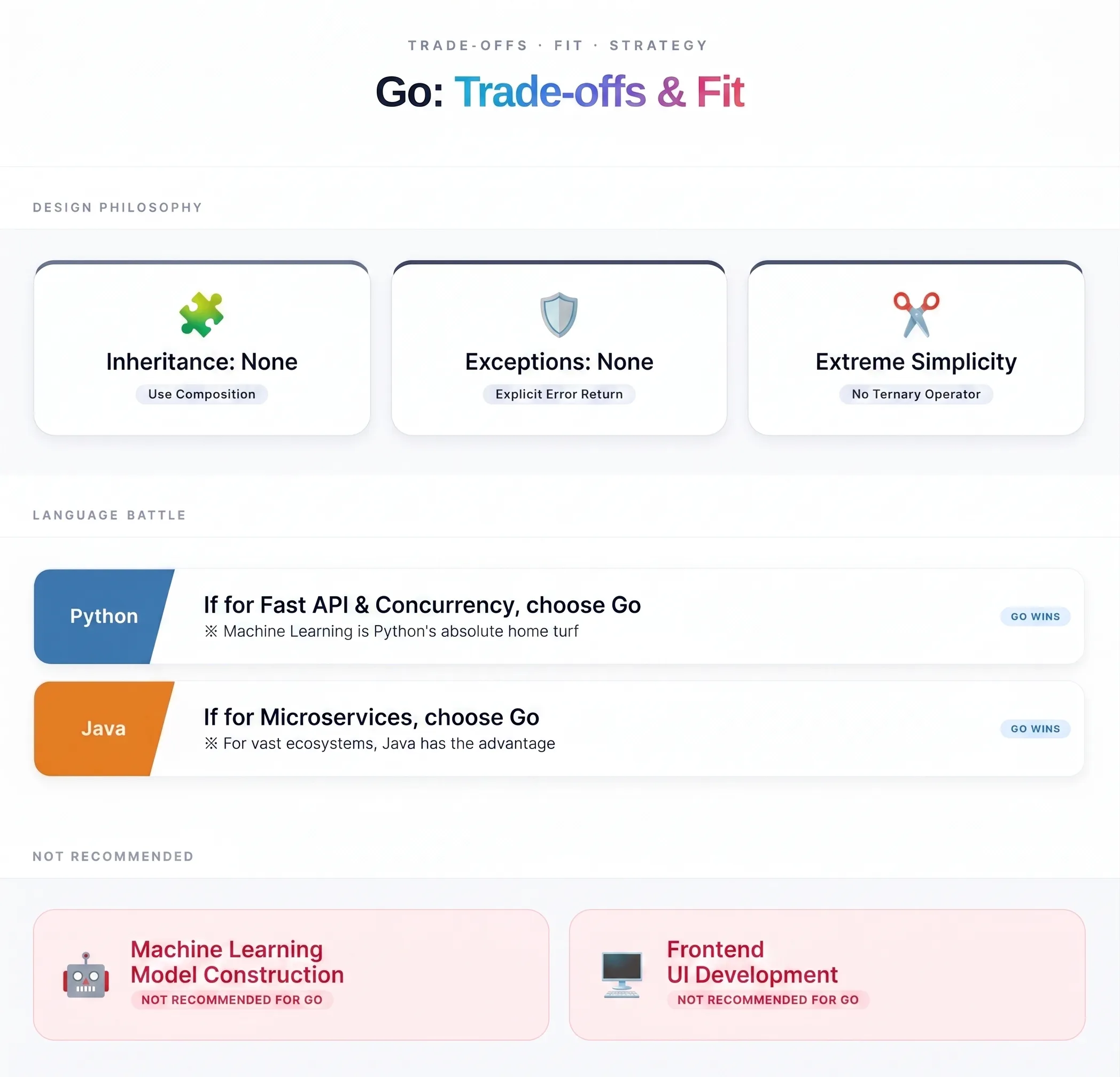
Go is not a one-size-fits-all language — it has clearly defined strengths.
The limitations listed below are not flaws, but intentional trade-offs rooted in Go’s design philosophy of valuing simplicity. Viewing them objectively will help you assess whether Go is the right fit for your goals.
The Absence of Inheritance and Exceptions Is an Intentional Design Trade-off in Go
Go deliberately omits several features that are taken for granted in other languages. Here are the most notable ones.
Key Features Go Does Not Have
No Inheritance:
Go has no class-based inheritance. Instead, design is achieved through a combination of interfaces and structs. Engineers coming from Java or C++ may find this unfamiliar at first.
No Exception Handling (try-catch):
Go handles errors as return values rather than using a try-catch mechanism. While this makes the flow of the code more explicit, it can lead to repetitive error-checking patterns throughout the codebase.
No Ternary Operator:
The condition ? true : false syntax does not exist in Go; if-else must be used instead.
Limited Real-World Guidance on Generics:
Generics (type parameters) were introduced in Go 1.18, but practical examples and established best practices are still relatively limited.
All of these reflect deliberate choices made in line with Go’s design philosophy: eliminate excess features so that code written by anyone tends to look similar.
Go Outperforms Python in Server-Side Workloads That Demand Speed and Concurrency
Go’s advantages over Python come down to three areas: execution speed, type safety, and concurrency.
Python is an interpreted language, which makes it slower than Go at runtime. Its dynamic typing also means type-related issues cannot be caught before execution.
For web servers handling large volumes of API requests or systems requiring real-time responsiveness, Go substantially outperforms Python.
On the other hand, Python has an overwhelming advantage for data science and machine learning model development.
ML libraries like TensorFlow, PyTorch, and scikit-learn are built for Python, and there is virtually no reason to switch to Go for this kind of work. Choosing the right tool for the job matters.
Go Outperforms Java for Lightweight, Simple Microservice Development
Java has a mature, well-established ecosystem centered on Spring Boot for enterprise full-stack development, backed by a rich library ecosystem.
For large-scale business applications, the depth of Java’s ecosystem is a significant strength.
Go, on the other hand, requires no heavy runtime like the JVM and produces lightweight binaries, giving it a major edge in startup speed in containerized and cloud environments.
In microservices architectures where many containers must start and scale out quickly, Go has a clear advantage over Java. That said, Go has not yet matched the maturity and breadth of Java’s ecosystem.
Machine Learning Model Development and Frontend Development Are Not Go’s Strong Suits
There are two domains where other languages are significantly better suited than Go, and it is worth knowing this upfront.
Areas Where Python or JavaScript Is a Better Fit Than Go
Machine Learning Model Development:
AI model training and research is dominated by Python and its ML libraries. Go lacks ML frameworks comparable to Python’s, making it a poor choice for this purpose.
Frontend Development:
Browser-based web UI development is the domain of JavaScript and TypeScript. While Go has some WebAssembly support, it is not a practical option for frontend work.
Focusing your Go learning on the areas where it excels — backend, infrastructure, and CLI tools — is the most efficient path to career advancement.
7. How to Learn Go: The Fastest Path for Beginners to Build Real Skills
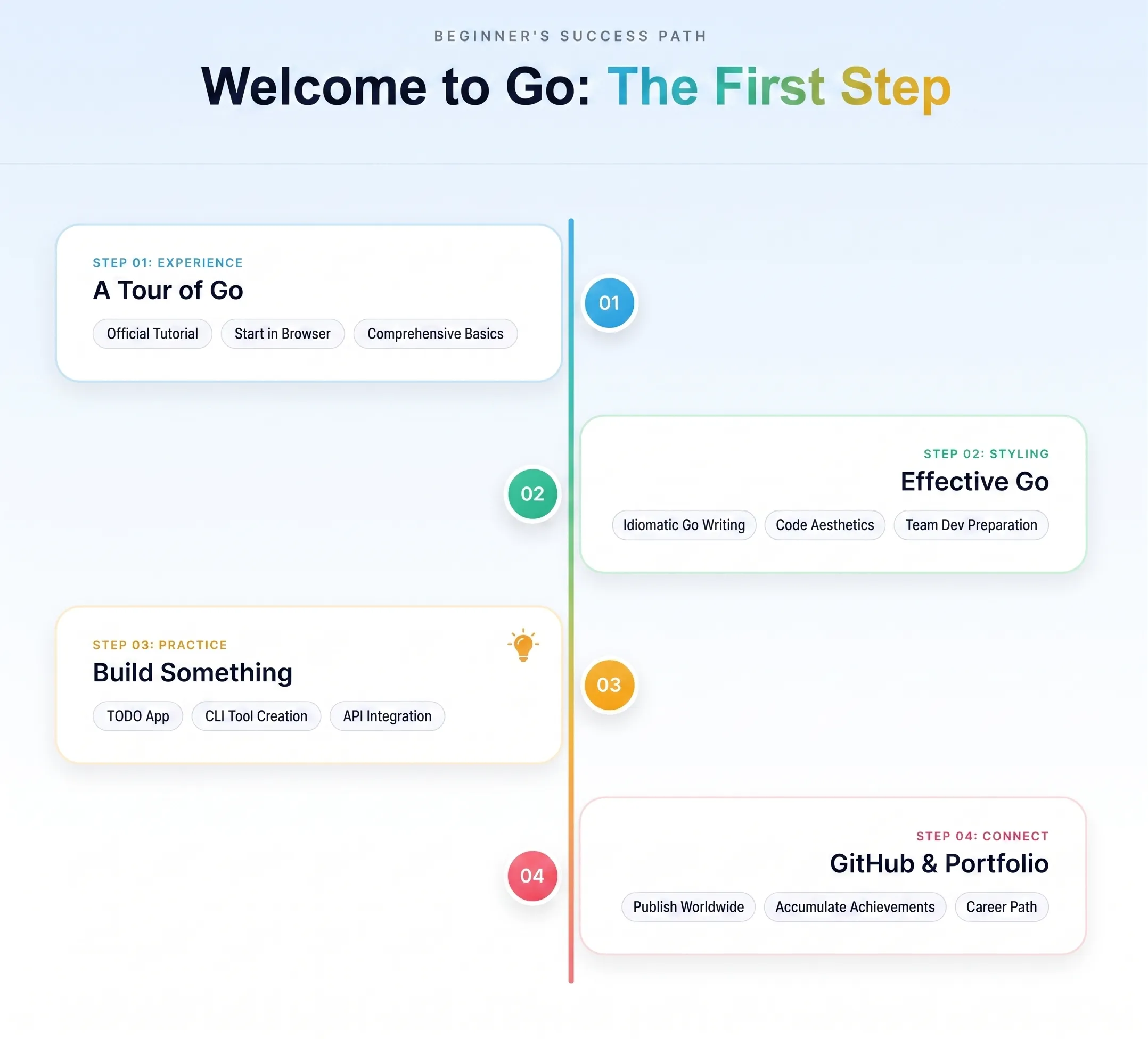
Go has excellent official learning resources, making it an accessible language to pick up through self-study.
By starting with the official tutorial and progressing step by step to building real working projects, you can develop solid skills systematically. Here is a concrete learning path you can act on right away.
Start with the Official Tutorial “A Tour of Go” to Get a Feel for the Language
The best starting point is the official interactive tutorial “A Tour of Go.”
You can run Go code directly in your browser — no local environment setup required.
It covers all the Go basics: variables, types, functions, loops, and goroutines. A Japanese-language version is also available for those who prefer it. The tour typically takes a few hours to a full day, and you can work through it in a focused weekend session.
If you are wondering where to start, open this tutorial and begin there.
Next, Study “Effective Go” to Learn How to Write Idiomatic Go
Once you have the basics down, move on to “Effective Go.”
This official document is the most important text for developing Idiomatic Go — writing code the way the Go community considers best practice.
Going beyond “code that just works” to understanding “what good Go code looks like” gives you the skills to contribute effectively to team projects and open-source work.
Additional Recommended Learning Resources
Books:
The Go Programming Language by Alan A. A. Donovan (available in English) is well regarded for readers who want to develop a deep understanding of Go’s design philosophy.
Online Courses:
Platforms like Udemy offer Go courses in video format, which work well for those who prefer learning by watching.
Build a CLI Tool or Web API from Scratch to Develop Practical Go Skills
After finishing tutorials and reference material, move on to building something that actually works. Simply copying code (“transcription exercises”) or reading alone rarely develops the skills you need in practice.
Here are some good starting projects for beginners.
Beginner Project Ideas
A TODO App REST API:
Covers HTTP routing, returning JSON responses, and basic data storage — all in one project. Implementing it using only the net/http package deepens your understanding of Go’s standard library.
A File Manipulation CLI Tool:
A tool that accepts command-line arguments and performs file reading, writing, or conversion. It lets you experience the simplicity of binary distribution firsthand, while also introducing CLI design.
A Weather API CLI App:
Gives you hands-on practice with HTTP requests to an external API, JSON parsing, and error handling.
Deliberately working from “code that vaguely works” to “code written with intentional design” is the habit that leads to the fastest skill development.
▼Related Reading
A strong GitHub portfolio is just one piece of the puzzle. Here’s how to build a complete job-search strategy as a software engineer — from preparation to offer stage.

Publishing Your Work on GitHub Raises Your Market Value as a Go Engineer
Publish the projects you build on GitHub. In job searches and freelance client acquisition, a GitHub portfolio gives hiring managers concrete code to evaluate — something far more persuasive than a resume line alone.
Being able to point to an actual code repository is a stronger demonstration of technical ability than simply writing “experience with Go” on a resume.
Going further, contributing to Go open-source projects — even small bug fixes or documentation improvements — leaves a positive impression on both hiring managers and technical evaluators.
Search GitHub for issues tagged “good first issue” to find beginner-friendly tasks to contribute to.
8. Summary: Go Is a Language Worth Learning for Engineers Aiming to Advance Their Careers
Go’s combination of simple syntax, fast execution, and lightweight concurrency makes it highly valued in backend, infrastructure, and CLI tool development.
As the data on three consecutive years of top salary rankings demonstrates, the career impact of mastering Go is significant — and its role as the infrastructure language of the AI era continues to expand.
Start learning today with the official tutorial, and take the first step toward publishing your own tool on GitHub.
■ Ready to Turn Your Go Skills Into a Higher Salary?
If you’re an engineer living in Japan with Japanese proficiency of N2 or above and want to move into a Go-based backend or infrastructure role, BLOOMTECH Career for Global can help. We connect skilled engineers with top Japanese tech companies actively hiring for cloud-native and backend positions.
▼Contact BLOOMTECH Career for Global here