
What is an MLOps engineer? Surprisingly few engineers can answer that question with confidence.
Many AI and machine learning projects stall at the PoC (proof of concept) stage and never make it into production. This “PoC wall” has become a major challenge both in Japan and around the world.
This article covers everything you need to know about MLOps engineers for a job change or career move, from the definition of the role to job responsibilities, required skills, salary, and how to become one.
- What MLOps engineers do and how the role differs from other positions
- The skills you need and how to become an MLOps engineer for a job change or career move
- Salary levels in Japan and the future outlook of the market

1. What Is an MLOps Engineer? Definition and Background

An MLOps engineer is a specialist who takes end-to-end responsibility for developing, deploying, and operating machine learning models.
The term “MLOps” combines Machine Learning and Operations. It applies the principles of DevOps, a methodology for making software development more efficient, to machine learning.
Google Cloud defines MLOps as “a practice that combines data science and IT operations to automate machine learning systems and accelerate their deployment to production.”
AWS describes it in a similar way: “a practice that unifies the machine learning development process with operations to deliver models to production continuously and reliably.”
Why MLOps Has Been Gaining Attention
The main driver is the “PoC wall” in AI projects. Around the world, models that worked well during the PoC stage kept running into trouble when it came to moving into production, maintaining accuracy, and scaling up, so many never reached practical use.
The MLOps engineer role emerged to solve this problem.
(Sources: Google Cloud Official Site / AWS Official Site )
MLOps Adds Machine Learning-Specific “Continuous Training (CT)” to DevOps
DevOps is built on two mechanisms: CI (continuous integration) and CD (continuous delivery).
MLOps adds a process unique to machine learning on top of these: “Continuous Training (CT)”.
Machine learning models tend to lose prediction accuracy over time. This is known as “concept drift.”
It happens because real-world data changes with shifts in consumer behavior or seasonal effects, so a model trained on past data no longer performs accurately.
CT prevents this drop in accuracy by regularly retraining the model on new data.
MLOps Automation Levels (Level 0 to 2)
Based on this idea, Google Cloud organizes MLOps maturity into three levels. The higher the level, the closer the system gets to running everything from model retraining to deployment automatically.
- Level 0
Fully manual. Model training, evaluation, and deployment are all done by hand - Level 1
Automated pipelines. Retraining runs automatically when the data changes - Level 2
Automated CI/CD pipelines as well. Every step from code changes to deployment is automated
(Source: Google Cloud Official Site )
A Role Created to Move Beyond “Build It and Forget It” AI
According to the AI White Paper published by IPA (Information-technology Promotion Agency, Japan), many AI and machine learning projects in Japan also remain at the PoC stage and never reach production.
Main Causes
The main causes cited are a lack of know-how in model operations, delays in building infrastructure, and immature data management.
As the bridge between PoC and production, MLOps engineers keep the models built by data scientists running reliably in business settings, and demand for them is growing rapidly in Japan as well.
(Source: IPA AI Research Report )
■ Find MLOps and AI Engineering Roles in Japan
As more Japanese companies try to move their AI projects beyond the PoC stage, engineers who can run machine learning models in production are in high demand. BLOOMTECH Career for Global supports engineers living in Japan with Japanese proficiency at JLPT N2 level or higher, introducing MLOps, AI, and cloud positions that match your skills and career goals.
▼Contact BLOOMTECH Career for Global here
2. What MLOps Engineers Do: A Role Spanning Development to Operations
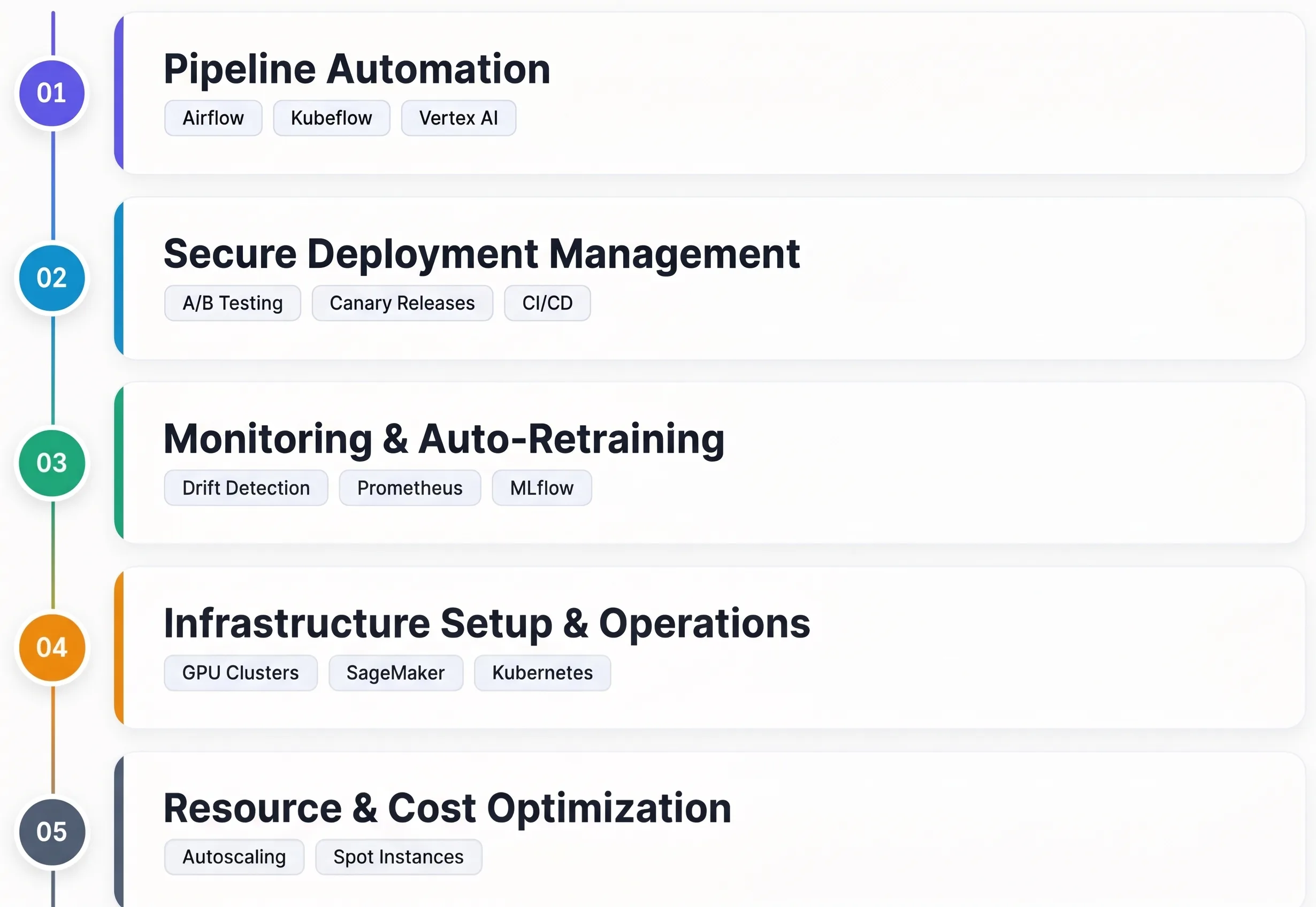
The work of an MLOps engineer covers five areas: model development support, deployment, pipeline automation, monitoring, and infrastructure management.
Each of these tasks is directly tied to business goals, and without MLOps engineers, it becomes difficult to keep AI systems running reliably.
Designing and Automating Machine Learning Pipelines Is the Core Task
The central job of an MLOps engineer is designing and automating machine learning pipelines.
They build systems that run the entire flow automatically, without human intervention: data collection → preprocessing → model training → evaluation → deployment → monitoring.
Once these systems are in place, data scientists can focus on researching and improving models.
In many cases, processes that took several days by hand finish in a few hours, making it possible to run AI improvement cycles at the speed the business needs.
Commonly used pipeline tools include Apache Airflow (workflow management), Kubeflow (ML pipelines on Kubernetes), and Vertex AI Pipelines (a managed service on Google Cloud).
Supporting Business Continuity Through Model Deployment and Release Management
Deployment and release management are about delivering trained models safely to production.
MLOps engineers use CI/CD pipelines to automate code testing, building, and deployment, creating a setup where models can be updated continuously while maintaining quality.
Production releases rely on techniques that keep the risks of model updates to a minimum.
A/B Testing
This method runs the old and new models in parallel to compare their performance. Data is collected over a set period, and if no problems are found, traffic is switched over to the new model.
Canary Release
Only a portion of all traffic (for example, 5%) is routed to the new model, with a setup in place to roll back immediately if a problem is found. Its key advantage is that releases can proceed in stages while limiting the scope of impact.
Preventing Model Accuracy Degradation Through Monitoring and Retraining
Deployment is not the finish line; it is the start of operations. In production, model accuracy declines over time due to concept drift (changes in the meaning of the data) and data drift (statistical changes in the input data).
One of the most important jobs of an MLOps engineer is to monitor this continuously and build systems that automatically trigger retraining when accuracy falls below a threshold.
Monitoring typically combines tools such as MLflow (experiment and model management), Prometheus (metrics collection), and Grafana (dashboard visualization).
These tools track model accuracy, inference speed, and error rates in real time so that anomalies can be detected early.
Infrastructure Management and Cost Optimization Are Also Part of the Job
MLOps engineers are also responsible for managing the entire infrastructure that models run on.
Using managed services such as AWS SageMaker, Google Cloud Vertex AI, and Azure Machine Learning, they handle everything from building GPU clusters for training to adjusting the scale of inference services.
Cost management is another important part of the job. Machine learning training is computationally expensive, and overusing resources can quickly drive up cloud bills.
MLOps engineers balance performance and cost by configuring autoscaling, using spot instances, and automatically shutting down unused resources.
3. How MLOps Engineers Differ from Other Roles: Where They Meet Data Scientists and DevOps

MLOps engineers are often confused with data scientists and DevOps engineers. Looking at it from the perspective of “who builds what, and who protects what” makes the differences between these roles clear.
Data Scientists Build Models, MLOps Engineers Keep Them Running
The main job of a data scientist is to design and develop models that solve business problems with machine learning, and to improve their accuracy.
Their focus is on “raising the quality” of models through statistical analysis, feature design, parameter tuning, and similar work.
MLOps engineers take those models and “build and protect the systems” that keep them running reliably in production.
By running the operational cycle of deployment, scaling, monitoring, and retraining, they deliver the value of the models built by data scientists to the business.
When these two roles work together, models that were stuck at the PoC stage can move into production.
DevOps Engineers and MLOps Engineers Share Methods but Work on Different Targets
DevOps engineers design and manage CI/CD pipelines to release software continuously. Their core work includes infrastructure as code (IaC), automated testing, and deployment automation.
MLOps engineers adopt many DevOps methods, but what they work on is not software but “machine learning models.”
Managing models requires version control for data as well as code, and MLOps engineers handle complexities that do not exist in software development, such as changes in training data, declining accuracy, and deciding when to retrain. This is the expertise unique to MLOps engineers.
| Item | Data Scientist | MLOps Engineer | DevOps Engineer |
|---|---|---|---|
| Main role | Model design and accuracy improvement | End-to-end ownership from development to operations | Automating software delivery |
| Main deliverable | Trained models | ML systems running in production | Deployment pipelines |
| Required knowledge | Statistics and ML theory | ML + infrastructure + DevOps | Infrastructure and CI/CD |
| ML-specific work | Yes (core) | Yes (operations side) | No |
▼Related Reading
SRE is another role that overlaps with DevOps. Compare SRE and DevOps practices, career paths, and salaries in Japan.

4. Skills and Tech Stack Required for MLOps Engineers
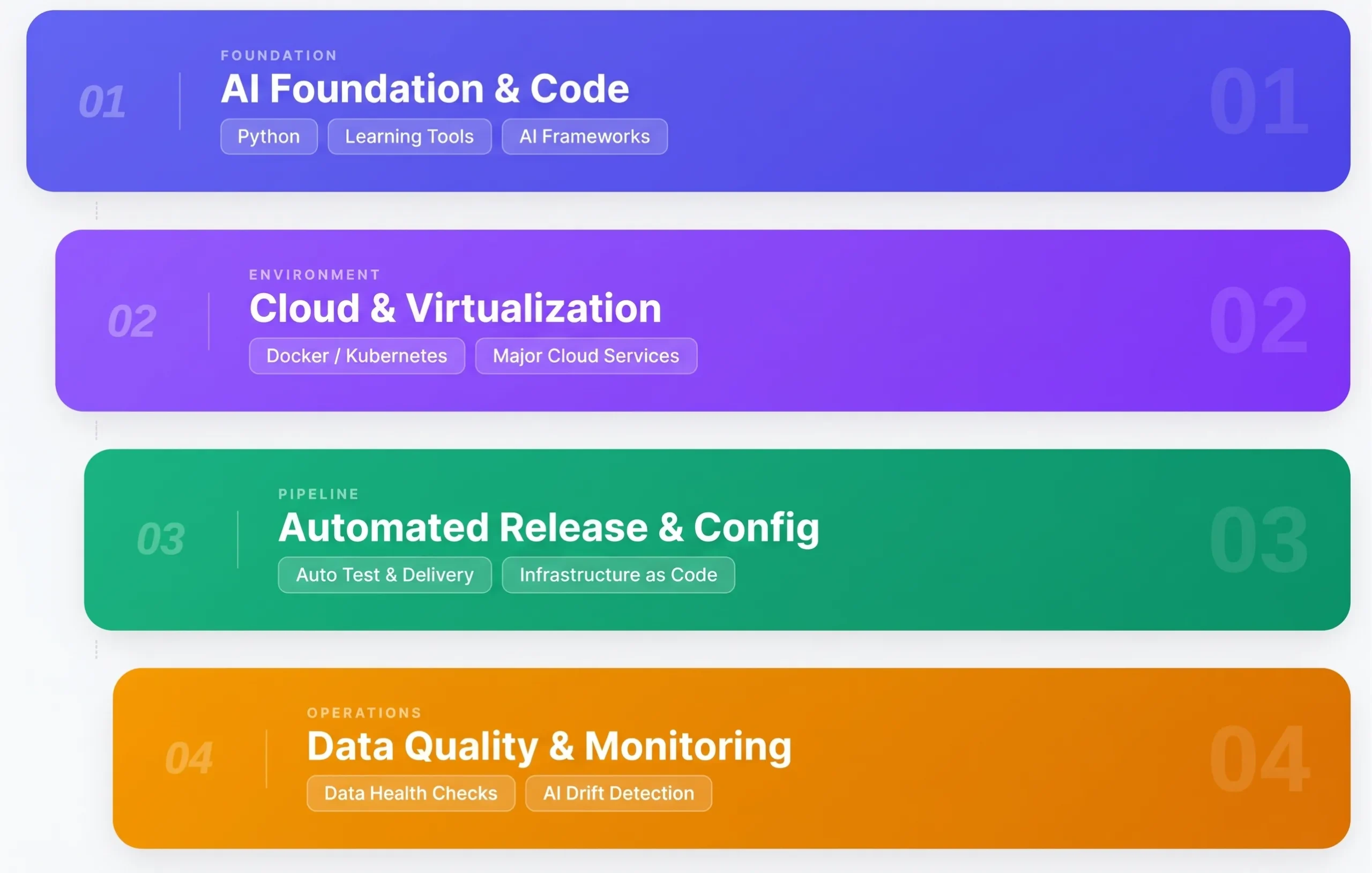
The skills MLOps engineers need fall into five categories: “programming,” “ML and data platforms,” “infrastructure and cloud,” “DevOps,” and “soft skills.”
Rather than trying to learn everything at once, the fastest path is to start from the skills you already use at work and build up step by step based on priorities.
Proficiency in Python and ML Frameworks Is the Starting Point
Python is an essential programming language for MLOps engineers.
Almost all machine learning tools run on Python, and it is used for everything from data processing and model building to pipeline automation. Getting to the point where you can write Python confidently is the starting line.
For ML frameworks, you are expected to understand the basics of TensorFlow, PyTorch, and scikit-learn.
Even if you rarely build models yourself, deploying and managing models created by data scientists requires an understanding of each framework’s save formats and inference mechanisms.
If you also learn MLOps-specific tools such as MLflow (experiment management and model registry) and DVC (version control for data and models), you can contribute right away on the job.
Cloud Platforms and Container Technology Are at the Heart of the Work
Cloud ML Services
MLOps work is designed around managed cloud ML services. Here are the key features of the three major services.
- AWS SageMaker
An integrated service for training, deployment, and monitoring, with a strong track record of adoption among Japanese companies. - Google Cloud Vertex AI
A fully managed MLOps platform that centralizes everything from pipelines to model management. - Azure Machine Learning
Works well with Microsoft products and is increasingly used by companies running on Azure.
A practical approach is to learn one of these providers in depth first and get a solid grasp of MLOps implementation patterns.
▼Related Reading
Thinking of starting with Vertex AI? Learn the basics of Google Cloud, its key services, pricing, and how it compares with AWS.

Container Management (Docker and Kubernetes)
When it comes to container technology, Docker and Kubernetes are must-have skills on the job. Packaging models into Docker containers eliminates differences between development and production environments and enables highly reproducible deployments.
Kubernetes is a platform for managing and orchestrating those containers at scale, and it is indispensable for managing the scale of ML pipelines.
Automating Pipelines with CI/CD and Infrastructure as Code (IaC)
CI/CD
In MLOps, CI/CD is also at the center of pipeline automation. Tools such as GitHub Actions and Jenkins are used to automate model testing, building, and deployment.
By creating a flow where pushing code changes to the repository automatically triggers tests and, if everything passes, deploys to production, you can achieve both release speed and quality.
IaC (Infrastructure as Code)
IaC is a method of managing infrastructure configuration as code. The best-known tool is Terraform. Defining and managing cloud resources in code ensures that environments are reproducible and prevents manual errors.
Managing the infrastructure for training clusters and inference services with IaC has become standard practice in MLOps.
Knowledge of Data Quality Management and Monitoring Sets You Apart
No matter how accurate a model is, it cannot produce correct results if the quality of the input data is poor.
MLOps engineers use data validation tools such as Great Expectations to build automated checks for the schema, types, and value ranges of data flowing into the pipeline.
In the operations phase, drift detection and alerting are ongoing challenges. MLOps engineers build systems that statistically detect changes in data distribution, automatically send alerts when accuracy drops below a threshold, and kick off retraining.
Engineers with these operations-specific skills are rare in the market and tend to be highly valued in the job market.
■日本でエンジニアとしてキャリアアップしたい方へ
海外エンジニア転職支援サービス『 Bloomtech Career 』にご相談ください。「英語OK」「ビザサポートあり」「高年収企業」など、外国人エンジニア向けの求人を多数掲載。専任のキャリアアドバイザーが、あなたのスキル・希望に合った最適な日本企業をご紹介します。
▼簡単・無料!30秒で登録完了!まずはお気軽にご連絡ください!
Bloomtech Careerに無料相談してみる
5. How to Become an MLOps Engineer: Career Paths and Certifications

There are three main entry points into MLOps engineering.
Infrastructure or DevOps engineers can add ML knowledge, data scientists or ML engineers can add infrastructure and operations knowledge, and backend engineers can learn both ML and infrastructure.
The key is to choose the most efficient route based on the skills you already have.
Moving from Infrastructure or DevOps Engineering Is the Fastest Route
The engineers most valued by recruiters are those with hands-on infrastructure or DevOps experience who have added ML knowledge on top.
Deployment, scaling, and monitoring are at the core of MLOps, and these are areas where skills gained in infrastructure or DevOps work can be applied directly.
If you have hands-on experience with CI/CD, Kubernetes, and Terraform, the hurdle to switching to MLOps is not that high.
The following steps are an efficient way to learn.
Learning Steps for Infrastructure and DevOps Engineers
- Step 1
Learn Python (data manipulation and scripting level is enough) - Step 2
Learn the basics of ML theory (enough to implement classification and regression models with scikit-learn) - Step 3
Get hands-on with cloud ML services (build pipelines with AWS SageMaker or similar) - Step 4
Gain experience implementing model management with MLflow and DVC
▼Related Reading
Building the DevOps foundation first? This roadmap shows the skills Japanese companies expect and how to grow your DevOps career.
Data Scientists and ML Engineers Can Also Shift to the Operations Side
Another strong route is for data scientists or ML engineers with model development experience to add deployment and infrastructure knowledge and move into MLOps.
Since they already understand ML theory and frameworks, the challenge is to fill in the infrastructure and DevOps skills.
The first hurdle on this route is learning Docker and Kubernetes. The first step is to understand how containers work and experience the full flow of packaging a model you built into a Docker image and delivering it to production.
After that, working on building CI/CD and using cloud ML services will round out the skills you need as an MLOps engineer.
Prove Your Skills Objectively with the Right Certifications
Certifications are an effective way to prove your skills objectively. They can be a strong selling point when changing jobs or winning projects.
Ideally, you should plan to earn certifications along two tracks: cloud and ML, and infrastructure and DevOps. A realistic approach is to start with one certification in the area closest to your current skills and then expand from there.
Cloud and ML Certifications
AWS Certified Machine Learning Specialty
A certification that systematically tests ML implementation and operations on AWS. It is highly valued at companies that use AWS.
Google Professional Machine Learning Engineer
A highly practical certification whose content ties directly to MLOps on GCP, including Vertex AI.
Azure AI Engineer Associate
A certification covering the design and implementation of AI services on Azure. It is highly valued at companies that use Azure.
Infrastructure and DevOps Certifications
CKA (Certified Kubernetes Administrator)
An international certification that proves your Kubernetes administration skills. It directly demonstrates your container management abilities.
AWS Solutions Architect
A certification covering AWS infrastructure design as a whole. It is widely recognized as a foundation for understanding cloud infrastructure.
As for the order, we recommend first earning one ML certification that matches the cloud environment (AWS, GCP, or Azure) of the companies or projects you are targeting, and then strengthening your profile with infrastructure certifications such as Kubernetes.
■ Take the Next Step Toward an MLOps Career in Japan
Whether you are coming from infrastructure, DevOps, or data science, your existing experience can be a strong foundation for an MLOps role. BLOOMTECH Career for Global helps engineers living in Japan with Japanese proficiency at JLPT N2 level or higher find positions where they can build on their current skills and grow into MLOps and machine learning infrastructure work.
▼Contact BLOOMTECH Career for Global here
6. MLOps Engineer Salaries and the Reality of the Job Market

The market value of MLOps engineers is rising rapidly in Japan. Let’s look at salary levels in Japan alongside growth forecasts for the global market.
Average Salaries in Japan Range from 6 to 9 Million Yen, and Over 10 Million Yen Is Realistic Depending on Skills
Public data from major Japanese job platforms such as Kyujin Box and Indeed shows that MLOps engineer salaries are mostly in the 6 to 9 million yen range.
For engineers with hands-on cloud and Kubernetes experience and a track record of operating multiple ML projects, a growing number qualify for positions offering over 10 million yen.
The freelance market is also worth noting. According to a SOKUDAN survey, the average rate for freelance machine learning engineer projects is equivalent to about 9.99 million yen per year, and there are several remote projects available from just one day a week.
Gaining experience as a full-time employee and then going freelance is also a realistic option for further increasing your income.
What determines your salary is not so much years of experience as the quality of your skills and the concreteness of your achievements, so it is important to be able to show the technologies you have learned as tangible results.
(Source: SOKUDAN Machine Learning Engineer Project Survey )
▼Related Reading
Want a broader view of pay in this field? See salary ranges for AI engineers in Japan and practical ways to raise your income.

The Global MLOps Market Is Expected to Reach About USD 89.9 Billion by 2034
According to market research by Fortune Business Insights, the global MLOps market is expected to reach USD 89.91 billion (about 9 trillion yen) by 2034, with a compound annual growth rate (CAGR) of 45.8%.
As the adoption of AI and machine learning accelerates worldwide, MLOps sits at the center of the market as the foundation that makes those technologies practical.
With demand for AI and ML adoption also rising in Japan, job openings for MLOps engineers are steadily increasing in the job market.
Hiring for MLOps talent is active in industries driving digital transformation (DX), such as manufacturing, finance, retail, and healthcare, and the number of skilled engineers has not kept up with demand. This gap is what is pushing up current salary levels.
(Source: Fortune Business Insights MLOps Market Report )
7. The Future of MLOps Engineers: How the Role Is Evolving in the Generative AI Era
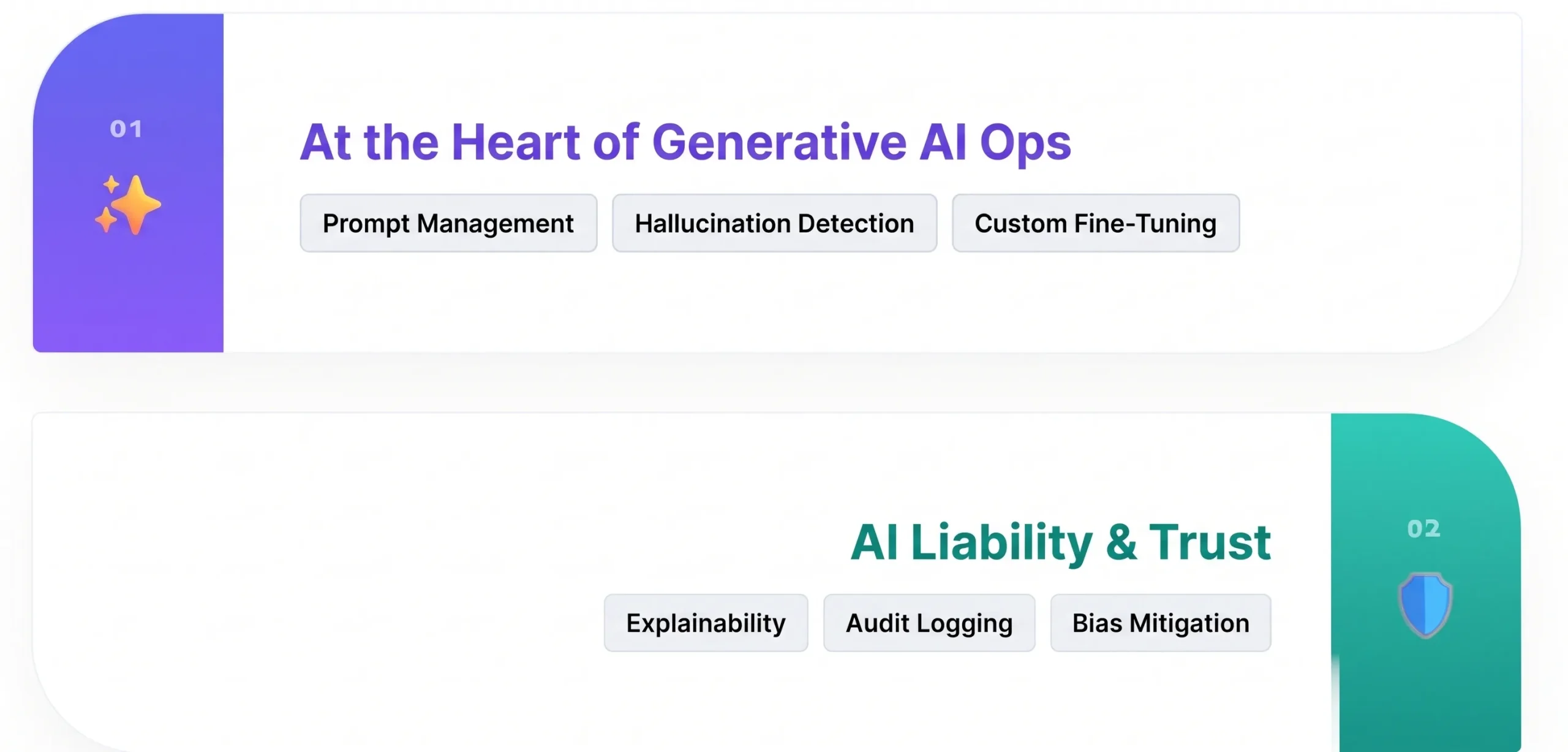
With the spread of generative AI (large language models, or LLMs), the role of MLOps is expanding even further.
In addition to operating traditional machine learning models, a new field called “LLMOps,” which focuses on integrating LLMs into enterprise systems and keeping them stable, is attracting attention, and demand for MLOps engineers is expected to grow even more as a result.
“LLMOps,” Which Supports LLMs in Production, Is Emerging as a New Specialty
LLMOps refers to the operational practices and structures for integrating large language models such as ChatGPT into enterprise systems and running them reliably in production.
The know-how built up in MLOps, including pipeline automation, monitoring, and infrastructure management, can be applied directly to LLMOps.
Key Tasks Unique to LLMOps
- Prompt management
Continuously managing prompt quality through version control and A/B testing - Model evaluation
Detecting hallucinations (outputs that are not factually accurate) and scoring output quality - Fine-tuning operations
Running additional training on custom data and updating models continuously
These tasks build on the knowledge of continuous training, deployment, and monitoring that MLOps engineers already have. Engineers with MLOps experience have a major advantage when learning LLMOps.
▼Related Reading
Interested in AI roles at Japanese companies? Explore 20 AI companies in Japan, plus salaries and visa information for foreign engineers.

AI Regulation and Stronger Governance Make MLOps Even More Important
Starting with the EU AI Act (the European Union’s AI regulation), countries around the world are moving to regulate AI systems and strengthen governance.
Under the EU AI Act, high-risk AI systems must meet requirements such as model explainability, management of audit records, addressing bias, and establishing quality assurance processes.
These requirements are directly linked to the model lifecycle management and monitoring systems that MLOps engineers design and manage.
MLOps engineers who can design governance with regulatory compliance in mind, manage security, and maintain audit logs are becoming increasingly important to companies, and their value is expected to keep rising.
8. What Is an MLOps Engineer? Summary of the Job, Skills, and How to Become One
An MLOps engineer is a specialist responsible for machine learning models from development through production operations, keeping AI that was once stuck at the PoC stage running for the business.
The work is wide-ranging, covering pipeline automation, deployment, monitoring, and infrastructure management, and the required skills span Python, cloud, containers, and CI/CD. Even so, it is a role that engineers with infrastructure or DevOps experience can move into relatively easily.
As a first step toward a career change, we recommend starting by building pipelines on a cloud ML service where you can put your current skills to use.
With the new specialty of LLMOps also expanding, the market value of MLOps engineers is expected to keep rising in the years ahead.
■ Grow Your MLOps Career in Japan with Expert Support
From MLOps and LLMOps to cloud infrastructure, the right next role can make a big difference to your career and salary. BLOOMTECH Career for Global offers dedicated career support for engineers living in Japan with Japanese proficiency at JLPT N2 level or higher, from job matching to interview preparation.
▼Contact BLOOMTECH Career for Global here